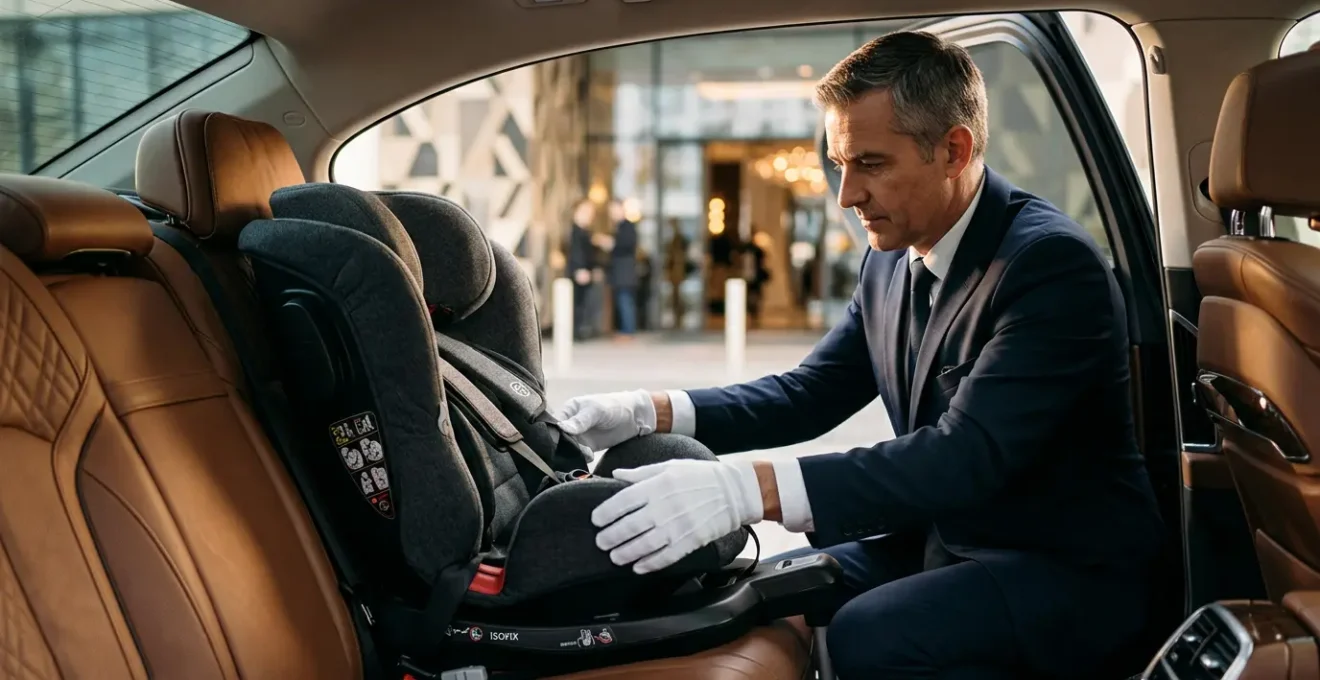
Relying on a chauffeur’s “professionalism” for child seat safety is a critical error; only your own technical verification guarantees security.
- ISOFIX is not infallible; it requires a multi-point manual audit beyond checking indicators.
- A seat that moves more than one inch at the belt path has already failed, regardless of how it was installed.
Recommendation: Adopt a non-negotiable, technician-level inspection protocol for every journey. Trust no one but your own verification process.
As a parent who prioritises safety, you make rational choices. You book a professional chauffeur service, assuming their premium price guarantees a higher standard of care, especially concerning the most precious passenger. You expect the child seat to be present, clean, and correctly installed. This assumption, however, is the single greatest risk in your child’s journey. The difference between a “fitted” car seat and a “technically correct and verified” car seat is a chasm of misunderstood physics and unacceptable risk.
The common advice to “check if it’s tight” is dangerously vague. True safety is not a matter of feeling or appearance; it is a matter of measurable tolerances and engineering principles. This is not about questioning the chauffeur’s intent, but about systematically eliminating the potential for human error—theirs and yours. A professional driver’s expertise is in navigating traffic, not necessarily in the complex mechanics of child restraint systems (CRS), which vary wildly between vehicle and seat models.
This guide abandons trust in favour of a technical protocol. We will not discuss the platitudes of child safety. Instead, we will provide a series of non-negotiable verification steps. The objective is to empower you with the mindset and methodology of a child seat safety technician, ensuring that your child’s safety is an established fact, not a hopeful assumption. From assessing the installation method to auditing the sanitisation process and mitigating secondary dangers like unsecured luggage, you will learn to see the vehicle’s interior as a controlled environment where you, and only you, have the final say on safety readiness.
The following sections provide a complete protocol to systematically verify every aspect of your child’s safety in a hired vehicle. This structure is designed to move from the core installation mechanics to the wider cabin environment, leaving no variable to chance.
Summary: A Technician’s Guide to Verifying Child Seat Safety in Chauffeur Services
- Why Isofix Is Safer Than Seatbelt Installation for Group 1 Seats?
- The “Wiggle Test” Every Parent Should Do Before Departure
- Group 0+ or Group 1:Why Choose a Chauffeur Over a Black Cab for High-Stakes London Meetings?
- Bring Your Own vs Hire: Which Is Safer for Compatibility?
- Who Cleaned the Car Seat Before Your Child Sat in It?
- What Happens if Loose Luggage Shifts During Emergency Braking?
- How to Ensure the Car Is Clean enough for a Crawling Baby?
- How to Travel from Gatwick with a Newborn Without a Meltdown?
Why Isofix Is Safer Than Seatbelt Installation for Group 1 Seats?
The superiority of ISOFIX for Group 1 seats is not a matter of opinion but a function of engineering designed to minimise the primary cause of child seat failure: incorrect installation. Unlike a seatbelt, which requires a complex and often counter-intuitive routing path, the ISOFIX system uses rigid, standardised anchor points built directly into the vehicle’s chassis. This creates a direct, physical connection between the child seat and the car frame, drastically reducing the margin for error. In fact, many parents find the system more intuitive, as evidenced by guidance suggesting that most first-time parents install ISOFIX seats correctly.
This rigid connection provides two key safety benefits. First, it significantly limits the seat’s movement during normal driving and, critically, during a collision, ensuring energy is absorbed as intended by the seat’s structure. Second, the system’s design, which often includes a top tether or a support leg, specifically combats rotational forces—a dangerous forward-and-downward pitching motion that can occur in a frontal impact. A seatbelt installation, even when performed correctly, is more susceptible to these forces due to the inherent elasticity of the belt webbing. However, the presence of ISOFIX connectors is not a guarantee of safety. A multi-point verification is non-negotiable.
Your ISOFIX Safety Verification Checklist
- Audible & Visual Confirmation: Verify that both metal connectors click audibly into the anchor points. Check for green indicators on both sides, but do not rely solely on them; they are a secondary check, not the primary proof.
- Manual Tension Test: Pull firmly on the connection points at the base of the seat where the ISOFIX arms enter. There should be no give. This tests the lock, not the overall seat stability.
- Anti-Rotation Device Engagement: Ensure the top tether is correctly routed and tensioned (not slack, not overtightened), or that the support leg is firmly on the vehicle floor with the correct indicator showing. This prevents dangerous rotation.
- Movement Test at Base: Perform the wiggle test (see next section) at the base. A correctly installed ISOFIX seat should exhibit less than one inch of lateral movement at the belt path.
- Harness Check: Confirm the child’s harness is at the correct height relative to their shoulders (at or just above for forward-facing) and passes the “pinch test” at the collarbone.
The “Wiggle Test” Every Parent Should Do Before Departure
The single most critical verification you can perform, regardless of installation method (ISOFIX or seatbelt), is the “Wiggle Test.” This is not a casual shake; it is a specific diagnostic procedure to assess the security of the installation at the belt path. A common and dangerous mistake is to check for movement at the top of the seat, where leverage will always create significant sway. The test must be performed at the base, where the seat is physically connected to the vehicle. The standard is absolute: the seat must not move more than one inch side-to-side or front-to-back at this point.
The prevalence of loose installation is alarmingly high. A landmark NHTSA observational study found 61% of forward-facing child restraints were misused, with loose installation being the primary error. This slack in the system is not a minor issue; in a crash, it allows the child to travel a greater distance before being restrained, subjecting them to higher impact forces and increasing the risk of secondary impact with the vehicle’s interior. A one-inch tolerance is the maximum acceptable limit for ensuring the child restraint system and the vehicle’s own safety features (like airbags and crumple zones) work in the correct sequence.
To perform the test correctly, use your non-dominant hand to apply firm, consistent pressure at the belt path—the slit in the seat’s base where the seatbelt or ISOFIX arms pass through. With your other hand, grip the seat firmly and attempt to move it side-to-side and front-to-back. The goal is not to dislodge the seat, but to feel for any slack or “play” in the connection. If you can move it more than an inch, the installation is failed and must be redone.
This image demonstrates the correct hand placement for the test. Notice the force is applied low and at the structural point of connection. This tactile feedback is your most reliable data point. It is more trustworthy than any single green indicator or audible click. Mastering this test transforms you from a passenger to an active safety auditor.
Group 0+ or Group 1:Why Choose a Chauffeur Over a Black Cab for High-Stakes London Meetings?
When travelling with a child, the choice between a professional chauffeur service and a black cab/taxi is not a matter of luxury, but of fundamental safety architecture. For a parent obsessed with technical correctness, the chaotic and unpredictable nature of the taxi system is untenable. The primary difference lies in legal accountability, fleet consistency, and the possibility of pre-journey verification—all of which are severely lacking in the standard taxi model.
A black cab driver, while an expert navigator, is a transport generalist operating within a system that often provides legal exemptions for child seat provision. You are relying on chance: does the driver happen to have a seat? Is it the correct group for your child? What is its history? Has it been in a collision? You cannot know. A professional chauffeur service, conversely, operates on a contractual basis. When you book a specific child seat, they have a legal duty of care to provide and, crucially, correctly install that exact seat. This creates a chain of accountability that is entirely absent when hailing a cab off the street.
The following comparison breaks down the critical safety differences from a technical perspective. A chauffeur service provides a controlled, predictable environment, while a taxi introduces an unacceptable number of unknown variables.
| Safety Aspect | Professional Chauffeur Service | Black Cab/Taxi |
|---|---|---|
| Legal Duty of Care | Contractual obligation to provide and correctly install requested seat | Often legally exempt from providing child seats |
| Fleet Consistency | Limited range of luxury vehicles with mastered installation procedures | Random vehicle models with varying anchor configurations |
| Driver Training | Often includes Child Passenger Safety certification | General driving qualification only |
| Seat Verification | Can confirm specific seat model in advance | No advance confirmation available |
| Installation Time | Pre-installed before pickup | Installed roadside if available |
| Seat History | Documented maintenance and crash-free guarantee | Unknown seat history and condition |
This table illustrates a clear conclusion: for a high-stakes journey where safety cannot be compromised, the controlled environment of a chauffeur service is the only logical choice. It is the only option that allows for the pre-verification and systemic control that a safety-conscious parent requires.
Bring Your Own vs Hire: Which Is Safer for Compatibility?
The decision to bring your own child seat versus hiring one from the chauffeur service presents a conflict between familiarity and compatibility. Bringing your own seat means you are an expert in its installation, you know its history, and you are comfortable with its harness system. However, it introduces a significant unknown: compatibility with the specific vehicle you will be travelling in. Conversely, hiring a seat from a reputable chauffeur service should mean it has been selected for perfect compatibility with their fleet, but you are entrusting your child to a device with an unknown history. Neither option is without risk, and the safest choice requires careful pre-travel diligence.
The rate of incorrect installation remains a significant concern. An analysis of car seat checks highlighted that, even among well-intentioned parents, a shocking number of errors occur. For example, a recent review found that 67% of car seats checked in 2024 were improperly installed or used. This underscores the risk of bringing your own seat and attempting to install it under pressure in an unfamiliar vehicle, potentially with unique challenges like deep leather cushions or difficult-to-access ISOFIX points.
The optimal strategy involves mitigating the risks of both options. If hiring a seat, you must become an interrogator. Before booking, demand the exact make and model of the seat they will provide. Research its safety ratings and, critically, its installation manual online. Ask the company to confirm the seat has a documented, crash-free history. If bringing your own seat, especially after air travel, you must perform a thorough inspection for structural damage. Airlines are notorious for mishandling these items, and invisible micro-fractures can compromise the seat’s integrity in a crash. Always use a padded travel bag and consider it a mandatory pre-installation step to check every component.
Who Cleaned the Car Seat Before Your Child Sat in It?
Beyond structural integrity and correct installation, the hygiene of a hired child seat is a critical safety parameter. The concern is not merely about dirt, but about exposure to allergens, bacteria from old food particles, and, most importantly, the chemical residue from improper cleaning products. Certain harsh cleaning agents can degrade the harness webbing over time, affecting its performance in a crash. Furthermore, the use of strong fragrances can cause respiratory irritation in young children. A “visibly clean” seat is not the same as a “hygienically safe” seat. As with installation, verification must replace trust.
You have the right to know the exact cleaning protocol used by the chauffeur company. A professional, safety-conscious service will have a clear, documented procedure and will not hesitate to share it with you. Vague assurances like “we clean it after every use” are insufficient. You need specifics. Do they use non-toxic, baby-safe cleaners? Do they disassemble the covers for washing, or just perform a surface wipe? Are the harnesses ever submerged or washed with detergents that could compromise their fire-retardant properties and tensile strength? The answers to these questions reveal the company’s true commitment to child safety.
Upon arrival, your own sensory audit is the final line of defence. Look for signs of wear and tear that could indicate a long, hard life. Inspect the crevices and corners for crumbs or debris. Most importantly, perform a smell test. The seat should smell neutral—free of perfumes, air fresheners, and especially smoke. Any chemical or stale odour is a red flag. Finally, feel the harness straps. They should be pliable and smooth. A stiff or sticky feel can indicate a buildup of cleaning product residue that could affect the buckle mechanism and the strap’s performance.
Sanitization Verification Protocol for Parents
- Direct Inquiry: Ask the chauffeur service, “What is your specific cleaning and sanitisation protocol for child seats between clients?”
- Product Verification: Follow up with, “Can you confirm you use non-toxic, baby-safe cleaning products and can you name them?”
- Harness Maintenance Check: Ask, “Are harness straps ever washed with detergents? What is your procedure for cleaning the harness?” (The answer should be wiping with a damp cloth only).
- Sensory Audit on Arrival: Perform a smell test for smoke, chemicals, or strong fragrances as soon as the door opens.
- Tactile Harness Test: Run the harness straps through your fingers. Check for stiffness or stickiness, which indicates product buildup that compromises safety.
- Crevice Inspection: Use your phone’s flashlight to inspect deep within the seat’s crevices for old food particles or other debris that pose bacterial risks.
What Happens if Loose Luggage Shifts During Emergency Braking?
The safety perimeter for your child extends beyond their restraint system to encompass the entire vehicle cabin. Any unsecured object, no matter how innocuous it may seem, becomes a potential projectile during a sudden stop, swerve, or collision. The laws of physics are unforgiving: an object’s weight is multiplied by the vehicle’s deceleration, transforming a water bottle, a tablet, or a briefcase into a dangerous missile. A chauffeur-driven vehicle, often spacious, can create a false sense of security, but the larger space can actually allow an object to gain more velocity before impact.
The focus on cabin integrity is often overlooked, even by professional drivers. A 2024 safety analysis by AAA documented numerous incidents where unsecured items became dangerous projectiles. The study found that items weighing as little as 1-2 pounds are capable of causing serious injury when the vehicle stops suddenly from typical city driving speeds of 30-40 mph. Consider the kinetic energy of a laptop flying from the rear shelf or a hard-sided suitcase shifting from the seat next to your child’s. The risk is not theoretical.
Case Study: The Physics of a Projectile
In a sudden stop from 35 mph, a 5kg briefcase (a common weight for a work laptop and documents) will exert a force of over 175kg at the moment of impact. This is more than enough force to cause catastrophic failure of a child seat’s plastic shell, or to cause severe blunt force trauma to a passenger. It is your responsibility to ensure the cabin is sterile of such threats before the journey begins. This means insisting that all luggage, bags, and loose items are securely stowed in the boot. No exceptions.
Before you allow the journey to begin, perform a visual sweep of the cabin. Check the rear shelf, the adjacent seats, and the floor. Politely but firmly instruct the chauffeur that all items, including their own, must be secured in the boot. This is not a matter of tidiness; it is a non-negotiable component of your pre-departure safety protocol.
How to Ensure the Car Is Clean enough for a Crawling Baby?
The standard of “clean” for an adult passenger is fundamentally different from the standard required for a crawling baby or a toddler who will inevitably drop toys, bottles, or food on the floor. For a young child, the floor is not just a surface; it’s an interactive zone. A professional cleaning service might leave a car looking immaculate, but their focus is on visible tidiness, not a micro-level safety audit for choking hazards or chemical residues. Your inspection must go deeper, literally getting down to your child’s eye level to see the world as they do.
Small, overlooked items like a dropped coin, a paperclip, or a stray button from a previous passenger can become a serious choking hazard. These items often find their way under seats or into door pockets, areas that a standard vacuuming might miss. Beyond physical objects, the unseen threat of cleaning chemical residues on carpets and upholstery is a major concern. Many valeting products contain volatile organic compounds (VOCs) that can off-gas for hours, potentially irritating a baby’s sensitive respiratory system. This is why requesting a ‘fragrance-free’ or ‘eco-clean’ service is a valid and important part of your booking process.
The following testimony from a parent highlights the necessity of this personal audit:
A parent using London chauffeur services reported finding small choking hazards during their own inspection that professional cleaning had missed. They now always bring their own blanket to create a controlled environment and request fragrance-free cleaning 24 hours before travel to allow any cleaning product residues to dissipate.
– Parent Experience, CHOP Safety Videos
This experience leads to a practical, two-pronged strategy. First, perform your own floor-level inspection. Kneel outside the open door and use your phone’s flashlight to scan under the seats and in all crevices. Second, establish a ‘zone of control’. Bringing a large, clean blanket from home and spreading it on the floor and seat creates a verified safe surface for your child to play and move on, effectively isolating them from any remaining unknown elements in the vehicle’s environment.
Key Takeaways
- Verification over trust is the only valid safety philosophy; assume nothing is correct until you have manually checked it.
- A child seat’s safety is a system: correct installation, a sterile cabin, and hygienic surfaces are all equally critical components.
- Your role is not that of a passenger, but of the final safety auditor. You have the authority and responsibility to delay departure until all protocols are met.
How to Travel from Gatwick with a Newborn Without a Meltdown?
Travelling with a newborn, especially after the sensory overload of a flight and the chaos of an airport like Gatwick, is a high-stakes logistical operation. The goal is to minimise stress and transition time, moving the baby from the terminal to the secure, controlled environment of the car seat as rapidly and smoothly as possible. A “meltdown” is often a physiological response to overstimulation, discomfort, or an unsafe seating position. A successful journey depends on meticulous pre-planning and a strict protocol executed in coordination with the chauffeur.
The single most important technical requirement for a newborn is their seating angle. Due to their lack of head control and weak airways, newborns must be in a semi-reclined position. A seat that is too upright can cause their head to slump forward, leading to positional asphyxiation. The standard is non-negotiable: according to NHTSA safety standards, babies must ride at a 30-45 degree recline to keep their airways open. Many infant seats have a built-in level indicator, but it is wise to verify this yourself with a simple inclinometer app on your smartphone before the baby is even placed in the seat.
The entire kerbside transition should be a pre-planned, sub-60-second event. This requires clear communication with your chauffeur. The car should be waiting at the designated pickup point, not circling the terminal. The interior should be pre-conditioned to a neutral 22°C (72°F) to avoid temperature shock. The car seat harness should be loosened and the buckles open, ready to receive the baby. Upon securing the child, sunshades should be deployed immediately to block out visual chaos, and the audio system should remain off. This meticulous control of the environment is not about being difficult; it’s about managing the sensory inputs for a tiny human who cannot yet regulate them on their own.
Frequently Asked Questions about Chauffeur Child Seat Safety
Can air travel damage my child’s car seat even if it looks fine?
Yes, checked car seats can suffer micro-fractures from being thrown or dropped during baggage handling, compromising structural integrity without visible damage. Always use a padded travel bag and perform a thorough inspection after flights.
What information should I provide when booking a chauffeur with a child seat?
Provide your child’s exact weight, height, and age, plus your own car seat model if bringing one. Request the specific seat model they’ll provide in advance to research safety ratings and compatibility with their vehicle fleet.
How can I verify a hired seat’s compatibility with luxury vehicles?
Professional chauffeur companies should have seats specifically selected for their fleet’s unique challenges, such as narrow-base models for sculpted sport seats or seats compatible with deep leather cushions and specific anchor point locations.