Vehicles & Comfort
Transporting professionals, executives, or VIPs is never simply about getting from one location to another. It is an intricate orchestration of logistics, rigorous safety standards, and uncompromising passenger comfort. Whether arranging a multi-city roadshow for a financial team or ensuring a solo executive arrives refreshed for a high-stakes meeting, the right vehicle sets the fundamental tone for the entire journey.
In the world of premium transport, every minor detail sends a message. From the exact legroom available in a luxury saloon to the specific brand of bottled water offered in the rear console, these elements collectively define the standard of service. This comprehensive resource explores the vital intersection of corporate perception, spatial logistics, and first-class amenities to help you navigate the complexities of high-end travel with absolute confidence.
The Psychology of Fleet Selection and Brand Perception
When a vehicle pulls up to a venue, it instantly communicates a silent but powerful message about the passenger and their organisation. Corporate brand perception is heavily influenced by these subtle visual cues, making vehicle choice a critical business decision rather than a mere preference.
How Colour and Model Shape First Impressions
For decades, the black Mercedes S-Class has been the undisputed symbol of authority, particularly within the finance and corporate sectors. While silver and white alternatives offer different stylistic nuances, black remains the industry standard for conveying gravity, reliability, and respect. Exploring alternative brands also shifts the narrative; opting for a Tesla Model X might project a forward-thinking, eco-conscious image, whereas a Range Rover communicates robust luxury and commanding road presence. However, travel bookers must tread carefully. Arriving at a meeting in a vehicle deemed overtly flashy can inadvertently alienate conservative clients who value discretion over spectacle.
Balancing Budgets with Executive Expectations
Balancing operational costs with high executive expectations is a daily challenge. While booking an E-Class is noticeably more expensive than ordering a standard minicab, that premium guarantees a vetted professional driver, impeccable reliability, and a quiet cabin conducive to last-minute work. For junior executives, a Mercedes E-Class or a BMW 5 Series often provides the perfect middle ground, comfortably fitting the budget while reserving the flagship S-Class or Maybach for senior C-suite members and highly valued clients.
Decoding Space: Wheelbases, Legroom, and Passenger Layouts
Physical comfort dictates how a passenger feels upon arrival. The physical dimensions of the cabin are paramount, particularly for tall individuals or those requiring the space to work on a laptop or rest extensively en route.
Standard vs Long Wheelbase (SWB vs LWB)
The addition of just a few inches in the rear cabin drastically alters the passenger experience. A Long Wheelbase (LWB) model allows passengers to fully recline their seats without uncomfortably crushing their knees against the front row. For a tall executive, the extra financial investment for an LWB saloon over a standard model is often crucial. A common logistical error is a booking code mix-up that sends an SWB car when an LWB was requested, instantly compromising the first-class experience, even on a short thirty-minute urban transfer.
Choosing the Right Format for Solo Trips or Teams
When transporting groups, the generic standard car category frequently falls short, sometimes resulting in a compact hybrid arriving when a spacious executive vehicle was expected. Choosing between a luxury MPV, like a Mercedes V-Class, and a larger Sprinter van depends entirely on the group’s size and the necessity for luggage. For executive teams, a luxury minicoach offers a vastly superior alternative to standard buses. These specialised vehicles often feature:
- Conference-style seating layouts allowing for face-to-face pre-meeting briefings.
- Soundproof driver partitions to ensure complete confidentiality during strategic discussions.
- Advanced air suspension systems that provide a significantly smoother ride than traditional leaf springs, essential for working on laptops.
The Hidden Complexities of Luggage Capacity
One of the most frequent logistical failures in executive transport is underestimating spatial requirements for baggage. A strict and accurate luggage count is absolutely essential to prevent severe delays or outright driver refusals at the pickup location.
Passenger Headcount vs Boot Space Reality
A prevalent misconception is that seven passengers with full-sized suitcases can comfortably fit into a standard seven-seater vehicle. In reality, deploying the third row of seats virtually eliminates the boot space. Furthermore, modern eco-friendly vehicles present their own unique spatial challenges; large hybrid battery packs can reduce standard boot capacity by up to thirty percent, making it nearly impossible to fit standard luggage for a solo traveller without careful planning.
Safe Loading and Capacity Limits
Loading delicate or oversized equipment requires professional skill to avoid scratching premium leather interiors. Whether a chauffeur is trying to strategically fit four large suitcases into a BMW 7 Series boot or assessing if oversized golf clubs will fit into a standard executive saloon, the physical dimensions of the cargo area dictate the operation. Furthermore, securing loose items is vital for safety; unrestrained luggage can shift violently and become highly dangerous during sudden emergency braking.
Defining First-Class Comfort and Onboard Amenities
True premium transport transcends high-end leather seating. It is defined by the meticulous curation of the onboard environment and the highly intuitive, unobtrusive service provided by the chauffeur.
Climate, Acoustics, and Ride Quality
The ability to easily adjust the climate control from the rear seats, or requesting cabin pre-conditioning before boarding, ensures immediate comfort regardless of extreme weather outside. Premium touches are non-negotiable in this tier of service: providing high-quality mineral water, such as Evian, is a baseline expectation, whereas offering tap water is entirely unacceptable. Ride smoothness also plays a major part in comfort, with flagship luxury models specifically engineered with advanced chassis technology to glide seamlessly over urban potholes.
The Subtle Art of Chauffeur Etiquette
A luxury vehicle should serve as a tranquil, mobile sanctuary. Passengers must be able to sync their mobile devices to the rear entertainment system in seconds. Crucially, the chauffeur’s demeanour must perfectly match the sophisticated environment. Unsolicited conversation is a frequent mistake that instantly shatters the first-class vibe, as travelling executives usually require absolute silence to prepare for vital meetings, make confidential phone calls, or simply decompress after a long flight.
In-Car Connectivity and Mobile Productivity
In the modern business landscape, a premium vehicle is frequently utilised as an extension of the corporate office. Therefore, maintaining robust, fast, and highly secure internet access is a fundamental operational requirement.
Secure Networks vs Public Wi-Fi
A dedicated in-car Wi-Fi network provided by a professional chauffeur service is generally much safer than public hotel connections, provided the vehicle’s network is thoroughly encrypted. Corporate travel bookers and security-conscious passengers should always verify the encryption protocols of the vehicle’s mobile hotspot to protect sensitive company data from interception.
Managing Bandwidth on the Move
While mobile smartphone technology advances rapidly, a dedicated 4G in-car router equipped with a high-gain external antenna often provides a more stable connection than a phone’s standard 5G signal, especially when moving at high speeds. However, bandwidth management remains a critical factor. When running multiple laptops on a single car hotspot, data limits and network dropouts must be actively mitigated. To ensure seamless productivity, follow these standard procedures:
- Verify the specific network encryption standard with the transport provider before the journey.
- Receive the Wi-Fi password via a printed cabin placard or a pre-journey email, rather than distracting the driver while the vehicle is in motion.
- Download exceptionally large presentations or video files prior to departure to conserve the vehicle’s mobile bandwidth.
Uncompromising Safety: Child Seats and Vehicle Standards
When executives travel with their families, safety protocols must immediately shift to accommodate younger, more vulnerable passengers, requiring stringent physical checks and highly specialised equipment.
The Importance of Isofix and Proper Fitting
The safety efficacy of any child seat relies entirely on its perfectly rigid installation. Utilising an Isofix anchorage system is universally recognised by safety bodies as far safer and significantly more stable than traditional seatbelt installations, particularly for Group 1 seats. Every parent, guardian, or chauffeur should perform a standard physical wiggle test before departure to ensure the seat is completely immobilised within the cabin.
Hygiene, Sourcing, and Compatibility
When booking transport for families, clients face the choice of bringing their own bulky child seats or hiring them directly through the chauffeur service. Relying on the professional provider guarantees that the seat seamlessly matches the specific vehicle’s anchor points. Furthermore, elite executive services adhere to exceptionally strict hygiene standards, ensuring that the equipment is meticulously sanitised before any child is permitted to sit in it, offering complete peace of mind to the parents.
Mastering the profound nuances of premium transport requires far more than simply selecting a vehicle with a luxury badge. From understanding exactly how alternative powertrains impact physical luggage capacity to ensuring the onboard connectivity is secure enough for sensitive corporate communications, every single detail contributes to the overarching passenger experience. By prioritising the intricate balance of vehicles and comfort, both travel managers and individual passengers can guarantee that every journey actively enhances productivity, strongly reinforces corporate prestige, and delivers an uncompromising standard of holistic safety.
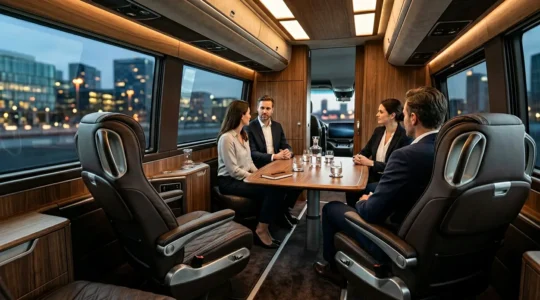
Why a Luxury Minicoach Is Better Than a Standard Bus for Executive Teams?
A luxury minicoach is not a smaller bus; it’s a strategic business tool that transforms travel into productive, confidential work sessions. Standard bus travel creates a “productivity dead-zone,” whereas an executive minicoach functions as a secure, mobile boardroom. Features like…
Read more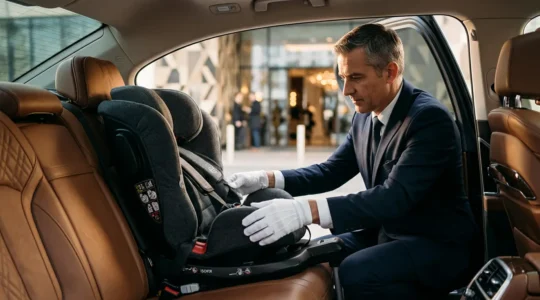
Are Your Chauffeur’s Child Seats Actually Fitted Correctly?
Relying on a chauffeur’s “professionalism” for child seat safety is a critical error; only your own technical verification guarantees security. ISOFIX is not infallible; it requires a multi-point manual audit beyond checking indicators. A seat that moves more than one…
Read more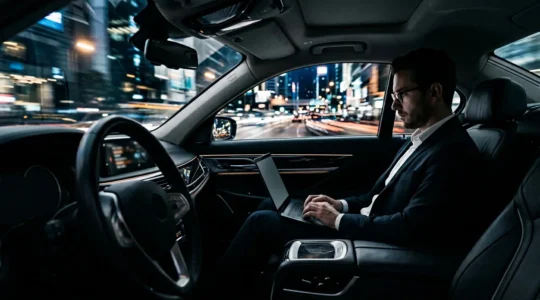
Is Public Hotel Wi-Fi Safer Than Your Chauffeur’s In-Car Network?
For an executive handling sensitive data, neither hotel nor chauffeur Wi-Fi is inherently ‘safe’; they are simply different threat surfaces requiring a structured risk mitigation protocol. The perceived speed of your phone’s 5G is often less reliable for sustained work…
Read more
The Tall Passenger’s Dilemma: Why Standard Wheelbase Cars Are a Tax on Your Performance
For executives over 6ft, a standard wheelbase car imposes an “ergonomic debt” that compromises performance long after the journey ends. The 4-5 extra inches in a Long Wheelbase (LWB) model are not just for comfort, but for enabling a fully…
Read more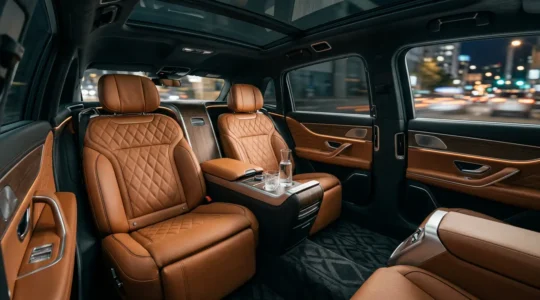
Beyond the Vehicle: What Audits Truly Define First Class Ground Service Today?
True First Class ground service isn’t defined by the car’s features, but by the flawless, anticipatory orchestration of the entire journey. The ultimate luxury is anticipatory silence and a driver who reads the room, not one who forces conversation. The…
Read more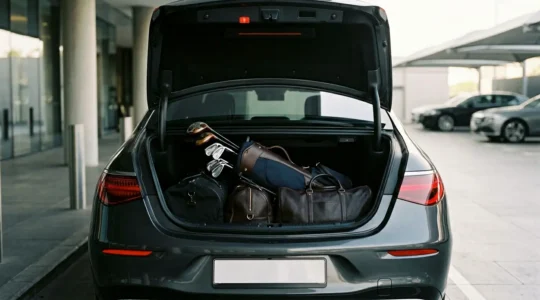
Will Your Golf Clubs Fit in a Standard Executive Saloon?
The advertised boot capacity of an executive saloon is a dangerously misleading metric; real-world usability is dictated by hidden geometry, intrusions, and loading ergonomics. Hybrid batteries and wheel arches can create unusable “dead space” that litres don’t account for. A…
Read more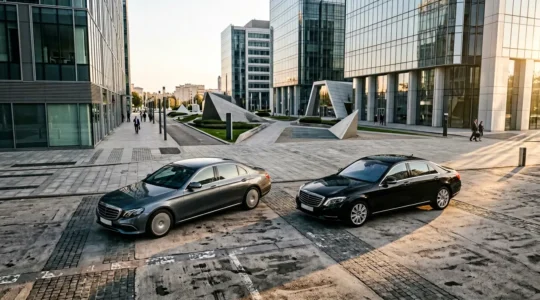
V-Class vs. Sprinter: Which Van Truly Works for a 6-Person Film Crew?
The V-Class offers executive comfort, but for a production crew with equipment, the Sprinter provides superior operational flow and prevents costly logistical friction. A standard 7-seater MPV lacks the dedicated cargo space for both a full passenger load and professional…
Read more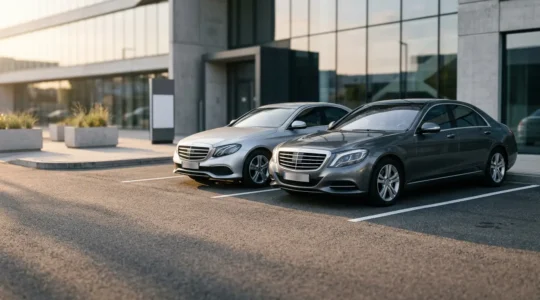
Mercedes E-Class or S-Class: Crafting a Pragmatic Executive Travel Policy
The choice between an E-Class and an S-Class is not about luxury, but about defining a clear, defensible, and cost-effective travel policy for your mid-level executives. The E-Class delivers the necessary professional image and comfort for most scenarios, representing the…
Read more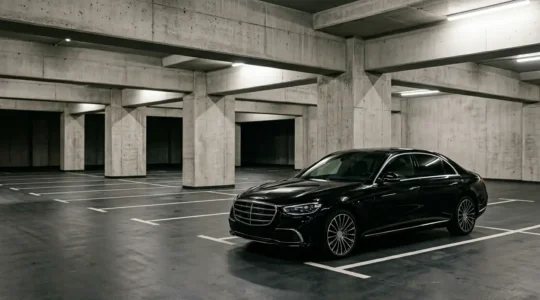
How Does Your Choice of Vehicle Impact Corporate Brand Perception?
Your choice of executive transport is not a logistical detail; it is a high-impact, mobile brand statement that actively shapes your corporate narrative. Vehicle selection operates on the level of semiotics, where colour, model, and brand heritage communicate specific values…
Read more