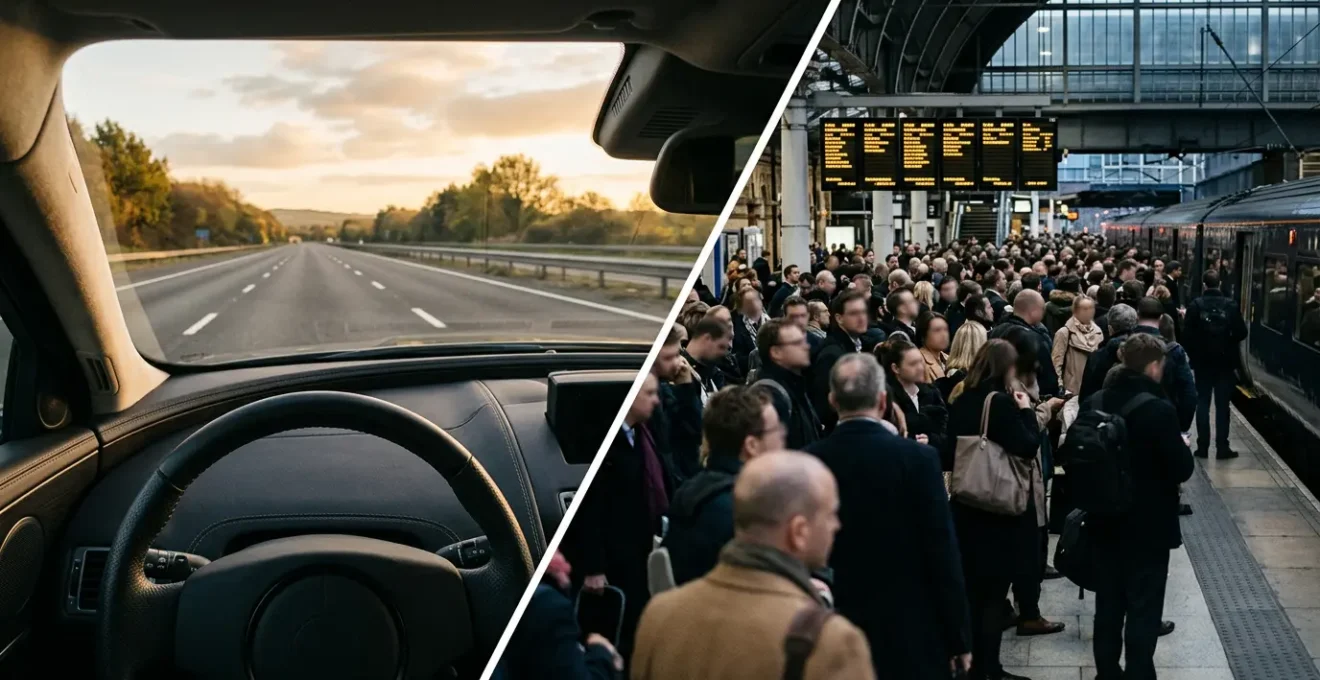
A private chauffeur service becomes more cost-effective than the train when the value of guaranteed arrival and productive work time outweighs the ticket price.
- UK rail journeys face significant reliability issues, and hidden ‘time costs’ at stations for transfers and queues can add over 45 minutes to a trip.
- For teams, a fixed-rate chauffeur is often cheaper than multiple first-class train tickets, especially for last-minute bookings or during peak travel.
Recommendation: Audit your next critical business trip using a ‘Schedule Integrity’ framework to quantify the real risks and costs of relying on rail travel.
For any corporate traveller, the blinking “Delayed” sign on a station departures board is a familiar sight. The subsequent scramble to rearrange meetings and manage expectations has become a routine part of UK intercity business travel. The conventional wisdom pits the perceived environmental benefits of rail against the flexibility of driving. However, this debate often overlooks the most critical metric for any business: the real, quantifiable cost of the journey.
The true calculation must go beyond the ticket price. It requires a logistical analysis of the Total Journey Cost, a comprehensive figure that includes the financial price, the value of lost time, the impact of reduced productivity, and the risk of schedule failure. The simple question of “car or train?” is flawed. The correct question is, “At what point does the cost of unreliability make a private car service not a luxury, but a strategic necessity?”
This analysis moves beyond generic advice to provide a data-driven framework for this decision. By breaking down each component of the Total Journey Cost—from punctuality statistics and hidden time sinks to productivity dead zones and direct cost comparisons—we will pinpoint the specific scenarios where a chauffeur-driven car is the most reliable and financially sound choice for business trips between hubs like London and Manchester.
The following sections provide a detailed breakdown, offering a clear, comparative view to help you assess the most efficient mode of transport for your specific business needs. This guide will equip you with the data to move from hopeful travel planning to guaranteed logistical execution.
Summary: A Data-Driven Reliability Analysis of UK Business Travel
- Why Do 30% of Intercity Rail Journeys Face Delays Over 15 Minutes?
- How to Save 45 Minutes on a Birmingham Trip by Skipping the Station Transfer?
- Train Tickets vs Private Car: When Does the Chauffeur Become Cheaper?
- Privacy or WiFi: What Is the Real Productivity Killer on Public Trains?
- When to Choose a Car Transfer: The 3 Scenarios Where Trains Fail
- Why Do On-Demand Prices Surge by 200% on Monday Mornings?
- Door-to-Door London to Brussels: Is It Faster Than the Train?
- London to Edinburgh by Car: Is the 7-Hour Drive Worth the Comfort?
Why Do 30% of Intercity Rail Journeys Face Delays Over 15 Minutes?
The core issue for any business traveller is not just the potential for delay, but the pervasive lack of certainty. This uncertainty is a quantifiable risk. According to the most recent statistics, the reliability of the UK’s rail network is a significant concern for time-sensitive travel. The latest Office of Rail and Road data reveals that only 67.5% of trains arrived on-time in the second quarter of 2024-25. This means nearly one in three services is late, a critical variable when planning for high-stakes meetings.
The problem is even more pronounced for the long-distance routes most often used by corporate travellers. Separate analysis has shown that long-distance operators are consistently the least reliable service category, with punctuality figures often dipping well below the national average. This systemic unreliability introduces a significant risk factor into the Total Journey Cost calculation. While a 15-minute delay might seem minor, it can be the difference between making or missing a critical connection or arriving composed versus flustered.
In contrast, professional chauffeur services operate on a model of guaranteed punctuality. As noted in the Corporate Travel Behavior Report, executives using these services experience significantly lower delays. This isn’t just a matter of comfort; it’s a strategic choice to eliminate a major variable of risk. The cost of a potential delay—the ‘Cost-of-Delay’—must be factored in, especially when the consequences of lateness are high. For a business traveller, guaranteed schedule integrity is the foundation of a productive trip.
How to Save 45 Minutes on a Birmingham Trip by Skipping the Station Transfer?
A train journey’s advertised duration is fundamentally misleading. It measures platform-to-platform time, ignoring the significant “hidden time costs” that occur at both ends of the trip. These periods represent dead time in a business traveller’s schedule. A true door-to-door analysis reveals that a significant portion of the journey is spent not in transit, but in navigating the complexities of the station environment itself. For a trip into a major hub like Birmingham New Street, these hidden costs can easily add 35 to 50 minutes of unproductive time.
This time loss can be broken down into several stages:
- Station navigation and platform finding: 5-10 minutes minimum at major terminals like Euston or Piccadilly.
- Security and ticket validation: An additional 5 minutes during peak hours.
- Platform waiting and boarding queues: A standard buffer of 10-15 minutes.
- Final mile taxi or tube queue at destination: 15-20 minutes is common at busy stations.
The illustration below contrasts the streamlined efficiency of a door-to-door service with the fragmented, time-consuming nature of a typical train journey.
As the visual demonstrates, a chauffeur service eliminates these productivity dead zones entirely. The journey begins at the office door and ends at the meeting venue’s entrance. This seamless transition converts what would be 45 minutes of stressful navigation and queuing into productive, billable, or preparatory time. When calculating the Total Journey Cost, this recovered time represents a direct financial saving and a significant reduction in travel-related friction.
Train Tickets vs Private Car: When Does the Chauffeur Become Cheaper?
A common misconception is that chauffeur services are prohibitively expensive. However, when assessed on a per-passenger basis for a team, or when factoring in the volatility of rail fares, a private car often emerges as the more economical option. The financial component of the Total Journey Cost is not just the price on a single ticket, but the total outlay for a team, including the high cost of flexibility demanded by business travel.
For a team of three executives travelling from London to Manchester, purchasing flexible first-class train tickets can easily exceed £600, especially during peak hours. A last-minute booking can push this figure even higher. In contrast, a professional chauffeur service for the same route often operates on a fixed-rate basis, typically falling within the £450-£550 range regardless of booking time. This provides crucial budget predictability. The following table provides a clear cost analysis for a team of three.
| Travel Scenario | Train Cost (3 executives) | Chauffeur Service | Time Value Added |
|---|---|---|---|
| Peak hours London-Manchester | £600 (3x first class flex) | £450-550 | 6 hours productive work time |
| Off-peak same route | £390 (3x advance tickets) | £450-550 | Privacy for confidential calls |
| Last-minute booking | £750+ (peak walk-up fares) | £450-550 (fixed rate) | Guaranteed departure time |
Beyond the direct cost, the value of productive time must be considered. Studies have confirmed a significant increase in business efficiency with productive travel time. A chauffeured journey transforms the vehicle into a secure, mobile office, allowing a team to collaborate, hold confidential discussions, or work uninterrupted for the entire duration. This reclaimed time represents a substantial return on investment that a train journey, with its inherent disruptions, simply cannot offer.
Privacy or WiFi: What Is the Real Productivity Killer on Public Trains?
The promise of “working on the train” often fails to materialise in practice. While patchy WiFi is a common complaint, the true productivity killer is more fundamental: the complete lack of privacy and the constant environmental stress. A crowded train carriage is one of the most significant productivity dead zones a business professional can face. It is impossible to hold a confidential phone call, discuss sensitive team matters, or deeply focus on complex documents. This environment actively hinders high-value work.
The impact is tangible. A recent study highlighted that the stress and fragmentation of journeys are major productivity drains. According to Blacklane’s 2024 Business Travel Productivity Report, a staggering 86% of business travellers lose at least one hour of productive time per trip, with C-level executives often losing between four and eight hours due to poorly planned or disruptive journeys. This lost time is a direct, albeit hidden, cost to the business.
The interior of an executive vehicle, as suggested by the image above, is designed to be a sanctuary of calm and confidentiality. It functions as a mobile office where the environment is controlled. The value of this privacy cannot be overstated. For legal, financial, or strategic discussions, it is not a luxury but an operational security requirement. By choosing a chauffeur service, a business is not just buying transport; it is investing in a secure, productive work environment for the entire duration of the journey.
When to Choose a Car Transfer: The 3 Scenarios Where Trains Fail
The decision to opt for a chauffeur service moves from a preference to a necessity in several key business scenarios where the inherent limitations of the rail network create unacceptable levels of risk or inefficiency. For the strategic planner, recognizing these trigger points is crucial. The adoption of these services is no longer a niche trend; industry data shows a high corporate adoption rate, with many firms now including chauffeur services in official travel policies to mitigate risk and ensure executive efficiency.
A chauffeur becomes the default optimal choice in the following situations:
- High-Stakes Meetings: When punctuality is non-negotiable, and a delay could jeopardise a contract, client relationship, or major negotiation. In these cases, the guaranteed arrival time of a pre-booked car outweighs any potential cost saving from a train.
- Multi-Stop Itineraries: For roadshows or days involving sequential meetings across different city districts or business parks. Navigating this type of schedule via public transport is logistically impossible and highly inefficient. A dedicated vehicle and driver provide the flexibility needed to adhere to a complex schedule.
- Confidential Work Requirements: Any journey that needs to be used for board-level calls, M&A discussions, or sensitive legal debriefs. The absolute privacy of a private vehicle is a prerequisite for this type of high-value work.
These scenarios highlight that the choice is often less about comfort and more about control. An industry report shows that 82% of companies now formally allow for chauffeur services, acknowledging them as a vital tool for business continuity and risk management. This validates the shift from viewing it as an expense to seeing it as a strategic investment in productivity and reliability.
Action Plan: Auditing Your Travel for ‘Schedule Integrity’ Risks
- Points of Contact: List all meetings, destinations, and critical timings for your trip.
- Collecte: Inventory existing travel options (train times, last-minute fare risks, taxi availability at the destination).
- Coherence: Confront the train schedule’s reliability (using the ~30% delay risk) against your non-negotiable arrival times.
- Mémorabilité/émotion: Identify the cost of failure. What is the financial or reputational impact of a 30-minute delay?
- Plan d’intégration: If the risk is unacceptable, secure a fixed-rate chauffeur service to guarantee schedule integrity.
Why Do On-Demand Prices Surge by 200% on Monday Mornings?
While on-demand ride-hailing apps offer an alternative to traditional taxis, they introduce another form of unpredictability into the Total Journey Cost: surge pricing. For business travellers, especially during peak times like Monday mornings or during transport strikes, these dynamic fares can skyrocket, sometimes increasing by 200-300%. This volatility makes accurate budget forecasting impossible and adds another layer of financial uncertainty to corporate travel planning.
A CWT Solutions Group report highlighted that a significant percentage of business travellers see commuting as a barrier to efficiency. The “price lottery” of ride-hailing apps during peak demand only exacerbates this. A journey that was affordable at booking can become exorbitantly expensive at the time of travel, turning a seemingly cost-effective plan into a budget issue. This is a risk that companies like Deloitte and PwC actively mitigate by using professional chauffeur services with pre-agreed, fixed rates.
Professional services operate on a fundamentally different model. By offering fixed pricing, they provide complete budget predictability. The price agreed upon at the time of booking is the final price, regardless of traffic, weather, or demand. This allows travel managers and finance departments to forecast costs accurately and eliminates the risk of unexpected expenses. As noted in a RolDrive business productivity study, this reliability is a key part of the service’s value.
While high-end vehicles and experienced drivers are a cost, the return on investment comes in the form of recovered executive time, fewer missed meetings
– RolDrive, Business Roadshow Productivity Study
This focus on ROI frames the cost correctly. The fixed price buys not just a journey, but the elimination of financial and scheduling risks, a core component of efficient business logistics.
Door-to-Door London to Brussels: Is It Faster Than the Train?
On the surface, high-speed rail like the Eurostar seems unbeatable for international city-centre journeys. The advertised 2-hour travel time from London to Brussels appears far superior to a 4.5-hour drive. However, once again, the platform-to-platform metric is deceptive. When analysing the full, door-to-door journey, the time advantage of the train shrinks dramatically and, in some cases, disappears entirely. This is before even considering the risk of cancellation, a growing concern as the latest rail performance data shows a 4.2% cancellation rate, an increase year-on-year.
A chauffeur service, utilizing the efficient Le Shuttle crossing, offers a competitive alternative. The key difference lies in the “hidden time costs” associated with international rail travel: lengthy check-in procedures, security, and final-mile transfers at both ends. This comparative analysis breaks down the total time commitment.
| Journey Component | Eurostar Train | Chauffeur + Le Shuttle |
|---|---|---|
| Check-in/Security | 90 minutes minimum | 25 minutes Le Shuttle |
| Travel time | 2 hours train | 4.5 hours driving |
| City center transfer | 30 mins each end | Door-to-door |
| Total door-to-door | 4.5-5 hours | 5 hours |
| Flexibility | Fixed departure | Leave anytime |
As the data shows, the total journey time is remarkably similar. The train’s speed advantage is almost entirely negated by the lengthy station procedures. Furthermore, the chauffeur service offers unparalleled flexibility. Departures can be scheduled at any time, adapting to the executive’s needs rather than a rigid train timetable. For a team travelling together, the private car also becomes a secure space for working or holding meetings throughout the entire 5-hour journey, a level of productivity impossible to achieve on the Eurostar.
Key takeaways
- UK long-distance trains have a significant on-time performance issue, with official data showing that nearly a third of services are delayed.
- The “door-to-door” journey time is the only relevant metric for business; station transfers, security, and waits can add 45+ unproductive minutes to a train trip.
- For teams of 2-3, a fixed-price chauffeur service is often more economical than multiple flexible first-class rail tickets and eliminates the risk of last-minute fare hikes.
London to Edinburgh by Car: Is the 7-Hour Drive Worth the Comfort?
For long-distance domestic routes like London to Edinburgh, a 7-hour drive can seem daunting compared to a 4.5-hour train journey. However, the calculation changes entirely when the journey itself is transformed from downtime into productive uptime. The question should not be “is it worth the drive?” but rather “is it worth recovering a full day of executive work time?”. The controlled, private environment of a chauffeured vehicle allows for this transformation, making the Total Journey Cost significantly lower than it appears.
This is not a theoretical benefit. The value of this recovered time can be directly quantified. A private car becomes a fully functional mobile office, enabling uninterrupted conference calls, document review, and strategic planning that would be impossible on a train with its constant announcements, station stops, and lack of privacy. For a senior executive, this time has a direct and substantial monetary value.
Case Study: Executive Productivity on Long-Distance Travel
An analysis by SSR Executive demonstrates the tangible financial return of using a chauffeur for a long-haul trip. For an executive earning a conservative £200 per hour, a 7-hour chauffeured journey from London to Edinburgh allows them to complete a full day’s work, effectively recovering £1,400 of productive time. In contrast, the same journey made by train involves significant productivity dead zones, and driving oneself would mean a complete loss of that work time. The investment in the chauffeur service is more than offset by the value of the work accomplished during the journey.
This perspective shifts the entire decision-making process. The 7-hour duration is no longer a negative factor but an opportunity. It represents a block of protected time that can be dedicated to high-value tasks. When comfort is redefined as the ability to work without interruption and stress, the long-distance chauffeured drive becomes the most comfortable and productive choice available.
To ensure your team’s schedule integrity and maximize productivity on your next critical intercity journey, evaluating a professional chauffeur service is no longer a luxury, but a strategic imperative. Analyse your ‘Total Journey Cost’ to make the most informed logistical decision.