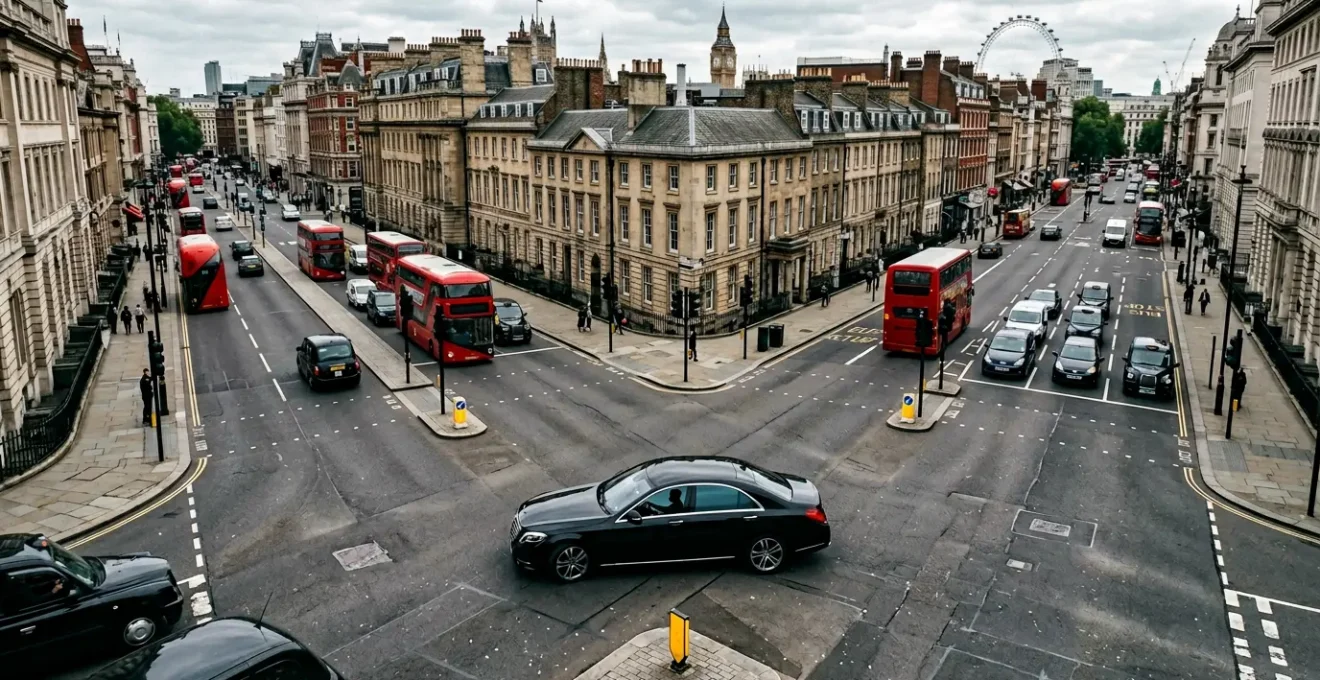
Saving time in London isn’t about having a better sat-nav; it’s about exploiting the predictable gaps and patterns the algorithms miss.
- Elite drivers use “traffic delta” knowledge—the gap between GPS data and ground reality—to beat estimates on seemingly congested routes.
- Strategic route sequencing and micro-manoeuvres, like corner drop-offs, save more time than simply finding the “fastest” road.
Recommendation: The key is trusting a driver whose expertise in route geometry and predictive scheduling turns gridlock into a calculated advantage.
For the time-poor executive, sitting in the back of a car watching the meter tick while the city grinds to a halt is more than an inconvenience; it’s a direct loss. The common advice—use Waze, avoid rush hour, know the Congestion Charge—is rudimentary. It’s the baseline, not the solution. Any driver can follow a GPS. But the difference between arriving on time and arriving 15 minutes early lies in a layer of knowledge that technology cannot replicate.
This isn’t about magic or illegal manoeuvres. It’s about a deep, almost cellular understanding of London’s circulatory system. It’s knowing that Wigmore Street is the pressure-release valve for Oxford Street, that a flight delay at Luton shifts rush-hour patterns by 45 minutes, or that the sequence of your meetings is more important than the distance between them. It’s about mastering what we call the traffic delta: the subtle, exploitable difference between what the map says and what the street is actually doing.
But what if the key to speed wasn’t simply a better route, but a fundamentally different way of thinking about the journey itself? This is the domain of the expert chauffeur, a route master whose brain is the most sophisticated navigation tool. They don’t just follow the road; they read its pulse, predict its behaviour, and manipulate its rules to their advantage.
This guide deconstructs that expertise. We will explore the specific, quantifiable strategies these drivers use to turn London’s infamous gridlock into a solvable puzzle, consistently delivering you to your destination faster than any algorithm alone could manage. We’ll examine the legal loopholes, the psychological routing, and the predictive scheduling that separates a standard journey from an optimised one.
This article breaks down the core strategies that separate elite chauffeurs from standard drivers. The following sections provide a detailed look into the specific techniques used to master London’s complex road network and save valuable time on every journey.
Summary: Mastering London’s Roads to Shave Off Crucial Minutes
- Which Taxis Can Use Bus Lanes and When Can Private Hire Cars?
- Why Avoiding Oxford Street Is Rule #1 for Efficiency?
- Corner Drop-Off vs Doorstep: Which Is Faster in One-Way Systems?
- Why Your Driver Must Use Real-Time Tracking for Delayed Luton Flights?
- GPS vs The Knowledge: When Should You Trust the Driver Over Waze?
- How Waze and Local Knowledge Combine to Save 20 Minutes?
- Why Scheduling Mayfair After The City Is a Traffic Nightmare?
- How Expert Drivers Avoid the M25 Car Park During Friday Rush Hour?
Which Taxis Can Use Bus Lanes and When Can Private Hire Cars?
The bus lane is the most visible and misunderstood advantage in London’s traffic game. For most drivers, it’s a forbidden zone guarded by cameras. For the expert chauffeur, it’s a strategic tool. The core rule is simple: licensed London taxis (black cabs) can use most bus lanes, while Private Hire Vehicles (PHVs), the category for most chauffeur services, cannot. This creates a fundamental divide. However, the real expertise lies in knowing the exceptions. While London is strict, a driver’s knowledge must extend to the fact that rules are not uniform across the UK; there are 5 designated bus lanes accessible to PHVs in Portsmouth, highlighting how location-specific this knowledge must be.
In London, the advantage isn’t about illegally using bus lanes, but about mastering their boundaries and timings. Many lanes are not 24/7. A lane operational from 7am-7pm becomes a free-flowing extra lane at 7:01pm—a fact many drivers, fixated on their GPS, will miss. The true route master knows the operational hours of every key bus lane on their primary routes. More importantly, they use the “slingshot technique”: legally entering a bus lane for the permitted 50-meter stretches near major junctions. This short burst is often enough to bypass a 10-car queue at a traffic light, saving 2-3 minutes at a single intersection. It’s not about driving *in* the lane; it’s about using it as a surgical tool to get ahead.
Your Action Plan: Strategic Bus Lane Usage
- Identify bus lanes with 7am-7pm restrictions and use them legally during off-peak hours.
- Master the ‘slingshot technique’ by using permitted 50-meter bus lane sections near major intersections to bypass bottlenecks.
- Monitor real-time bus frequency; a savvy driver knows to avoid even a permitted lane when multiple buses are operating to prevent getting boxed in.
- Pre-plan drop-offs on side streets adjacent to red routes to avoid stopping penalties and keep moving.
- Use bus lane entry points strategically, entering just after a bus stop where traffic has naturally slowed to let passengers on or off.
This is a game of inches and seconds. An expert driver doesn’t see a solid red line; they see a set of rules with defined edges and times, and they operate right on that edge for maximum efficiency. It’s a prime example of how deep, granular knowledge beats a simple “avoid traffic” algorithm.
Why Avoiding Oxford Street Is Rule #1 for Efficiency?
To the tourist, Oxford Street is a destination. To the professional driver, it’s a trap. It’s not just the volume of traffic; it’s the *type* of traffic. Sat-navs see it as a major artery, a direct A-to-B route. A route master sees it as a chaotic ecosystem of double-decker buses stopping every 100 metres, unpredictable pedestrian flows spilling onto the road, and an endless stream of delivery vehicles. The GPS algorithm can’t quantify this human chaos. It sees a “slow” road, but it doesn’t understand the stop-start whiplash that can turn a half-mile journey into a 20-minute ordeal.
The expert’s rule is simple: never touch Oxford Street. The secret is the use of parallel relief roads. Wigmore Street to the north and Brook Street/Grosvenor Street to the south are the chauffeur’s corridors. They are less glamorous and have their own traffic lights, but their flow is predictable. There are fewer buses, no flagship stores disgorging thousands of shoppers, and a more consistent traffic rhythm. This is a core principle of route geometry: the shortest path is rarely the fastest. An expert driver has a mental map of these “twin” roads for every major bottleneck in London.
As this visual demonstrates, the choice is between a line of congested, frequently stopping vehicles and a path of smoother, more consistent flow. The time saving here is not about higher speed, but about maintaining momentum. While Waze might route you onto Oxford Street because it appears 100 yards shorter, the chauffeur knows the traffic delta is massively in favour of the parallel route. They will manually override the GPS because their experience-based data on pedestrian density and bus schedules is more accurate than the algorithm’s real-time traffic data alone. This decision alone can easily save 10 minutes on a cross-town journey.
Corner Drop-Off vs Doorstep: Which Is Faster in One-Way Systems?
In the world of executive transport, the final 100 metres of a journey can be the costliest. The client’s request is always “to the door,” but in London’s labyrinthine one-way systems, fulfilling this literally can add five to seven minutes of frustrating circling. A professional driver understands the critical difference between service and efficiency. The “doorstep delivery” in a tight Mayfair or Soho street often means entering a one-way loop, getting stuck behind a delivery van, and navigating a three-point turn. It feels like premium service, but it’s a time-sink.
The street-smart alternative is the corner drop-off. By stopping just before entering the one-way maze, on a corner with a clear exit, the driver can save an entire loop. The client has a 30-second walk, but the car saves five minutes. This is a crucial judgement call. It requires reading the client and the situation: for a passenger with heavy luggage or mobility issues, the doorstep is non-negotiable. But for a time-crunched executive hopping out for a meeting, the corner drop is the faster, smarter play. The driver presents it not as a shortcut for them, but as a time-saver for the client: “It will be quicker for you if I drop you here, sir/madam, just around the corner.”
This strategic decision is based on a quick mental calculation of risk and reward, a process that is invisible to any GPS. The following table breaks down the driver’s thought process when approaching a destination within a complex one-way system.
| Drop-off Type | Driver Time Impact | Client Walking Time | Risk Factors | Best Use Case |
|---|---|---|---|---|
| Corner Drop-off | Saves 4-5 minutes | 30-60 seconds walk | Low box-in risk | One-way systems, narrow streets |
| Doorstep delivery | Adds 5-minute loop | Zero walking | High congestion risk | Elderly/disabled passengers, heavy luggage |
| Adjacent street | Saves 3 minutes | 90 seconds walk | Medium risk | Red route avoidance |
This analysis demonstrates a key aspect of the chauffeur’s expertise: managing the client’s perception of time versus the actual time saved. By communicating the benefit, the corner drop-off is reframed from an inconvenience to a mark of an efficient, savvy service that respects the client’s schedule above all else.
Why Your Driver Must Use Real-Time Tracking for Delayed Luton Flights?
Airport pickups are a game of precision timing, and flight delays are the biggest variable. An amateur driver relies on the airline’s website. A professional uses a dedicated flight tracking app like FlightAware or FlightRadar24. But an elite chauffeur goes deeper. They don’t just track the landing time; they track the ‘on-block’ time—the moment the plane physically arrives at the gate and the doors can open. This can be 10-15 minutes after landing, especially at a busy airport like Luton.
Why does this matter? Because airport parking is expensive, and waiting times are tightly controlled. Most premium chauffeur services typically include 60 minutes of complementary waiting time at airports, starting from the scheduled arrival. A two-hour delay isn’t just a two-hour wait. It’s a complete shift in the traffic landscape. A flight scheduled to land at 3:30 PM, putting the journey into central London squarely in the 4:30 PM peak rush hour, might now land at 5:30 PM. The subsequent journey at 6:30 PM will face a completely different, often lighter, traffic pattern. An expert driver recalculates the entire route and expected journey time based on this new reality.
The protocol is meticulous. The driver positions themselves at a nearby, free-of-charge holding area. They track the ‘on-block’ time, then add a mental buffer based on the specific airline and terminal for baggage reclaim and immigration (e.g., 20 minutes for a domestic flight with hand luggage, 45 for an international flight with checked bags). They only enter the short-stay pickup zone, initiating the parking charge, when the passenger calls to say they are walking out of the terminal. This synchronisation minimises costs and ensures the car is pulling up to the kerb at the exact moment the client arrives. It’s a seamless experience born from obsessive data-tracking and predictive analysis, saving both time and money.
GPS vs The Knowledge: When Should You Trust the Driver Over Waze?
Waze, Google Maps, and other GPS systems are phenomenal tools for spotting major incidents and widespread congestion. They are reactive, pooling data from thousands of users. But they are not predictive, and they lack nuance. This is where “The Knowledge”—the legendary encyclopaedic street-map held in the mind of a London driver—is superior. The real art is knowing when to trust the machine and when to trust the human. The GPS is for the macro-picture; The Knowledge is for the micro-knowledge that wins the final mile.
Trust the driver, not the GPS, when the situation involves predictable human patterns. Waze will show a road as clear at 3:15 PM, but the driver knows a school lets out at 3:30 PM, and that ‘clear’ road will become a gridlocked nightmare of double-parked 4x4s for the next 25 minutes. Trust the driver when a road is blocked for a non-traffic reason—a film crew, a burst water main, a local market. The driver will see the initial signs and divert to a parallel ‘rat-run’ long before the data filters through to the Waze algorithm. This is the essence of a top-tier chauffeur’s value, built on years of experience. As Addison Lee’s executive standards demand:
A minimum of five years’ professional private hire or taxi driving experience, with expert knowledge of London’s roads and routes
– Addison Lee Executive Standards, Chauffeur Service Requirements
This deep-seated expertise is an active, living database. The driver knows the delivery schedules for shops on Regent Street, the traffic light sequencing on Park Lane, and the back-alleys that connect Mayfair to Soho. They are processing a richer, more textured data set than the GPS. While the app sees a red line and suggests waiting, the driver sees a temporary blockage and already knows three ways around it. The GPS is a tool; The Knowledge is the intelligence that wields it.
How Waze and Local Knowledge Combine to Save 20 Minutes?
The ultimate strategy for time-saving isn’t a battle between GPS and human knowledge, but a fusion of the two. An elite chauffeur uses Waze or Google Maps not as a commander, but as a consultant. The app provides the broad strategic overview—a major accident on the A40, for example—while the driver’s local knowledge provides the tactical response. The app says “25-minute delay ahead,” but the driver’s brain instantly plots a complex sequence of side streets through Notting Hill that the algorithm would never consider.
This synergy turns data into action. The driver keeps the map open to monitor the macro situation but makes their own micro-decisions. They trust the app’s long-range alerts but override its short-range suggestions. This combination is most powerful when dealing with temporary or time-specific congestion that algorithms struggle to interpret correctly. A GPS sees a queue and recommends waiting, assuming it’s standard traffic. The driver identifies the cause—a school pickup, a market closing—and knows the exact time it will clear, or the specific backstreet to bypass it.
The following table illustrates real-world scenarios where this blend of technology and experience creates significant time savings. The GPS identifies the problem, but local knowledge provides the superior solution, demonstrating a tangible return on expertise that far outweighs blind trust in an algorithm.
| Scenario | GPS Recommendation | Local Knowledge Override | Time Saved |
|---|---|---|---|
| School pickup queue (3:30pm) | Shows congestion | Wait 5 minutes for queue to clear | 8 minutes |
| Temporary film crew blocking | Shows road as clear | Take parallel street immediately | 15 minutes |
| A40 major incident | Suggests wait in traffic | Complex rat run through Notting Hill | 20 minutes |
| King’s Road Saturday 2pm | Shows moderate traffic | Fulham Road backstreet grid | 12 minutes |
This dynamic partnership is the pinnacle of efficient driving. The driver isn’t just following directions; they are in a constant dialogue with the data, enriching it with years of on-the-ground experience to produce a result that is faster, smarter, and more reliable than either source could achieve alone.
Why Scheduling Mayfair After The City Is a Traffic Nightmare?
The most overlooked aspect of saving time in London is predictive scheduling. An efficient journey isn’t just about the route taken; it’s about the time of day it’s attempted. A common mistake for executives with back-to-back meetings is geographical planning: a 10am meeting in the City of London followed by a 12pm in Mayfair seems logical on a map. In reality, it’s a traffic disaster. The problem lies in the tidal flow of London’s traffic.
The morning rush hour (7:30-9:30am) is a massive inbound flow towards the City and Canary Wharf. The evening rush (4:30-6:30pm) is a mass exodus from these same centres towards the residential west and suburbs. Scheduling a journey *against* this tide is key. A wise itinerary puts City of London appointments early in the morning, before 11am. The transition to the West End (Mayfair, Soho) should be planned for the mid-day lull, between 11am and 2pm, when traffic is at its lightest. Scheduling a trip from the City to Mayfair at 4pm means you are trying to drive west at the exact moment half the city’s workforce is doing the same. You’re swimming against the strongest current.
This strategy also takes into account financial considerations like the Congestion Charge. Transport for London’s current congestion charge requires a £15 daily payment for driving within the zone between 7:00-18:00 on weekdays. By sequencing all central appointments within a single block, you avoid multiple entries and exits, but the timing of that block is what determines the time spent in traffic. An expert chauffeur will often advise on the scheduling of meetings, suggesting a sequence that aligns with the city’s natural traffic rhythms. A 20% time buffer is a standard rule for any cross-city journey attempted after 3:30pm, as the ‘evening escape’ can start early and unpredictably.
Key Takeaways
- True time-saving comes from exploiting the “traffic delta”—the gap between GPS data and on-the-ground reality known only through experience.
- Strategic choices like using parallel relief roads (e.g., Wigmore St instead of Oxford St) and opting for corner drop-offs over doorstep deliveries in one-way systems are crucial micro-decisions.
- The best chauffeurs fuse technology with “The Knowledge,” using GPS for macro-alerts and their own expertise for tactical, time-saving manoeuvres that algorithms miss.
How Expert Drivers Avoid the M25 Car Park During Friday Rush Hour?
The M25 on a Friday afternoon is not a motorway; it’s London’s biggest car park. For journeys to Heathrow or Gatwick, getting caught in the Friday getaway rush can add 60-90 minutes to a trip. An expert driver’s strategy for avoiding this is not about finding a magical clear lane. It’s an avoidance plan activated hours in advance. At 2pm on a Friday, the driver checks the status of the M25. If traffic is already building near key junctions like the M4 or M23 interchange, the standard route is immediately abandoned.
The plan involves a complete bypass using a pre-planned sequence of A-roads. For a Heathrow journey from Central London, this means shunning the M4/M25 route entirely and sticking to the A4 (Great West Road) all the way. For Gatwick, it might involve taking the A23 and then cutting across country roads via Epsom and Reigate. These routes may look longer on a map and involve more traffic lights, but they maintain a crucial element: consistent movement. It is always faster to travel at a steady 30mph on an A-road than it is to sit stationary for 20-minute intervals on the M25.
The driver also knows their “point of no return.” For a Heathrow run, they must be past the Chiswick Flyover by 4pm. Any later, and the feeder traffic onto the M4 becomes so dense that the A-road escape route is the only viable option. This strategy requires immense confidence and a deep knowledge of the road network outside the core of London. It also requires practical preparation, like having offline maps of all alternative routes downloaded, as mobile signals can be unreliable in the more rural sections of these bypasses. It’s the ultimate example of proactive, strategic routing over reactive, GPS-led driving.
Ultimately, navigating London efficiently is a craft built on these layers of knowledge. By trusting a driver who has mastered these techniques, you are not just buying a journey; you are investing in a time-saving strategy that begins long before the engine starts. To put these principles into practice, the next logical step is to work with a service that values and cultivates this level of driver expertise for every journey.