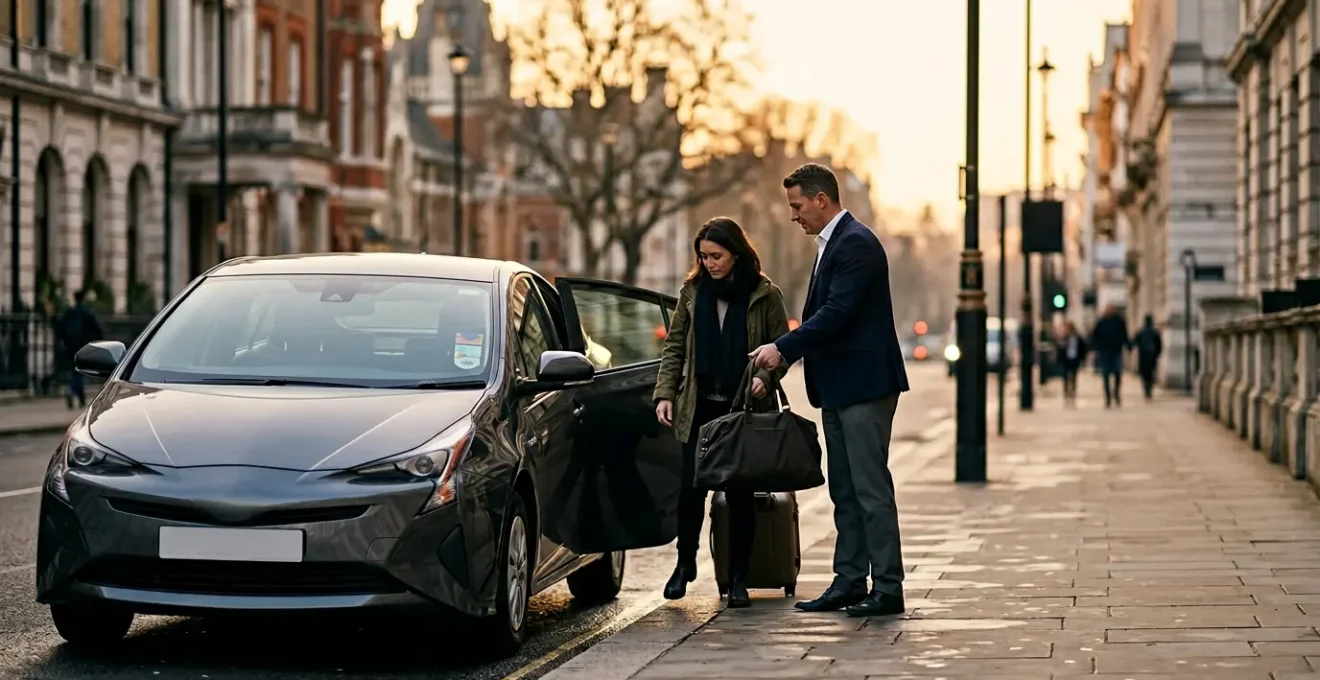
Your safety in a London private hire vehicle goes far beyond the driver’s ID badge; it’s a multi-layered ecosystem of regulations designed to prevent incidents before they happen.
- Vehicle age limits and mandatory modern safety features directly reduce the risk of mechanical failure and accidents.
- Strict rules on driver working hours and rigorous background checks ensure the person behind the wheel is fit, alert, and trustworthy.
Recommendation: Empower yourself by understanding these rules. Knowing how to verify a license or report an issue makes you an active participant in your own safety.
When you book a private hire vehicle (PHV) in London, your immediate safety check might be to match the driver’s face to the app and glance at their ID badge. It’s a sensible first step, but it’s only the visible tip of a vast and intricate iceberg. Beneath the surface lies a comprehensive framework of Transport for London (TfL) regulations, a meticulously designed safety ecosystem that protects you from the moment you book your ride to the moment you step out of the car. Many passengers assume safety is just about the driver, but TfL’s approach is far more holistic, encompassing the vehicle’s mechanics, the driver’s physical and mental state, and clear lines of accountability.
While common advice focuses on “checking the licence,” this overlooks the proactive, preventative measures that are constantly at work. This isn’t just a list of rules; it’s a system of interlocking gears. The logic behind banning older cars isn’t arbitrary, the limits on working hours are scientifically based, and the screening process a driver undergoes is deliberately rigorous. Understanding this regulatory logic is the key to truly appreciating the level of protection afforded to you as a passenger. This guide moves beyond the platitudes to decode this system, revealing how each regulation, from bus lane access to seatbelt laws, is a deliberate layer of protection designed with your journey in mind, transforming you from a passive passenger into an empowered and informed customer.
This article breaks down the key components of TfL’s protective framework. We will explore the specific regulations that govern vehicles, drivers, and your rights, giving you the knowledge to travel with greater confidence.
Summary: How TfL’s Safety Ecosystem Protects Passengers
- Why Are Older Vehicles Banned from London Private Hire Fleets?
- Working Hours: How Do Regulations Prevent Driver Fatigue?
- The ID Badge: What Information Must Be Visible to the Passenger?
- How to Report a Dangerous Vehicle to Transport for London?
- Seatbelts and Taxis: What Is the Law for Rear Passengers?
- How to Check if Your Chauffeur Is Licensed by TfL in Seconds?
- Which Taxis Can Use Bus Lanes and When Can Private Hire Cars?
- What Screening Checks Do Top London Chauffeurs Pass Before Driving You?
Why Are Older Vehicles Banned from London Private Hire Fleets?
The requirement for a modern fleet is a cornerstone of TfL’s proactive prevention strategy. It’s not about aesthetics; it’s a data-driven policy to ensure every vehicle meets stringent safety and environmental standards. An older car carries inherent risks that go beyond simple wear and tear. Metal fatigue, deterioration of critical suspension and steering components, and outdated safety systems all contribute to a higher risk profile. TfL mitigates this by enforcing strict age limits on licensed vehicles. For instance, TfL has been reducing the maximum age for vehicles with older emission standards, effectively phasing out less safe and more polluting cars.
Newer vehicles come with a host of non-negotiable safety features that older models lack. This includes:
- Mandatory Electronic Stability Control (ESC), which significantly reduces the risk of skidding and loss of control.
- Advanced airbag systems that offer superior protection for all occupants in a crash.
- Modern materials and construction techniques that better resist structural fatigue.
This continuous modernisation is a critical part of the safety ecosystem. It ensures that the mechanical platform of your journey is as robust as possible, lowering the probability of component failure.
Case Study: The Zero Emission Capable (ZEC) Mandate
A prime example of this philosophy is the rule that from 1st January 2023, all private hire vehicles licensed for the first time must be Zero Emission Capable (ZEC). While the primary driver is environmental, this policy has a powerful secondary safety effect. It forces a constant renewal of the fleet, guaranteeing that new entrants are not just cleaner, but are also equipped with the very latest safety technologies mandated by modern manufacturing standards. This demonstrates TfL’s dual commitment to building a safer and greener transport network for London.
Ultimately, by banning older vehicles, TfL removes a significant variable of risk from the equation. It’s a fundamental layer of protection that works silently in the background of every trip you take.
Working Hours: How Do Regulations Prevent Driver Fatigue?
A safe vehicle is only half the equation; an alert and focused driver is just as critical. Driver fatigue is a leading cause of accidents, and TfL addresses this head-on with strict regulations on working hours. This is a core part of their proactive prevention strategy, designed to stop tired drivers from getting behind the wheel in the first place. These rules are not mere suggestions; they are legally binding requirements that operators like Uber, Bolt, and Addison Lee must enforce through their technology. The regulations typically stipulate maximum driving hours within a 24-hour period and a weekly cycle, as well as mandating minimum continuous rest periods.
The system works by creating layered accountability. While the driver is responsible for managing their rest, the operator is legally required to monitor these hours and prevent a driver from accepting new fares once they have reached their limit. This is often managed via the driver’s app, which will automatically log them out and enforce a mandatory rest break. This technological enforcement removes the commercial pressure a driver might feel to continue working when tired, making safety the priority.
As a passenger, you are protected by this invisible safety net. The regulatory logic ensures that the driver of your late-night journey home has not been on the road for an excessive and dangerous amount of time. It’s a system that prioritises human limitations over commercial gain, ensuring the person in control of the vehicle is fit to operate it safely. This focus on driver welfare is a direct investment in passenger safety.
The ID Badge: What Information Must Be Visible to the Passenger?
The driver’s ID badge is the most visible symbol of TfL’s regulatory power and your first tool for passenger empowerment. While it may seem like a simple piece of identification, it represents the successful completion of a rigorous licensing process. Every licensed London PHV driver is required to wear their badge so it is clearly visible to the passenger at all times. This is not just a formality; it is your right to be able to identify the person responsible for your journey. The badge must display key pieces of information: a clear, recent photograph of the driver, their full name, a unique licence number, and the licence expiry date.
This information serves as your initial verification checkpoint. It allows you to confirm that the person driving the car is the same person registered to the vehicle you booked through the app. This simple act is a powerful deterrent against unauthorised or fraudulent drivers. The expiry date is also crucial, as it confirms the licence is current and that the driver remains in good standing with TfL, subject to ongoing checks.
Furthermore, TfL is continually enhancing transparency to bolster passenger confidence. For example, new TfL regulations from July 1, 2024, require vehicles to display signage with information on how passengers can make a complaint. This complements the ID badge by providing a clear, in-vehicle pathway for raising concerns, reinforcing the principle of accountability. The badge and accompanying signage work together to create an environment where the driver is clearly identifiable and answerable for the service they provide.
How to Report a Dangerous Vehicle to Transport for London?
All PHV drivers must self-report any arrest, charge, caution, or conviction within 48 hours
– TfL Notice 05/24, Transport for London Official Notice
This rule highlights a key principle of the safety ecosystem: layered accountability. While TfL and operators monitor safety, passenger reporting is a vital source of on-the-ground intelligence. If you encounter a vehicle you believe is unsafe or a driver whose behaviour is dangerous, you are not helpless. Reporting the issue directly to TfL empowers you to act as a crucial check and balance within the system. Your report can trigger an investigation, a vehicle inspection, or a review of a driver’s licence. Even reports on minor issues are valuable, as they help TfL build a pattern of behaviour that may indicate a larger problem with a driver or operator.
The key to an effective report is to be factual, prompt, and detailed. Emotional language is less helpful than a clear, concise description of the issue. Whether it’s a problem with the vehicle’s condition (e.g., bald tyres, broken seatbelt) or the driver’s actions (e.g., speeding, using a phone), providing specific details allows TfL to take targeted action. Making a report is a direct way to contribute to the safety of yourself and future passengers.
Your Action Plan: Reporting an Issue to TfL
- Gather Key Information: Note the vehicle registration number, the driver’s PHV licence number (from their badge), and the date, time, and location of the incident.
- Act Promptly: Submit your report as soon as possible, ideally within 48 hours, while the details are still fresh in your mind. Use TfL’s official online reporting forms.
- Be Specific and Factual: Clearly describe the safety issue. For example, instead of “the driver was bad,” use “the driver exceeded the speed limit on the A40 and was using a handheld mobile device.”
- Distinguish Between Issues: Differentiate clearly in your report if the problem was with the vehicle’s physical condition or the driver’s behaviour, as this directs the investigation.
- Use the Right Channels: For serious concerns, use the official TfL complaint form online. For follow-up, you can email tphlicensingsupport@tfl.gov.uk.
By taking these steps, you are not just making a complaint; you are actively participating in the regulatory process and upholding the high standards TfL sets for all its licensees.
Seatbelts and Taxis: What Is the Law for Rear Passengers?
Seatbelt laws in London’s licensed vehicles can be a source of confusion for passengers, as different rules apply to traditional black cabs (Hackney Carriages) and Private Hire Vehicles (PHVs). In a PHV—the category that includes services booked via apps like Uber, Bolt, or local minicab firms—the law is straightforward. If the vehicle is fitted with seatbelts, you must wear them. There is no exemption for rear-seat passengers. This is a critical safety rule, and failing to comply can not only lead to injury but also impact any potential insurance claim. Insurers may argue for reduced compensation if your injuries were made worse by not wearing a seatbelt.
In contrast, black cabs have a historical exemption where passengers in the separated rear compartment are not legally required to wear a seatbelt. However, this does not mean it is safe to forego one. For your own protection, the clear advice from all safety bodies is to always wear a seatbelt if one is available, regardless of the vehicle type. For children, the responsibility rests with the parent or guardian to ensure they are correctly restrained, either in a suitable child seat or using the adult belt if they are tall enough.
The following table, based on information from UK safety and police guidance, clarifies the differences. As a passenger, the safest and simplest approach is to always buckle up.
| Vehicle Type | Rear Seatbelt Requirement | Insurance Implications |
|---|---|---|
| Black Cabs (Hackney Carriages) | Historical exemption applies | Standard coverage applies |
| Private Hire Vehicles (PHVs) | Mandatory if fitted | Compensation may be reduced if not worn |
| Child Passengers | Parent responsible for child seats | Some operators offer pre-fitted seats |
How to Check if Your Chauffeur Is Licensed by TfL in Seconds?
Verifying your driver’s licence is the single most powerful act of passenger empowerment you can perform. It confirms that the person driving you has passed TfL’s entire gauntlet of safety and background checks. This process is intentionally rigorous; the typical processing time for a new PHV licence application is 3-4 months, a clear indicator of the depth of the vetting involved. Fortunately, TfL provides several quick and easy ways for you to verify that your driver is legitimate before you even get in the car.
The verification process is a simple cross-reference of physical and digital information. It should only take a few seconds and provides immediate peace of mind. Here is a step-by-step guide to follow:
- Observe the Physical Badge: The driver must be wearing their blue PHV driver badge. Check the photo and name.
- Check the Vehicle Disc: A corresponding yellow licence disc should be displayed on the front and rear windscreens of the vehicle.
- Use the Online Checker: The definitive check is TfL’s free online ‘PHV Driver Licence Checker’. You can enter the driver’s licence number or the vehicle’s registration number.
- Match the Details: The online tool will show you the driver’s name and a photograph. This must match the person in front of you.
If there is any mismatch—if the driver has no badge, if the photo doesn’t match, or if the online checker returns different details—you should not enter the vehicle. Cancel the ride, citing a safety concern, and report the incident immediately to both the operator (e.g., Uber) and TfL, providing the vehicle registration.
This quick check is your final link in the chain of the safety ecosystem. It ensures that all the preceding layers of protection—the background checks, the medical exams, the training—are validated in the real world, right before your journey begins.
Which Taxis Can Use Bus Lanes and When Can Private Hire Cars?
Licensed Taxis (Black Cabs) are considered part of the public transport network with a ‘hail and ride’ function, whereas PHVs are a pre-booked service
– Transport for London, TfL Official Policy
This fundamental distinction in service models is the reason behind the different rules for bus lane access. Black cabs, which can be hailed on the street, are integrated into London’s public transport infrastructure, much like buses. Their ability to use bus lanes helps them move efficiently through traffic, providing a flexible public service. This access is a universal right for all licensed London taxis.
In contrast, Private Hire Vehicles (PHVs) operate on a pre-booked basis only. They are not permitted to be hailed on the street and are therefore classified differently. As a general rule, PHVs are not allowed to use bus lanes. Driving in a bus lane is a traffic violation for a PHV driver and can result in a penalty charge. As a passenger, if your PHV driver uses a bus lane, they are likely breaking the law. This can be an indicator of a driver who is willing to bend other rules as well.
There are very few exceptions to this rule. Some specially designated wheelchair-accessible PHVs may be granted permission to use bus lanes, but this is not the norm. It’s also important to note that rules can sometimes vary between different London boroughs, although the general prohibition for standard PHVs is consistent across the city. The table below, drawing from a parliamentary briefing on taxi regulation, summarises the key differences.
| Vehicle Type | Bus Lane Access | Exceptions |
|---|---|---|
| Black Cabs (Licensed Taxis) | Full access to bus lanes | None – universal right |
| Standard PHVs | No access to bus lanes | Some wheelchair-accessible PHVs may have permission |
| Borough Variations | Rules may vary | Check local London borough regulations |
Understanding this rule helps you recognise professional, compliant driver behaviour and adds another layer to your awareness as an informed passenger.
Key Takeaways
- Your safety is protected by a ‘safety ecosystem’, not just a single rule.
- Vehicle age and working hour limits are proactive measures to prevent accidents before they happen.
- You are an empowered participant; you have the right and the tools to verify licences and report concerns.
What Screening Checks Do Top London Chauffeurs Pass Before Driving You?
The foundation of the entire TfL safety ecosystem is the rigorous screening process that every single applicant must pass before they can be licensed. This isn’t a simple formality; it’s an in-depth, multi-stage vetting procedure designed to ensure that only individuals of good character are entrusted with transporting the public. The process creates a high barrier to entry, filtering out unsuitable candidates long before they have a chance to get behind the wheel. The cornerstone of this is the mandatory criminal background check.
The Enhanced DBS Check
TfL requires all private hire driver applicants to undergo and pass an Enhanced Disclosure and Barring Service (DBS) check. This is the highest level of criminal record check available in the UK. It goes far beyond checking for current, unspent convictions. It delves into an applicant’s full criminal history, including spent convictions, cautions, warnings, and reprimands. Crucially, it also includes a check against the government’s barred lists, which identify individuals who are legally barred from working with children and vulnerable adults. This check provides a comprehensive picture of an individual’s background, ensuring maximum public protection.
Beyond the criminal check, the screening process is a comprehensive assessment of a driver’s fitness and capability. This layered assessment includes:
- Age and Experience: Drivers must be at least 21 years old and have held a full driving licence for a minimum of three years.
- Medical Fitness: A certificate from a TfL-approved doctor is required to confirm the driver meets DVLA Group 2 medical standards, the same as those for bus and lorry drivers.
- Skills and Knowledge: Applicants must pass a Safety, Equality, and Regulatory Understanding (SERU) assessment to prove their knowledge of the rules, a topographical skills test for navigation, and an English language test.
- Ongoing Duty: This accountability doesn’t end once licensed. Drivers have an ongoing legal duty to report any arrest or conviction to TfL within 48 hours.
This comprehensive set of checks ensures that when a licensed driver arrives, they have been thoroughly vetted for their character, health, and professional competence.
By understanding this deep-seated regulatory framework, you are no longer just a passenger. You become an informed consumer, able to recognise the signs of a safe, compliant service and empowered to act if standards are not met. The next time you step into a PHV, you can do so with the confidence that an entire ecosystem is working to protect you.