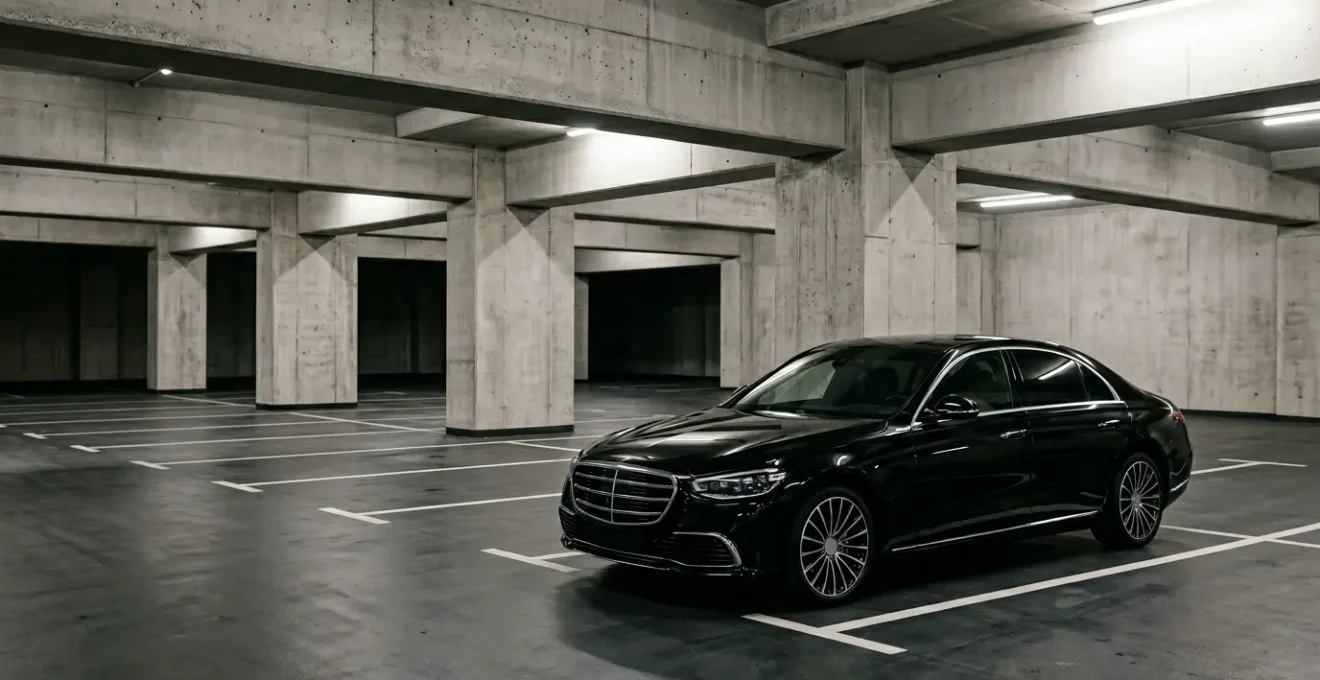
Your choice of executive transport is not a logistical detail; it is a high-impact, mobile brand statement that actively shapes your corporate narrative.
- Vehicle selection operates on the level of semiotics, where colour, model, and brand heritage communicate specific values like authority, innovation, or discretion.
- Misalignment between the vehicle’s message and your brand’s identity can alienate clients, while strategic consistency across a fleet builds a powerful, unified perception.
Recommendation: Shift from a cost or availability-based selection process to a strategic, brand-led approach where every vehicle is chosen to reinforce your core marketing message.
As a marketing director, you meticulously craft every touchpoint of your brand’s story. From the typography on your website to the ambience of your product launch, every detail is engineered to convey a specific message. Yet, one of the most visible and physically present brand ambassadors is often chosen based on logistics or availability: the executive vehicle. Whether it’s collecting a VIP from the airport or transporting your team to a roadshow, the car is a rolling billboard, and its message is potent.
The common approach is to default to a “luxury” vehicle, assuming the premium badge does all the work. Discussions often revolve around simple correlations: a German saloon for seriousness, an EV for sustainability. But this surface-level thinking misses the profound opportunity to engage in what can be called vehicle semiotics—the art and science of understanding how cars function as signs and symbols. The choice of vehicle is a non-verbal dialogue with your clients, investors, and the public. It communicates your company’s values, its position in the market, and its vision for the future, long before a single word is spoken.
But what if the established symbols of luxury are no longer sufficient? What if a “flashy” car sends the wrong signal to a conservative client, or an entire fleet of identical cars communicates an unintended message about your corporate culture? This guide moves beyond the platitudes. We will not just tell you *that* cars matter; we will deconstruct *how* they build meaning. We will explore the subtle signifiers that separate mere transportation from true brand narrative architecture, transforming your vehicle choice from an operational expense into a strategic marketing asset.
This article provides a strategic framework for aligning your vehicle selection with your brand identity. We will dissect the messaging behind specific models, colours, and configurations to empower you to make deliberate, impactful choices.
Summary: Vehicle as Messenger: How Your Choice of Car Architects Corporate Brand Perception
- Why Does a Black Mercedes S-Class Signal “Authority” in Finance?
- Black, Silver, or White: Which Car Colour Commands Most Respect?
- Tesla Model X or Range Rover: Which Says “Forward-Thinking” Better?
- The “Too Flashy” Mistake That Alienates Conservative Clients
- How to Ensure Uniformity When Booking 10 Cars for a Roadshow?
- Executive Saloon or Black Cab: Which Offers Better Privacy for Sensitive Calls?
- Luxury MPV vs Minibus: At What Point Do You Lose the “Executive” Feel?
- Mercedes E-Class or S-Class: Which Saloon Fits Your Junior Executive Budget?
Why Does a Black Mercedes S-Class Signal “Authority” in Finance?
The black Mercedes-Benz S-Class is more than a car; it’s a cultural icon, a universally understood symbol of power, gravitas, and success. For decades, it has been the default choice for state leaders, CEOs, and financial titans. This perception isn’t accidental but the result of deliberate brand positioning and consistent semiotic messaging. The S-Class has long been Mercedes-Benz’s flagship, a showcase of its latest technology and most opulent luxury, which is why the S-Class has ranked as the world’s best-selling luxury sedan. This market dominance reinforces its status as the benchmark, the gold standard by which other luxury vehicles are measured.
The colour black is intrinsically linked to formality, power, and seriousness. In the context of the financial industry, where discretion and unwavering confidence are paramount, a black S-Class becomes a piece of non-verbal communication. It projects an image of impenetrable authority and sober judgment. It doesn’t shout; it affirms. The vehicle’s design language—typically conservative, elegant, and substantial—further enhances this message. It avoids fleeting trends in favour of timeless lines, suggesting stability and long-term vision, core values in the world of finance.
Case Study: The S-Class as the Ultimate Symbol for Business Leaders
In high-stakes corporate environments, from boardrooms to airport arrivals for VIPs, the Mercedes S-Class signals more than just transport; it represents achievement, refined taste, and professional authority. The vehicle is engineered for the executive who requires a secure and tranquil environment to work while in transit. This creates an aura of discretion and a specific kind of “discretion-heavy luxury” that serves as the perfect, non-distracting backdrop for sensitive conversations with key guests or during vital investor relations activities.
Ultimately, the S-Class’s authority comes from a perfect state of perceptual congruence. The brand’s heritage (engineering excellence), the product’s attributes (quiet, safe, luxurious), and the user’s context (high-stakes business) all align to create a single, powerful narrative. It’s a masterclass in using a physical object to reinforce an abstract concept like authority.
Black, Silver, or White: Which Car Colour Commands Most Respect?
While the model of a car sets the foundational narrative, its colour is the primary emotional and psychological modifier. Colour is the first thing the brain processes, and in the corporate world, the choice is far from arbitrary. The monochromatic trio of black, white, and grey (including silver) dominates the executive landscape for a reason: these colours are perceived as sophisticated, timeless, and serious. They form a neutral canvas that allows the brand’s message, rather than the car’s personality, to take centre stage. Black remains the undisputed king of formality and authority, often preferred for top-tier luxury vehicles where it accentuates presence and power.
White, on the other hand, has evolved. Once seen as a base colour, high-quality pearl or metallic whites now signal modernity, cleanliness, and a connection to technology (think Apple). It’s a confident, forward-looking choice that feels less imposing than black. Silver and grey are the quintessential middle ground, projecting competence, efficiency, and understated elegance. They are the safe, intelligent choice, suggesting a leader who values substance over style and makes pragmatic decisions. These shades are less likely to offend and blend seamlessly into any professional environment, making them a versatile option for corporate fleets.
The strategic selection depends entirely on the intended message. A tech startup launching a disruptive product might opt for a fleet of pearl white saloons to signal innovation. A law firm meeting a conservative client would be better served by the quiet confidence of charcoal grey or the absolute authority of deep black. The key is to match the colour’s inherent psychological message with the specific context of the business interaction.
The following data provides insight into how these colours perform in the market, which directly influences their perception in a corporate context. The higher a colour’s popularity in the luxury segment, the more it is associated with premium status.
| Color | Global Market Share 2024 | Corporate Fleet Preference | Luxury Vehicle Preference |
|---|---|---|---|
| White | 31% | 10% more likely | Standard |
| Gray | 22% | Standard | Rising |
| Black | 18% | Standard | 25% more popular |
| Silver | 10% | 15% more likely (male buyers) | Declining |
Tesla Model X or Range Rover: Which Says “Forward-Thinking” Better?
The definition of “forward-thinking” in the automotive world is a fascinating brand battleground. On one side, you have Tesla, a company built from the ground up on a tech-first, disruption-oriented ideology. A Tesla Model X, with its minimalist interior, oversized screen, and iconic Falcon Wing doors, doesn’t just suggest the future; it screams it. Choosing a Tesla is a clear statement of breaking from the past, embracing a digital-native mindset, and prioritizing pure-play innovation. It aligns perfectly with brands in tech, venture capital, and creative industries that want to project a narrative of being on the bleeding edge.
On the other side stands the Range Rover, a symbol of established, old-world luxury and capability. However, with its latest iterations, particularly its plug-in hybrid (PHEV) and forthcoming all-electric models, the narrative has shifted. A new Range Rover no longer just speaks of heritage; it speaks of an established leader confidently adapting to the future. It blends tradition with innovation, suggesting stability and foresight. This message is powerful for industries like modern finance, premium real estate, and established consulting firms that want to signal they are evolving without abandoning the foundations of their success. It’s less a revolution, more a sophisticated evolution.
Tesla signifies a break from the past and a tech-first ideology. The Range Rover (especially PHEV/EV) signifies an established leader adapting to the future, blending tradition with innovation.
– Industry Analysis, Corporate Vehicle Choice Analysis
Interestingly, the public perception of who is leading the EV transition is becoming more nuanced. While Tesla pioneered the market, a survey from VerticalScope found that 34% of EV owners voted legacy automakers as doing the best job of switching to electrification. This suggests that the “forward-thinking” crown is up for grabs. The choice between a Model X and a Range Rover, therefore, is a strategic one: do you want your brand narrative to be one of radical disruption or of enduring, adaptive leadership?
The “Too Flashy” Mistake That Alienates Conservative Clients
In the pursuit of projecting success, there’s a fine line between looking premium and appearing “too flashy.” Crossing this line is one of the most common and damaging mistakes in corporate vehicle selection, especially when dealing with conservative clients or industries like law, accounting, or wealth management. A loud, ostentatious vehicle—think a brightly coloured sports car or an overly customized SUV—can signal a lack of seriousness, fiscal irresponsibility, or a focus on style over substance. For a client entrusting you with their finances or legal matters, this can be a fatal blow to credibility. The vehicle’s message must be one of understated confidence, not arrogant display.
The error stems from a misunderstanding of luxury. True executive luxury isn’t about attracting attention; it’s about commanding respect through quality, craftsmanship, and discretion. The goal is to achieve perceptual congruence, where the vehicle’s personality perfectly matches the client’s expectations of your brand. For a conservative client, this means a car that is elegant, comfortable, and impeccably maintained, but not attention-seeking. Brands like Genesis, Volvo, or even a higher-trim Audi often excel here, offering superb luxury and technology without the aggressive posture of some rivals. Choosing an Audi A8 over a Lamborghini Urus for a meeting with a family office is not a budgetary decision; it’s a strategic one.
The context of the meeting is also critical. A vehicle that is appropriate for a glamorous product launch in a major city might be jarringly out of place when visiting a client’s headquarters in a more traditional suburban setting. The key is to demonstrate that you understand their world and respect their values. A subtly luxurious vehicle communicates that you are successful but also sensible, trustworthy, and focused on them, not on yourself. It’s a powerful message that builds trust before you even shake hands.
Your Action Plan: Context-Based Vehicle Selection
- Client Industry Assessment: Analyse the client’s sector. Financial services and law favour traditional luxury (e.g., Mercedes, Audi), while tech and creative fields are more accepting of bold choices (e.g., Tesla, Porsche).
- Meeting Location Analysis: Consider the environment. Distinctive vehicles are more acceptable in major urban centres than in conservative suburban or rural settings where subtlety is valued.
- Client Demographics Evaluation: Gauge the age and culture of the client’s team. Younger executives may appreciate innovation and design risks, while senior, established leaders often value heritage and timelessness.
- Occasion Matching: Differentiate the vehicle based on the event’s purpose. A board meeting requires understated elegance, whereas a celebratory product launch can justify a statement-making vehicle.
- First Meeting Protocol: When in doubt, default to subtle luxury. For initial encounters, vehicles like a Genesis G90, Volvo S90, or Audi A8 project premium quality without the risk of appearing ostentatious.
How to Ensure Uniformity When Booking 10 Cars for a Roadshow?
When scaling from a single executive journey to a multi-vehicle roadshow, the concept of uniformity becomes a critical element of your brand’s narrative architecture. A fleet of 10 cars arriving at an event is a powerful visual statement, and any inconsistency can dilute or distort your intended message. The primary challenge is ensuring every vehicle, from the first to the last, communicates the same standard of quality and aligns with the event’s tone. This requires a proactive strategy with your transport provider, moving beyond a simple request for “10 black saloons.”
The most direct approach is Strict Uniformity: booking 10 identical models in the same colour. This sends a strong egalitarian, “one team” message. It suggests cohesion, discipline, and meticulous planning. However, this isn’t the only strategy. Tiered Uniformity can be used to reflect a traditional corporate hierarchy, for instance, with one flagship S-Class for the CEO and nine E-Class saloons for the senior team. This reinforces established structures of authority. The key is that the choice must be deliberate. A random mix of models and years suggests poor planning and a fragmented organization.
Beyond the vehicles themselves, a sophisticated strategy considers Sensory Uniformity. This involves mandating a consistent in-car experience across the entire fleet. This can include specifying the brand of bottled water, ensuring universal charging cables (USB-C) are available in every car, and even curating a subtle, brand-approved music playlist. This attention to detail elevates the experience from simple transit to a curated brand touchpoint, creating a consistent sensory signature that subtly reinforces your brand’s commitment to quality and excellence for every single passenger.
As this comparative analysis of fleet strategies shows, a robust contingency plan is also crucial. What happens if one car is unavailable? Your booking should include a pre-approved list of substitute vehicles or an upgrade protocol to maintain the desired level of quality and consistency.
| Approach | Message Conveyed | Implementation | Contingency Plan |
|---|---|---|---|
| Strict Uniformity | Egalitarian, team-first | 10 identical E-Class, same color | Pre-approved substitute list |
| Tiered Uniformity | Traditional hierarchy | 1 S-Class (CEO), 9 E-Class | Upgrade protocol for replacements |
| Sensory Uniformity | Premium experience consistency | Mandate water brands, charging cables, playlist | Experience package backup |
Executive Saloon or Black Cab: Which Offers Better Privacy for Sensitive Calls?
For an executive, time in transit is not downtime; it’s a mobile office where sensitive negotiations, strategic planning, and confidential calls take place. In this context, privacy is not a luxury—it is a fundamental requirement. The choice between a high-end executive saloon and a standard black cab (or ride-hailing equivalent) becomes a critical decision about information security. While a black cab offers a physical partition, it falls short in providing true acoustic and visual privacy. The environment is unpredictable, the driver is an unknown variable, and the vehicle itself is not designed to insulate conversations.
A premium executive saloon, by contrast, is engineered specifically for this purpose. These vehicles are designed as a “cone of silence” for the rear passenger. This is achieved through subtle signifiers of privacy that are felt rather than seen. For example, as noted in Consumer Reports’ comprehensive testing, top-tier models like the Mercedes S-Class feature laminated acoustic glass, extensive sound-dampening materials in the body panels, and even specially designed tyres to minimize road noise. This creates a serene cabin environment where conversations are unintelligible from the outside and the driver’s compartment is acoustically isolated.
Furthermore, features like electric rear and side-window sunblinds provide instant visual privacy at the touch of a button, shielding occupants and sensitive documents from view. The professional chauffeur is another key component. They are vetted, trained in discretion, and bound by service agreements, making them a trusted part of the secure environment, unlike a random driver from a ride-hailing app. Choosing an executive saloon is therefore not an extravagance; it is a conscious investment in a secure, controlled, and confidential workspace. It sends a clear message to your client or colleague: “Our conversation is important, and its privacy is guaranteed.”
Luxury MPV vs Minibus: At What Point Do You Lose the “Executive” Feel?
When transporting a small group of executives, the line between a premium experience and group transit is easily blurred. The choice between a luxury Multi-Purpose Vehicle (MPV) like a Mercedes V-Class and a standard minibus defines this boundary. The “executive feel” is lost the moment practicality overtly triumphs over personal space, comfort, and dignity. A minibus, with its bench seats, narrow aisle, and functional interior, is fundamentally designed for efficient group transport. It requires passengers to compromise on personal space and comfort, immediately eroding the sense of prestige.
A luxury MPV, on the other hand, is designed to be a business lounge on wheels. The “executive” status is maintained through several key features that prioritize the individual within the group. The experience hinges on a few non-negotiable elements:
- Individual Seating: The presence of individual “captain’s chairs,” often with recline and climate control functions, is the clearest differentiator. It preserves personal space and status.
- Premium Materials: Full leather upholstery and high-quality trim are expected. Fabric seats or hard plastic surfaces immediately signal a budget-oriented, non-executive vehicle.
- Personal Amenities: Each passenger should have access to their own dedicated USB-C or power port. Having to share outlets breaks the premium experience.
- Ease of Access: Wide, powered sliding doors allow for dignified entry and exit. Having to duck or squeeze through a narrow, manual door instantly eliminates the feeling of luxury.
The tipping point is also a matter of numbers. A true executive experience is difficult to maintain beyond six or seven passengers. Once the capacity approaches double digits, the vehicle’s dynamic shifts from a private cohort to a public tour group, regardless of the amenities. Ultimately, choosing a luxury MPV is a declaration that the comfort and status of each individual in the group are as important as the destination itself. Opting for a minibus signals that the primary goal is simply logistics, a message that can undermine the premium positioning of your brand or event.
Key Takeaways
- Your vehicle choice is an active part of your brand’s non-verbal communication strategy.
- Subtle signifiers like colour, acoustic privacy, and interior materials often convey a stronger message than the badge on the bonnet.
- The right vehicle depends entirely on context; what works for a product launch might alienate a conservative client.
Mercedes E-Class or S-Class: Which Saloon Fits Your Junior Executive Budget?
This question, while seemingly about budget, is fundamentally a question of strategic brand messaging. The choice between a Mercedes-Benz E-Class and an S-Class for a junior executive is a decision about the story you want to tell. It’s not about what the company can afford, but what message it wants to invest in projecting. The E-Class is the quintessential executive workhorse—a symbol of competence, professionalism, and reliability. Assigning an E-Class to a rising manager signals that the company recognizes and rewards their contribution with a high-quality, respectable vehicle. It says, “You are a valued and capable professional on our team.”
The S-Class, however, operates on a different semiotic level. It is the chariot of the final decision-maker. Its presence signifies ultimate authority, senior leadership, and the pinnacle of the corporate hierarchy. Placing a junior executive in an S-Class, even if the budget allows, can create a state of perceptual incongruence. It may send a confusing message to clients, who might mistake them for a more senior leader, leading to awkward dynamics. Internally, it can also disrupt established hierarchies and be perceived as an unearned status symbol.
This is where the role of the brand consultant becomes crucial, as articulated by one industry analysis:
The choice isn’t about affordability; it’s about what message the company wants to invest in. The E-Class projects ‘competent and reliable professional’. The S-Class projects ‘senior authority and final decision-maker’.
– Automotive Industry Analysis, Corporate Fleet Management Strategy
Therefore, the “right” choice is the vehicle that tells the most accurate and effective story for that executive’s role. For a junior executive, the E-Class is often the more strategic choice. It provides a clear and powerful incentive, aligns with their current position, and leaves the S-Class as an aspirational goal, a symbol of the next level of achievement to strive for. This creates a clear and motivating narrative of progression within the company’s brand structure.
By viewing every vehicle choice through this strategic lens, you transform a simple logistical decision into a powerful act of brand architecture. The next time you book a car, ask not just “Is it available?” but “What story will it tell?”