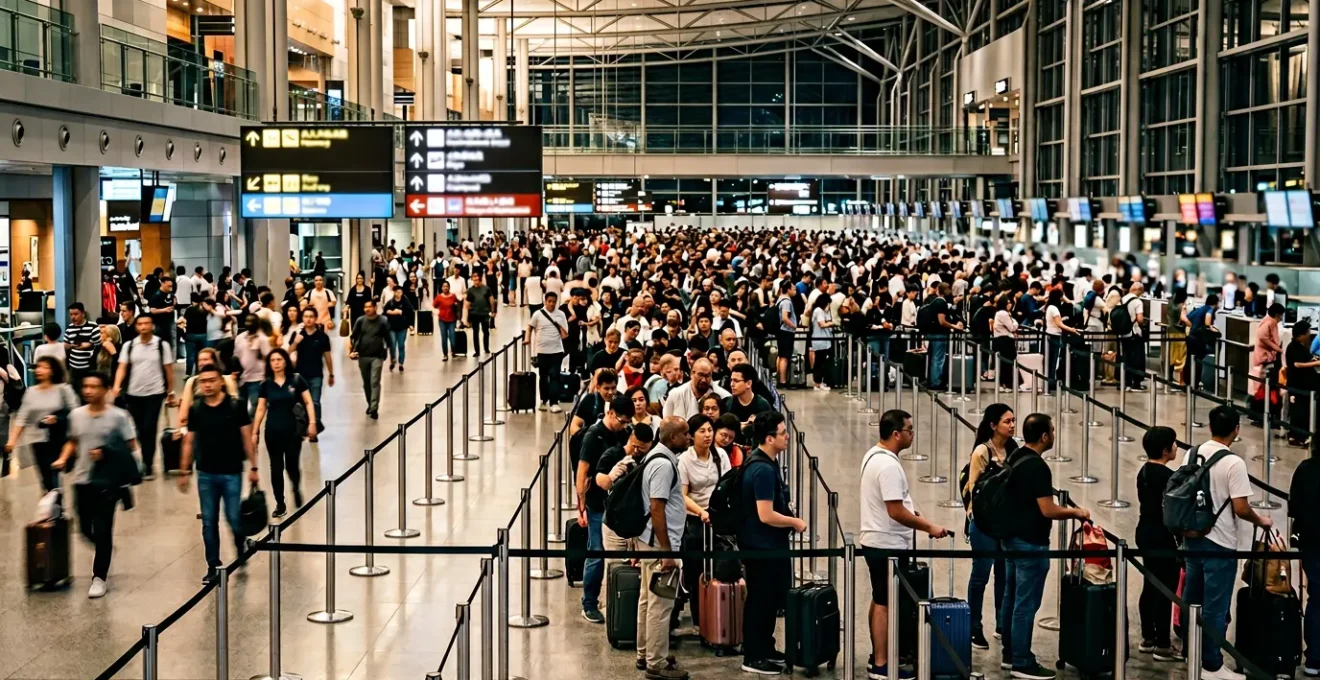
Facing a long customs queue after an international flight creates a significant risk of incurring expensive chauffeur waiting fees.
- Grace periods are often insufficient for non-EU arrivals during peak times, leading to automatic charges.
- The key to avoiding fees lies not in hoping for the best, but in strategically calculating your pickup time and communicating proactively with your driver.
Recommendation: Shift from being a passive passenger to a proactive manager of your arrival by using a tiered buffer calculation and a clear communication protocol, turning a stressful situation into a controlled process.
The moment you step off a long-haul flight, the last thing you want is a race against the clock. Yet for many international travelers arriving at Gatwick, this is the reality. You see the passport control queue snaking back, and a single question dominates your thoughts: will my pre-booked car still be there when I get out, and how much extra will it cost me? The common advice is to simply “add a bit of extra time” or “call the driver,” but this vague guidance often fails when faced with a two-hour delay.
This anxiety is a symptom of a broader challenge: navigating the opaque policies of chauffeur services in a post-Brexit, high-traffic travel environment. The grace period, waiting charges, and booking terms are not just fine print; they are the operational mechanics that determine the success and cost of your journey. Many travelers assume these rules are rigid and non-negotiable, leaving them feeling powerless against mounting fees.
But what if the key wasn’t simply hoping for a short queue, but understanding the system to master it? This guide takes a customer service policy expert’s view, moving beyond guesswork to provide a strategic framework. We will dismantle the core components of airport pickups, from calculating realistic buffers to deploying effective communication scripts. The goal is to empower you with the knowledge to transform your arrival from a source of stress into a seamless, predictable experience.
This article provides a complete toolkit for managing the logistics of your chauffeur service. We will explore the specific challenges at major UK airports, break down the safest booking methods, and provide actionable protocols to ensure you never pay unnecessary waiting charges again. Follow this guide to understand the system and take control of your arrival.
Summary: Navigating Chauffeur Policies for UK Airport Arrivals
- Why Does Passport Control at Gatwick Take Longer on Sunday Nights?
- How to Calculate the Perfect Pickup Slot for Non-EU Arrivals?
- Fixed Time or “Flight Landing” Time: Which Booking Type Is Safer?
- The Communication Error That Racks Up £40 in Waiting Charges
- When to Call Your Driver: The Critical 15-Minute Window During Delays
- Eurostar Arrival to Car Seat: How Long Does Customs Really Take?
- What Passport Rules Apply to Chauffeur Passengers Entering France?
- What Is the Safe Arrival Buffer for Long-Haul Flights from Manchester?
Why Does Passport Control at Gatwick Take Longer on Sunday Nights?
The Sunday evening crunch at Gatwick is a predictable bottleneck for international travelers. This peak period is caused by a convergence of factors: a high volume of long-haul flights arriving from North America and the Middle East, combined with the end-of-weekend return of holidaymakers. For non-EU passport holders, this can translate into significant delays that far exceed the standard grace period offered by most chauffeur services. The process is not a single queue but a multi-stage challenge involving deplaning, walking to immigration, the passport check itself, and then baggage reclaim.
Understanding the specific terminal dynamics is crucial. While both terminals experience pressure, the South Terminal often sees slightly longer queues. Data shows that processing can easily stretch from a baseline of 45 minutes to over an hour and a half during these peak times. According to recent airport processing data, the average wait time can be 45 to 90 minutes, with the Sunday morning rush potentially extending this to two hours. This is why a standard 45 or 60-minute grace period is often inadequate, triggering waiting charges before you’ve even collected your luggage.
Passengers eligible for e-Gates (including those from the UK, EU, USA, Canada, and Australia) can often save considerable time. However, their availability is not guaranteed, and a single non-eligible member in a family can require the entire group to use the manned desks. Proactive travelers can mitigate these delays by monitoring real-time wait times on apps, pre-filling landing cards, and positioning themselves at the front of the aircraft for a quicker exit, potentially saving 15-20 minutes at immigration alone.
The following table, based on typical processing data, highlights the differences between Gatwick’s terminals during these high-pressure periods.
| Terminal | Average Wait | Peak Hours | Best Strategy |
|---|---|---|---|
| South Terminal | 60-90 mins | Sunday 18:00-22:00 | Morning arrivals 6-9am worst |
| North Terminal | 45-75 mins | Sunday 17:00-21:00 | Use e-Gates when available |
Ultimately, travelers arriving on Sunday nights must assume a significant delay and build a conservative buffer into their travel plans, a process we will detail next.
How to Calculate the Perfect Pickup Slot for Non-EU Arrivals?
Booking a chauffeur for a “best guess” time is a recipe for stress and extra charges. The key to a smooth pickup is to replace guesswork with a structured calculation. A “tiered buffer formula” allows you to build a realistic arrival window based on specific, predictable variables. This proactive approach puts you in control and aligns your expectations with the on-the-ground reality of airport operations. Instead of a single, arbitrary number, you construct your buffer layer by layer.
Start with a baseline buffer for your arrival terminal. For Gatwick, a good starting point is 60 minutes for the North Terminal and 75 minutes for the South Terminal. Next, add modifiers based on your passenger profile and flight details. A business traveler with only cabin baggage needs no extra time, but a family with young children and multiple checked bags should add at least 30 minutes. The time of arrival is another critical layer; add 20-25 minutes for notorious peak periods like Sunday evenings or early morning arrival banks.
The final, and often overlooked, factor is baggage reclaim. The arrival of a wide-body aircraft like an Airbus A380 means hundreds of bags hitting the carousel at once, easily adding another 15-20 minutes to your wait. By adding these tiers together, you create a robust and defensible pickup time. For example, a family arriving at Gatwick South on a Sunday evening would calculate their buffer as: 75 mins (base) + 30 mins (family) + 20 mins (Sunday PM) = a total buffer of 125 minutes. This is the number you should use when booking your car service.
This data-driven approach is far more reliable than a simple guess and provides a solid foundation for communicating with your chauffeur service provider should further delays occur.
Fixed Time or “Flight Landing” Time: Which Booking Type Is Safer?
When booking an airport transfer, you are typically presented with two options: a “Fixed Time” pickup or a “Flight Landing” time booking. While the former seems straightforward, it is by far the riskier option for international arrivals. A Fixed Time booking means your grace period starts at that exact time, regardless of whether your flight is on time, early, or delayed. If your flight is delayed by an hour, you may have already exhausted your grace period and be incurring waiting charges before you even touch down.
The “Flight Landing” option, coupled with a pre-agreed grace period, is the industry standard and the safest choice. With this method, the chauffeur company tracks your flight in real-time. Your grace period—the complimentary waiting time—only begins once the flight has officially landed. This automatically protects you from any flight delays, as the pickup time adjusts accordingly. The only risk you bear is the ground-side delay at passport control and baggage claim, which you can manage using the buffer calculation discussed previously.
As one industry analysis highlights, this booking type is also preferred by service providers themselves, which can lead to better service. In the “Ultimate Guide to Airport Chauffeur Services,” experts note:
Most companies prefer ‘Flight Landing’ bookings as it allows for better fleet management and driver allocation. Customers who choose this option may receive more flexibility or better service in case of minor issues.
– Industry Analysis, Ultimate Guide to Airport Chauffeur Services
The decision matrix below clarifies which booking type is most appropriate for different scenarios, consistently favoring the flexibility of a “Flight Landing” booking for unpredictable international journeys.
| Scenario | Recommended Booking | Risk Level | Reasoning |
|---|---|---|---|
| VIP on tight schedule | Fixed Time | High | Assumes both flight & ground delays risk |
| International arrival | Flight Landing + Grace | Low | Only ground delay risk |
| Connecting flight | Flight Landing | Low | Automatic adjustment for delays |
| Domestic with history of delays | Flight Landing | Very Low | Provider manages fleet better |
For any international arrival, the choice is clear: always select a “Flight Landing” time booking to insulate yourself from flight delays and start your journey on a predictable, stress-free footing.
The Communication Error That Racks Up £40 in Waiting Charges
The single most costly mistake a traveler can make is assuming the driver automatically knows about ground-side delays. While chauffeur companies track flights, they have no visibility into the length of passport control queues or baggage reclaim issues. Silence is interpreted as a smooth process. When a passenger fails to communicate a delay, the clock on the grace period runs down, and waiting time charges—often billed in 15-minute increments—begin to accumulate automatically. A 60-minute delay beyond a standard grace period can easily add £40 or more to your bill.
This is not a punitive measure but a matter of operational logistics. The driver has a schedule, and extended, uncommunicated waiting impacts their ability to serve other clients. The error is not experiencing a delay; it’s the failure to manage it proactively. A simple, timely update can transform a costly problem into a simple logistical adjustment. The key is to provide brief, specific updates at critical points in your journey through the terminal.
Effective communication follows a clear protocol. As soon as you land and have a signal, a quick message confirming your arrival and progress is essential. If you encounter a significant queue at passport control or a delay at the baggage carousel, another update with a revised estimate is crucial. This information allows the dispatch team or the driver to make an informed decision: they might extend your grace period, or in the case of a very long delay, agree to have the driver return at a later time, which can be far cheaper than paying for an hour of waiting. For groups, designating a single person to handle all communication prevents conflicting messages and confusion.
Your Pre-Arrival Chauffeur Service Audit
- Policy Review: Locate the chauffeur service’s stated grace period and waiting time fee structure on your booking confirmation. Save their primary contact number and any app-based communication channels.
- Booking Verification: Cross-check your booking confirmation against your flight ticket. Confirm they have the correct flight number, landing date, and that you selected a “Flight Landing” time booking.
- Buffer Cross-Check: Use the tiered formula from this guide to calculate your own buffer. If it’s significantly longer than the company’s standard grace period, be prepared to communicate early.
- Communication Plan: Pre-write a short message for your driver (e.g., “Landed, at passport control. Long queue, estimate 60+ mins.”). Decide who in your group will be the sole communicator.
- Contingency Plan: Have the driver’s direct number handy. Decide in advance your financial limit for waiting time before you would ask the driver to return later.
By shifting from passive waiting to active communication, you change the dynamic from a transaction to a partnership, where both parties work together to solve a logistical challenge.
When to Call Your Driver: The Critical 15-Minute Window During Delays
While text messages are useful for initial updates, a voice call becomes essential at one critical juncture: 15 minutes before your grace period is due to expire. This is the moment of truth where you must negotiate a solution. Texting at this stage is too passive; it can be missed, and it doesn’t allow for a real-time discussion about options. A phone call demonstrates that you are actively managing the situation and respect the driver’s time, which is the key to unlocking flexibility.
From the chauffeur’s perspective, this proactive call makes a world of difference. As one professional driver explained, they often have to pay for parking out-of-pocket while waiting, and uncommunicated delays create financial and scheduling stress. A passenger who calls *before* the grace period ends is seen as a partner in solving a problem. In contrast, a passenger who emerges 30 minutes late without any contact is simply a source of extra charges. The driver’s willingness to be flexible is almost always tied to the timing and method of communication.
A Chauffeur’s Perspective on Wait Time Management
A San Francisco chauffeur servicing SFO’s international terminal revealed that drivers must arrive 15 minutes before a flight lands and typically expect to wait 60-90 minutes for passengers to clear customs, often paying for parking fees themselves. He reported that passengers who proactively call before their grace period expires are almost always met with flexible solutions, such as a waived or reduced waiting fee. However, those who make contact only after the grace period has ended are rigidly charged the full waiting fees as per company policy, as the opportunity for collaborative planning has been lost.
When you make that call, be prepared with specific information. State your booking reference, confirm when your grace period ends, explain your current location and estimated delay, and then propose a solution. A powerful question is: “What works better for you? Should I cover the extended waiting time, or would you prefer to leave and return at a new, specified time?” This puts the driver in control and shows you value their operational constraints. It opens the door to a mutually agreeable solution that is often far cheaper than passively incurring charges.
This single, well-timed phone call is the most powerful tool you have to mitigate costs and ensure your driver is waiting for you with a smile, not a stopwatch.
Eurostar Arrival to Car Seat: How Long Does Customs Really Take?
For travelers heading to London, the Eurostar offers a dramatically different and more predictable arrival experience compared to airports. The primary reason is that all necessary customs and immigration checks for entry into the UK are completed in mainland Europe (e.g., in Paris, Brussels, or Amsterdam) before you board the train. This “pre-clearance” model fundamentally changes the arrival timeline. When you disembark at St Pancras International, there are no further passport controls; you simply walk off the platform, collect your luggage if necessary, and exit the station.
This streamlined process means the total time from stepping off the train to being in your pre-booked car is exceptionally short. For most passengers, this journey takes between 15 and 30 minutes. This is significantly faster than the 60-90 minutes (or more) required at an airport. Consequently, the grace period required for a Eurostar pickup is much shorter, typically only 15-20 minutes, which is more than sufficient to account for any minor delays in disembarking a crowded train.
The table below clearly illustrates the stark contrast in timing between arriving at Gatwick Airport and St Pancras International.
| Factor | Airport (Gatwick) | Eurostar (St Pancras) |
|---|---|---|
| Immigration Check | At arrival (45-90 min) | Before departure (included) |
| Customs Walk-through | After baggage claim | Minimal/None at arrival |
| Platform to Exit | N/A | 10-15 minutes |
| Typical Grace Period | 45-60 minutes | 15-20 minutes |
| Car Seat Installation | +5-10 minutes | +5-10 minutes |
Even with the need to install a child’s car seat, which adds 5-10 minutes, the entire process at St Pancras remains highly efficient. The risk of incurring waiting time charges is minimal, provided the passenger books the pickup for 15 minutes after the scheduled train arrival time.
This makes the Eurostar not only a convenient mode of transport but also a far more predictable option for travelers who need to coordinate a seamless onward journey by car.
What Passport Rules Apply to Chauffeur Passengers Entering France?
For UK citizens traveling by chauffeur to France or other EU countries post-Brexit, understanding Schengen Area rules is as critical as remembering your passport. The regulations are no longer as simple as showing a valid passport; specific validity and length-of-stay rules are now strictly enforced. Failure to comply can result in being denied entry at the border, a situation that chauffeur services typically treat as a “no-show,” meaning you would be liable for the full cost of the journey without it ever taking place.
The most important regulation is the 90/180-day rule. UK citizens can stay in the Schengen Area for a maximum of 90 days within any 180-day period. This is a rolling timeframe, so it’s crucial to track your travel days carefully. Your passport must also meet two validity requirements: it must have been issued less than 10 years before the date you enter, and it must be valid for at least three months after the day you plan to leave. To prove compliance, it is essential to get your passport stamped on both entry and exit.
Chauffeur companies facilitating cross-channel travel require accurate Advance Passenger Information (API) at the time of booking. This data is submitted to border authorities and must match your travel documents exactly. Furthermore, there are strict rules on what you can bring into the EU. For example, you must declare any cash amounts over €10,000. It’s the passenger’s sole responsibility to ensure all their documentation and declarations are in order. As official Gatwick Airport guidance for post-Brexit travel confirms, the critical Schengen Area rule UK citizens must follow post-Brexit is the 90-day maximum stay in any 180-day period.
To avoid any issues, travelers should use a checklist to verify their documentation before departure:
- Ensure passport validity extends 3 months beyond planned departure from the Schengen Area.
- Get your passport stamped on both entry and exit to track 90/180 day compliance.
- Provide accurate Advance Passenger Information (API) to the chauffeur company at booking.
- Declare cash amounts over €10,000 when entering from outside the EU.
- Prepare documentation for minors, such as birth certificates and parental consent letters if they are traveling with only one parent or guardian.
Ultimately, the responsibility for legal entry rests entirely with the passenger, and thorough preparation is the only way to guarantee a smooth cross-border journey.
Key Takeaways
- Calculate a realistic buffer time by layering factors like terminal, time of day, and passenger profile, rather than relying on standard grace periods.
- Always choose a “Flight Landing” time booking over a “Fixed Time” booking for international arrivals to protect yourself from flight delay costs.
- Proactive communication is your best tool: send text updates on your progress and make a voice call 15 minutes before your grace period expires to negotiate solutions.
What Is the Safe Arrival Buffer for Long-Haul Flights from Manchester?
Calculating a safe arrival buffer for Manchester Airport (MAN) requires a nuanced approach similar to Gatwick, but with its own specific terminal characteristics. The airport has undergone significant changes, with the expansion of Terminal 2 and the decommissioning of Terminal 1. This means that a one-size-fits-all buffer is no longer effective. Your calculation must be tailored to your specific arrival terminal and the corresponding airline operations.
Terminal 2 is now the primary hub for most long-haul carriers, including major Middle Eastern and North American airlines. While modern, its sheer size means that passengers may face long walks from the gate to immigration, a factor that must be included in your buffer. A safe base buffer for a long-haul arrival at T2 is 75 minutes. This should be adjusted for peak arrival banks, such as the wave of Middle East flights in the morning (6-9 am) or North American flights in the evening. As noted by Qsensor Airport Intelligence, “Terminal 2 now hosts the majority of airlines, including Emirates and Etihad, with a 15-minute walk required for some gates.” This detail highlights the need for a generous buffer.
Terminal 3, primarily used by Ryanair and other European carriers, generally has a faster processing time. A 60-minute buffer is often sufficient, though this can vary based on flight schedules. As with any airport, you must then apply passenger profile modifiers: subtract 15 minutes for a business traveler with no checked bags or add 20 minutes for a family. For instance, a family arriving on a morning Emirates flight into T2 should calculate their buffer as: 75 mins (T2 base) + 20 mins (morning peak) + 20 mins (family profile) = 115 minutes. This is the realistic pickup time to provide your chauffeur service.
The table below provides a quick reference for terminal-specific buffer calculations at Manchester.
| Terminal | Characteristics | Recommended Buffer | Peak Arrival Banks |
|---|---|---|---|
| Terminal 1 | Decommissioning – Limited facilities | 60 mins (if still operational) | Mostly closed |
| Terminal 2 | Modern but longer distances | 75 mins | Morning: Middle East flights Evening: North America |
| Terminal 3 | Primarily Ryanair | 60 mins | Variable based on European schedules |
By applying this tailored calculation, you align your booking with the operational realities of the airport, minimizing stress and eliminating the risk of unexpected fees.