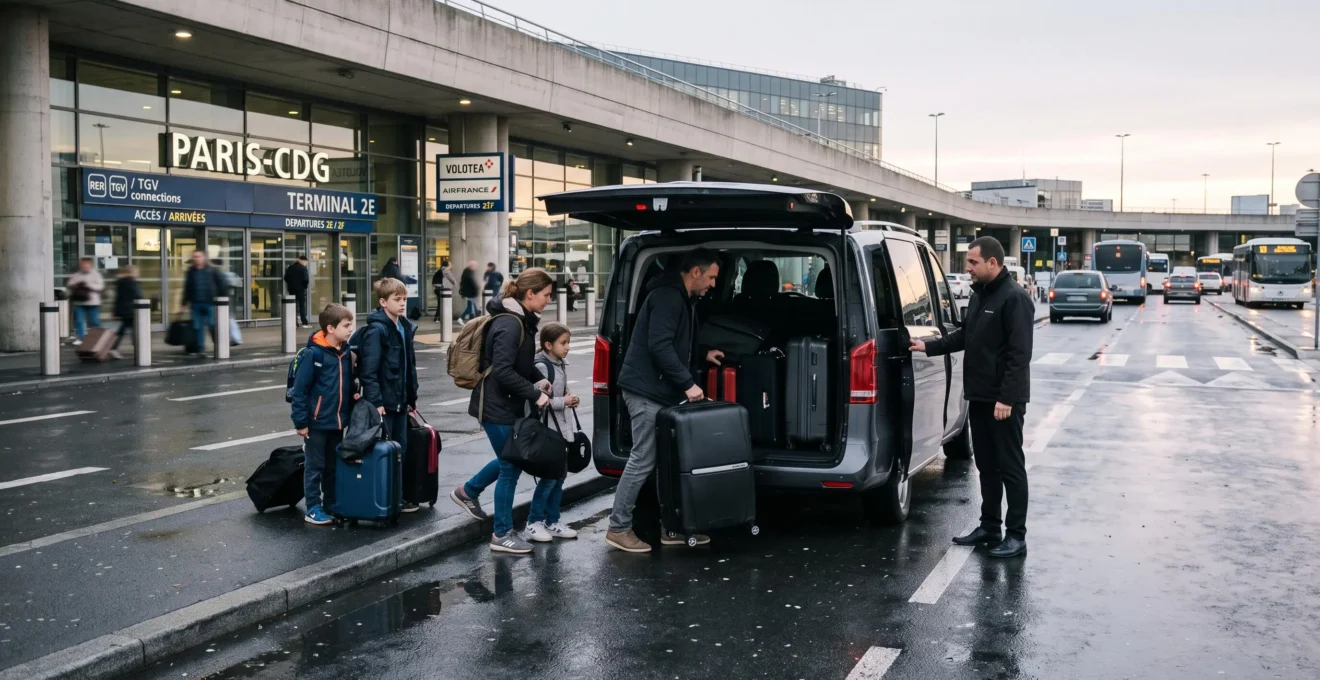
Organising a group transfer around Roissy Charles-de-Gaulle rarely comes down to price alone. Whether you are picking up relatives after a long-haul flight or shuttling clients between the airport and a business meeting, the real question is which minibus hire agency actually fits your group, your luggage and your schedule. The answer depends on a handful of concrete criteria: available fleet, licence rules, airport logistics and the match between vehicle and purpose.
This guide walks you through those criteria one by one, with a decision grid built around group size, luggage volume and the family-versus-corporate split. The goal is simple: help you decide with less uncertainty, before you book.
Direct answer: The best minibus hire branch at Paris-Nord Roissy CDG is the one that combines a fleet matching your group size (typically 7 or 9 seats), enough luggage room, airport delivery or pickup, and booking conditions compatible with your flight timings — not simply the lowest headline rate.
What should you look for in a minibus hire agency at Paris-Nord Roissy CDG?
Choosing the right minibus hire branch in Paris-Nord means looking beyond the advertised price to evaluate the fleet, airport logistics, booking conditions, and suitability of the vehicles for your journey. These criteria are particularly important when organizing group travel to or from Paris-Charles de Gaulle Airport (CDG), where passenger comfort, luggage capacity, and pickup arrangements can make a significant difference. Start by examining the available fleet. A minibus hire branch in Paris-Nord that offers several seating configurations, typically 7-seat and 9-seat vehicles, provides greater flexibility for families, business travelers, and larger groups. Depending on availability, options such as manual or automatic transmission can also help you choose a vehicle that suits your driving preferences. Having access to different vehicle sizes makes it easier to accommodate both passengers and luggage without compromising comfort.
Airport logistics are equally important. Before booking, check how the rental agency handles vehicle collection and return, whether its location is convenient for CDG transfers, and what arrangements apply to late arrivals or early departures. Clear information about deposits, mileage limits, insurance, and cancellation policies is another sign of a well-organized rental service.
Ultimately, the best minibus hire branch in Paris-Nord for your needs is one that combines an appropriate fleet with transparent rental conditions and practical access to the airport. By comparing these factors on an equal basis, you can identify a solution that matches your group size, travel schedule, and budget while making your journey through the Paris-Nord area more straightforward.
Then look at the practical side: can the vehicle be collected close to the terminals, or will your group need to drag suitcases across the city first? Booking conditions, opening hours and customer reviews round out the picture. The sheer scale of air traffic involved makes this logistical layer decisive: Paris Aéroport (CDG and Orly combined) passengers handled by Paris Aéroport (CDG and Orly combined) handled 107.0 million passengers in 2025, up 3.4% year on year, according to Groupe ADP traffic figures. Agencies that are organised for that volume tend to be more reliable at peak times.
Four criteria to compare before you book
- Fleet variety: at least two seating configurations available.
- Airport logistics: delivery, pickup or an agency close to the terminals.
- Booking clarity: visible conditions, opening hours and recent reviews.
- Vehicle-to-purpose fit: family comfort or corporate presentation.
Imagine a family of seven arriving at Terminal 2E with six large suitcases. Agency A offers a 9-seat minibus delivered to the airport parking; Agency B has a cheaper 7-seat van, but requires a shuttle ride to a suburban depot. On paper, Agency B wins on price. In practice, Agency A saves an hour of logistics and avoids the risk of leaving luggage behind.
Fleet, luggage capacity and driving licence requirements
Technical criteria are where most booking mistakes happen. The gap between a 7-seat and a 9-seat minibus looks small, but it changes everything once you add suitcases, child seats or professional equipment. Clarifying seats, luggage and licence rules upfront prevents last-minute surprises at the counter.
7 seats or 9 seats: which configuration fits your group?
A 7-seat minibus suits compact groups travelling with moderate luggage: four to six adults with a cabin bag each, for instance. A 9-seat version becomes necessary as soon as the group approaches eight people, or when luggage volume competes with passenger space. For a family of eight travelling with full-size suitcases, booking a 9-seat vehicle leaves one row that can be partly folded or kept for bags, rather than forcing a tight fit on every seat.

How much luggage really fits in a 9-seat minibus?
Luggage capacity in a 9-seat minibus depends on how many seats are actually occupied. With nine passengers on board, the dedicated boot is usually enough for cabin bags plus a few mid-size suitcases, but rarely for nine full-size cases. For airport transfers with heavy luggage, planning one empty seat row for bags is a common and realistic adjustment. Ask the agency for the boot volume and, if possible, for a photo of the rear compartment with the last row in place.
The table below summarises the typical trade-offs between the two most common configurations. It is a decision grid, not a technical specification: always confirm exact volumes with the agency.
| Criterion | 7-seat minibus | 9-seat minibus |
|---|---|---|
| Ideal group size | 4 to 6 passengers | 7 to 9 passengers |
| Luggage with full occupancy | Cabin bags + a few suitcases | Cabin bags + limited suitcases |
| Luggage with one row freed | Comfortable for a short break | Comfortable for a full family holiday |
| Driving licence (France) | Category B | Category B (up to 9 seats incl. driver) |
| Typical use | Small family, short corporate transfer | Large family, group of colleagues, clients |
Can you drive a 9-seat minibus with a category B licence?
Yes, within clear limits. According to official rules on category B vehicles, a category B licence allows you to drive a vehicle designed to carry people or goods with a maximum authorised weight (PTAC) of 3.5 tonnes and up to 9 seats including the driver. The Ministry of Education guidance on minibuses confirms the threshold: “C’est à partir de 10 places qu’un véhicule est considéré comme un véhicule de transport en commun.” In other words, from the 10th seat onwards, you move into the professional transport category, which requires a different licence.
Practical consequence: any minibus marketed as “9 seats including driver” is drivable with a standard French category B licence, provided the PTAC stays within 3.5 tonnes. Non-French licences should be checked individually with the agency.
Gearbox matters too. A manual transmission is often cheaper, but after a long-haul flight, an automatic can be a welcome comfort, especially in dense Paris-Nord traffic. If several people will share the driving, confirm that each driver is comfortable with the chosen setup.
Airport delivery and pickup: a decisive convenience factor
For a group arriving at Roissy CDG, the vehicle collection point often matters as much as the vehicle itself. An agency that can hand over the minibus close to the terminal — or in a dedicated airport zone — removes an entire layer of logistics: no shuttle to a distant depot, no splitting the group, no juggling with luggage trolleys across platforms.
The impact is particularly strong after a long-haul flight. Instead of waiting for a shuttle and then queuing at a city branch, your group loads directly into the vehicle and leaves. On the return leg, dropping the minibus off at a dedicated airport area means you avoid rush-hour detours before check-in. For families with young children, or for a corporate group travelling with equipment, that time saving is usually worth more than a modest price difference.
Before you book, ask three concrete questions: where exactly is the pickup point relative to the terminals, who meets the group on arrival, and what happens if the flight is delayed. A clear answer on all three is a reliable sign of an agency used to handling airport transfers.
Compare two realistic scenarios. In the first, a group of eight lands at Terminal 2F at 7 a.m., takes a shuttle to a city branch, waits for the counter to open, then drives back toward Paris-Nord — easily two hours lost. In the second, the same group collects a 9-seat minibus a few minutes from the terminal and is on the road within 30 minutes. The second option is rarely the cheapest line item, but it is almost always the most efficient for a group.
Matching the minibus to your trip: family holidays vs corporate transfers
Once the technical questions are settled, the final filter is use case. A family trip and a corporate transfer impose different priorities on the same vehicle, and the right choice reflects those priorities honestly.

Family holidays: space, comfort and child seats
For a family trip, the key criteria are usable space, luggage room and the possibility to install child seats. A 9-seat configuration with one or two seats freed for bags is often more comfortable than a tightly packed 7-seater. Ask whether the agency can provide child seats or boosters, and whether the sliding door is easy to operate for children and older relatives. For a two-week holiday with sports equipment or a pushchair, confirm roof storage or an extended boot option.
Corporate transfers: image, consistency and reliability
- Recent, clean vehicle that reflects well on the host company.
- Consistent model across repeated transfers for the same client.
- Comfortable seating for short meetings or calls on board.
- Enough room for cabin bags without stacking them on laps.
- A premium presentation usually costs more than a basic model.
- Availability of a specific model can be tight at peak periods.
- Automatic gearbox models may be fewer in the fleet.
For a corporate transfer, the vehicle is part of the client experience. A recent, well-maintained minibus with consistent interior finish sends a clearer signal than a cheaper van that looks tired. If you organise repeated transfers for the same client, ask whether the agency can guarantee the same model each time — consistency is itself a professional signal.
Specific uses: equipment, music, photo and video crews
Some groups need a minibus less for people than for gear. Photo and video crews, musicians or small production teams often travel with bulky, fragile cases. In these situations, a 9-seat configuration with a removable rear row usually works better than a nominally larger vehicle with fixed seats. Specify the type and dimensions of your equipment when you request a quote; a serious agency will tell you honestly whether their fleet is suitable.
Checklist for booking your minibus at Paris-Nord
Before confirming a reservation, a short structured check protects you from the three most common surprises: a vehicle that is too small, a pickup point that is too far, or booking conditions that do not match your flight schedule. The following steps apply equally to a family holiday and a corporate transfer.
- Confirm seats and luggageMatch the number of passengers and suitcases to the chosen configuration (7 or 9 seats). Ask for boot volume when all seats are occupied.
- Verify the driving licenceMake sure the main driver holds a category B licence valid for a 9-seat vehicle up to 3.5 tonnes PTAC. Check conditions for drivers with non-French licences.
- Check airport logisticsClarify the exact pickup and drop-off point near CDG, the handling of flight delays and the opening hours of the counter.
- Review booking conditionsRead the cancellation policy, mileage limits, fuel policy, insurance coverage and any additional driver fee before paying.
- Compare reviews and promotionsScan recent customer reviews for signals about vehicle condition and service. Check for promotional codes, but never let a discount override the fit of the vehicle.
Watch out for last-minute changes: if your flight is delayed into the night, confirm in writing that the agency can still deliver or receive the vehicle outside standard opening hours. A verbal agreement at booking is not enough.
For corporate transfers in particular, the vehicle you choose is part of the message your company sends to clients and partners. If you want to go deeper on that angle, this analysis of how your vehicle choice impacts corporate brand perception is a useful complement to the operational checklist above.
Can I drive a 9-seat minibus with a standard category B licence?
Yes, a French category B licence allows you to drive a vehicle with up to 9 seats including the driver, provided the maximum authorised weight stays at or below 3.5 tonnes. From the 10th seat onwards, the vehicle becomes a public transport vehicle and requires a different licence.
How many suitcases fit in a 9-seat minibus for an airport transfer?
With nine passengers on board, the dedicated boot usually accommodates cabin bags plus a limited number of mid-size suitcases. For a group travelling with full-size luggage, freeing one seat row for bags is often the realistic solution. Always confirm the exact boot volume with the agency.
Is it better to book an agency that delivers the minibus at CDG?
For most group transfers, yes. Collecting the vehicle close to the terminals removes shuttle rides and limits logistics after a long flight. It usually costs slightly more than a city branch but saves time and reduces stress, especially for families or corporate groups.
Which minibus should I book for a corporate transfer with clients?
Prioritise a recent, well-maintained vehicle with a clean interior and consistent presentation. A 9-seat minibus often offers more comfort than a tightly filled 7-seater, and a familiar model across repeated transfers reinforces a professional image.
Choosing a minibus hire branch at Paris-Nord Roissy CDG is less a question of brand than a sequence of concrete decisions: the right seat count for your group, enough luggage room for your trip, a licence that matches the vehicle, a pickup point that fits your flight, and a presentation that fits your use case. Work through those criteria in order, confirm each point with the agency before paying, and the booking stops being a bet and becomes a planned step of your trip.