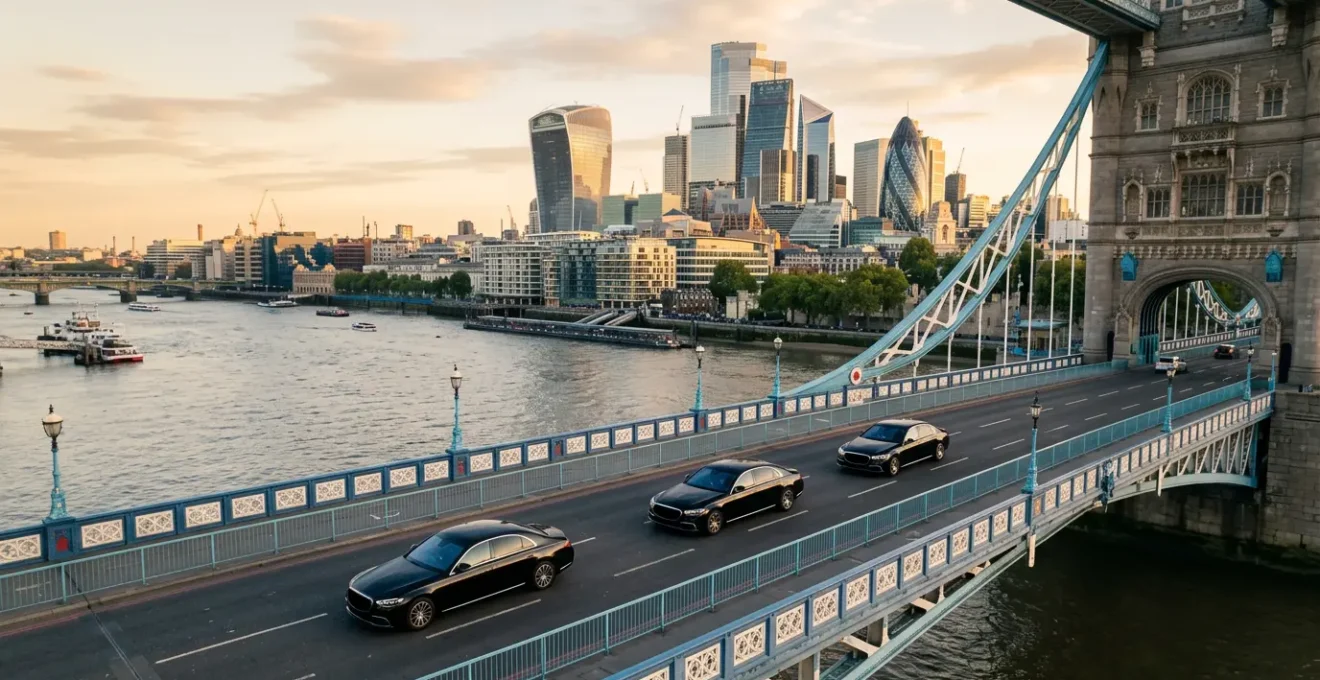
Executing a flawless IPO roadshow in London isn’t about luxury; it’s about eliminating every single point of logistical failure through military-grade precision.
- Coordination of multiple vehicles is a tactical operation, where a single delay creates a cascade effect that jeopardises the entire day.
- Vehicle choice, driver intelligence, and in-car privacy are non-verbal signals of your firm’s meticulousness and respect for the deal’s integrity.
Recommendation: Adopt a zero-failure protocol that treats transport not as a commodity, but as a critical, strategic function of the deal itself.
For the investment banker coordinating an IPO roadshow, the day is a high-wire act. Eight meetings across the City and Mayfair, with principals whose time is measured in thousands of pounds per minute. In this environment, transport is not a logistical footnote; it is the central nervous system of the operation. The common wisdom is to “plan ahead” and “book a professional,” but this advice dangerously underestimates the stakes. It ignores the brutal reality of London traffic, the critical need for absolute confidentiality, and the powerful semiotics of the vehicle you arrive in.
The conventional approach treats roadshow transport as a series of glorified taxi rides. This is a critical error in judgement. A 10-minute delay is not just an inconvenience; it’s a cascading failure that signals disorganisation to the very investors you need to impress. A casual conversation overheard by a driver can compromise a deal-sensitive valuation. The entire process demands a fundamental shift in perspective.
This guide reframes the challenge. Forget what you know about executive travel. The true key is to treat the roadshow as a logistical military operation conducted on civilian streets. It’s about implementing a zero-failure protocol where every variable is controlled, from convoy communication tactics to the driver’s intimate knowledge of a bank’s discrete side entrances. It’s a system designed to deliver principals to their marks on time, prepared, and secure, without a single exception.
We will deconstruct this protocol piece by piece, providing the actionable intelligence required to ensure your transport logistics become a source of strength, not a catastrophic point of failure.
Summary: How to Execute an IPO Roadshow with Zero Transport Failures?
- Why Keeping 3 Cars Together in London Traffic Is an Art Form?
- How to Ensure Deal-Sensitive Discussions Remain Private in the Car?
- The “Meeting Overrun” Protocol That Saves the Rest of the Day
- What Snacks and Stationeries Must Be in a Roadshow Car?
- Why Being Late by 10 Minutes Can Cost Your Firm £5,000 in Reputation?
- Why Does a Black Mercedes S-Class Signal “Authority” in Finance?
- Why Choose a Chauffeur Over a Black Cab for High-Stakes London Meetings?
- Why Your Driver Must Know the Side Entrances of City Banks?
Why Keeping 3 Cars Together in London Traffic Is an Art Form?
Coordinating a single executive vehicle through London is a challenge. Orchestrating a three-car convoy carrying the CEO, CFO, and key bankers is a tactical operation demanding military-grade precision. The primary threat is the ‘cascade failure’. Research on complex logistical events like roadshows confirms that a simple 10-minute delay before the first meeting can easily cascade to 30 minutes by lunchtime, creating an impression of chaos and disrespect. The goal is not just to get from A to B, but to maintain the integrity of the convoy as a single, cohesive unit, arriving and departing in perfect sync.
This is not achieved by simply telling drivers to “follow each other.” It requires a pre-defined communication and contingency protocol. The complexity is immense, as seen in major operations like the Uber IPO roadshow, which involved meticulous logistical planning across multiple global financial centres. The lead vehicle’s driver acts as the convoy commander, with the last vehicle’s driver as the second-in-command (2IC). All drivers must be on a dedicated, secure communication channel (like a closed group chat or radio) for real-time updates on traffic, route diversions, and timing adjustments.
The protocol must include pre-agreed-upon emergency procedures. For instance:
- Vehicle Breakdown: The affected vehicle immediately pulls over to a safe location. The 2IC’s vehicle stops with them to provide support, while the lead vehicle proceeds with the principals to the next meeting to maintain the schedule. Constant communication is maintained between the detached unit and the main convoy.
- Convoy Separation: If separated by traffic lights, the lead vehicles proceed to the next designated ‘safe stop’—a pre-planned, quiet side street—to regroup, rather than attempting risky manoeuvres in live traffic.
- Redundancy: Every vehicle must have printed paper directions and contact sheets as a non-negotiable backup to any digital system. Technology fails; the protocol must not.
Treating convoy coordination as an art form built on rigid protocols is the only way to mitigate the inherent chaos of London’s streets and project an image of absolute control.
How to Ensure Deal-Sensitive Discussions Remain Private in the Car?
During an IPO roadshow, the vehicle is an extension of the boardroom. Discussions about valuation, investor sentiment, and negotiation strategy are the norm. Ensuring these conversations remain completely confidential is not a luxury; it is a fundamental security requirement. A single leaked detail can compromise the entire offering. As experts from Diligent Corporation highlight in their analysis of IPO trends, “Ensuring the security and confidentiality of sensitive information during the IPO process is critical.” This extends beyond cybersecurity to the physical environment of the transport itself.
The selection of the vehicle is the first line of defence. A standard taxi or ride-share vehicle offers zero guarantee of privacy. A professional roadshow vehicle, such as a Mercedes S-Class or V-Class, must be equipped with specific features. The most critical are acoustic privacy glass and a retractable privacy partition between the driver and the passenger cabin. These are not for show; they are functional tools that create a secure ‘bubble’ for sensitive dialogue.
Beyond the physical hardware of the car, the ‘software’—the chauffeur—is equally important. A roadshow chauffeur is not a driver; they are a discreet professional bound by a non-disclosure agreement (NDA) as a standard part of their contract. They are trained to be invisible and inaudible. Their focus is on the road and logistics, not the conversation in the back. The protocol is clear: the driver does not initiate conversation with principals, and the intercom is only ever used by the passengers to communicate instructions. This creates an environment of guaranteed discretion, allowing executives to seamlessly transition from one high-stakes meeting to the next without breaking their strategic dialogue.
The “Meeting Overrun” Protocol That Saves the Rest of the Day
In the world of IPO roadshows, the schedule is sacrosanct. However, one of the most common and disruptive variables is the ‘meeting overrun’. A positive investor meeting can easily extend by 15 minutes, which, without a protocol, can derail the subsequent four appointments. This is particularly critical in the final execution phase of an IPO, where timelines are compressed and regulatory deadlines loom. A delay isn’t just a delay; it’s a direct threat to a schedule where, at a macro level, things like the 134-day deadline for financial statements can cause significant issues if milestones are missed.
A robust “Meeting Overrun” protocol is therefore not reactive, but proactive. It begins with the initial itinerary planning. The coordinator must work with the chauffeur service to build in ‘buffer zones’ and alternative routes for every leg of the journey. The protocol is activated by a single point of contact—the roadshow coordinator—who is in constant communication with both the executive team on the ground and the chauffeur team.
The protocol operates as follows:
- Immediate Notification: The moment an overrun is likely, the lead executive’s assistant notifies the coordinator.
- Dynamic Re-routing: The coordinator relays the new departure time to the lead chauffeur. The chauffeur team immediately reassesses the route to the next destination, leveraging live traffic data to see if the planned buffer is sufficient or if an alternative route is required.
- Next-Party Notification: The coordinator contacts the team at the *next* meeting, providing a precise, updated ETA. This is not an apology, but a professional adjustment, managing expectations and demonstrating control over the schedule.
- Continuous Assessment: This process is repeated throughout the day, with the coordinator and chauffeur team functioning as a central command unit, constantly adjusting logistics to absorb delays and keep the overall roadshow on track.
This structured approach replaces panic with a clear chain of command and action. It acknowledges the fluid nature of high-stakes meetings while imposing a system of control that protects the integrity of the day’s remaining schedule.
What Snacks and Stationeries Must Be in a Roadshow Car?
The contents of a roadshow vehicle are not about comfort; they are about maintaining peak performance of the executive team throughout an intensely demanding day. When the success of a roadshow can lead to a result like Reddit’s IPO, which saw a 48% day-one increase in share price, every detail that supports the presenting team matters. Forgetting a crucial document or having a principal suffer from low energy before a key meeting is an unforced error that a zero-failure protocol makes impossible. The vehicle must be stocked not like a minibar, but like a mobile forward operating base.
The required inventory falls into two categories: performance sustenance and operational equipment. These items should be confirmed via a checklist with the chauffeur service 24 hours in advance.
Performance Sustenance:
- Water: Still and sparkling, always at room temperature. Cold water can constrict vocal cords.
- High-Quality Snacks: Avoid sugary items that cause energy crashes. Focus on protein bars, unsalted nuts, and perhaps some dark chocolate. The goal is stable energy.
- Mints: Not gum. Mints are more discreet before entering a meeting.
- Tissues and Hand Sanitizer: Basic but essential for maintaining composure and hygiene.
Operational & Stationery Equipment:
- Wi-Fi Hotspot: A dedicated, high-speed, and secure in-car Wi-Fi connection is non-negotiable for last-minute presentation tweaks or market checks.
- Multi-Port Charging Cables: A selection of USB-C, Lightning, and Micro-USB cables to charge all team devices.
- A4 Notepad and Pens: High-quality, reliable black ink pens (at least three) and a crisp notepad for urgent notes.
- Printed Itineraries: A hard copy of the day’s schedule, including addresses, contact names, and phone numbers, for every principal.
- Stapler and Paperclips: For collating any last-minute printed documents.
These items are not amenities. They are the essential toolkit that enables an executive team to remain focused, energised, and operationally effective between meetings, directly contributing to the flawless execution of their pitch.
Key Takeaways
- An IPO roadshow is a high-stakes logistical operation where transport failure translates directly to reputational and financial cost.
- Success requires a zero-failure protocol that controls every variable, from multi-car convoy coordination to the non-verbal signals sent by vehicle choice.
- Driver expertise, specifically their intimate knowledge of financial district geography and commitment to discretion, is a critical strategic asset, not a commodity service.
Why Being Late by 10 Minutes Can Cost Your Firm £5,000 in Reputation?
In the context of an IPO roadshow, time is not just money; it is a direct reflection of competence and respect. While it’s difficult to assign a precise number, a £5,000 reputational cost for a 10-minute delay is a conservative estimate of the damage. This figure isn’t about a direct financial penalty. It represents the erosion of investor confidence. Investors are being asked to trust the management team with hundreds of millions of pounds. If that team cannot manage its own schedule, it raises a significant red flag about their ability to manage a complex public company.
Punctuality is a proxy for meticulousness. Arriving late signals disorganisation, a lack of preparation, and a fundamental disrespect for the investor’s time. This initial negative impression can colour the entire meeting, forcing the executive team to start on the defensive. The first 10 minutes are spent apologising and rebuilding credibility, rather than building a compelling investment case. This is a subtle but powerful psychological disadvantage in a high-stakes negotiation.
The downstream consequences are even more severe. A roadshow is about building momentum and confidence. A reputation for being disorganised can spread quickly within the tight-knit investment community. This can lead to reduced engagement, lower demand for the shares, and ultimately, a weaker valuation. The link between perception and financial reality is direct; post-IPO, companies that fail to meet expectations can face severe consequences. In fact, recent IPO market analysis shows a nearly 40% stock price decline following a company’s first disappointing earnings report. The seeds of that disappointment can be sown by the perception of incompetence established during the roadshow, starting with something as simple as a 10-minute delay.
Therefore, the cost of being late is not a hypothetical risk. It is a tangible liability that undermines the very purpose of the roadshow: to build maximum investor confidence and secure the highest possible valuation for the company.
Why Does a Black Mercedes S-Class Signal “Authority” in Finance?
The choice of vehicle for an IPO roadshow is a calculated act of non-verbal communication, or semiotics. In the financial districts of London, a black Mercedes-Benz S-Class is not just a luxury car; it is a universally understood symbol. It signals professionalism, substance, and meticulous attention to detail. As one London chauffeur service specializing in corporate roadshows notes, “Arriving at a high-profile investor meeting in a pristine, late-model Mercedes-Benz S-Class… silently communicates to prospective partners that your firm values punctuality, quality, and meticulous attention to detail.” It projects an image of stability and authority before a single word is spoken.
This is not about extravagance. A flashy, brightly coloured sports car would signal recklessness and poor judgement. A standard saloon or taxi would signal a lack of importance or a cost-cutting mentality, which can be interpreted as a lack of confidence in the offering. The S-Class, or its equivalent like the BMW 7 Series, occupies a specific niche. It represents the pinnacle of corporate sophistication without being ostentatious. It is the uniform of the global business elite, and adhering to this code shows you understand the rules of the game.
The choice of vehicle also extends to the rest of the team. While principals occupy the sedans, the supporting team of analysts and associates often travels in a Mercedes V-Class or a discreet Sprinter. This maintains a consistent standard of quality and professionalism across the entire delegation. The entire convoy moves with a singular, unified aesthetic of serious purpose.
The following table breaks down the strategic use of different vehicles within a roadshow fleet:
| Vehicle Type | Capacity | Best Use Case |
|---|---|---|
| Mercedes S-Class | 3-4 executives | The epitome of corporate sophistication |
| BMW 7 Series | 3-4 executives | Luxury paired with advanced business tech features |
| Mercedes V-Class | 6-7 team members | Ideal for small corporate groups |
| Mercedes Sprinter | 12 passengers | Perfect for team transport during large roadshows |
Ultimately, the vehicle is the first handshake with a potential investor. Choosing a black S-Class is a deliberate strategic decision to ensure that first impression is one of unwavering authority and competence.
Why Choose a Chauffeur Over a Black Cab for High-Stakes London Meetings?
For a tourist, a black cab is an iconic London experience. For a high-stakes IPO roadshow, relying on one is an act of gross negligence. The difference between a professional chauffeur service and hailing a cab is the difference between a controlled, strategic operation and a game of chance. A black cab offers a ride from A to B. A roadshow chauffeur service provides a comprehensive logistical support system engineered for zero failure. This isn’t about luxury; it’s about eliminating variables in an environment that has no margin for error.
A black cab driver’s job ends at the destination. A chauffeur’s job is to execute a pre-planned mission. They operate under a strict protocol that covers every contingency. This includes proactive monitoring of Transport for London (TfL) and National Highways alerts to route around disruptions before they become a problem. The driver receives a detailed brief with postcodes, building access notes, and the mobile number for the contact person at each meeting. They are not just a driver; they are an extension of the roadshow coordinator’s team on the ground.
Furthermore, discretion is not guaranteed with a public hire vehicle. A chauffeur, especially one experienced in financial roadshows, operates under a signed NDA. They are trained for absolute discretion, ensuring that sensitive conversations about the deal remain secure within the vehicle. This level of trust and professionalism is impossible to guarantee with a random driver. The entire service is built around a single point of contact at the dispatch office, providing the coordinator with a direct line to the entire on-the-ground operation, allowing for real-time adjustments with one call.
Action Plan: Key Protocols of a Professional Chauffeur Service
- Briefing and Itinerary: The service must confirm receipt and understanding of a detailed, timed schedule with planned buffers and specific door-to-door routing instructions.
- Driver Intelligence: Drivers must receive a comprehensive brief including all postcodes, on-site contact persons, security access notes, and pre-vetted parking instructions for each location.
- Contingency Planning: The service must operate with tight time windows, pre-planned buffers for delays, and a single point of contact at dispatch for immediate schedule adjustments.
- Real-Time Monitoring: The dispatch team actively monitors TfL and National Highways data to dynamically re-route the convoy around traffic, accidents, or public transport disruptions.
- Positional Awareness: The service must provide live position checks on demand, and briefs (printed or digital) should include points of interest and security contacts for each stop.
Choosing a chauffeur is not an expense; it’s an investment in control, security, and the flawless execution of the roadshow’s most critical component: getting the right people to the right place, at the right time, in the right state of mind.
Why Your Driver Must Know the Side Entrances of City Banks?
In the high-stakes theatre of an IPO roadshow, the arrival is a critical scene. Pulling up to the main, congested entrance of a City bank, caught in a scrum of taxis and delivery vans, projects chaos. A seamless arrival at a discrete, pre-vetted side entrance projects control and insider knowledge. This is why a chauffeur’s ‘venue intelligence’—their intimate, street-level knowledge of the financial district’s geography—is a priceless strategic asset. As one leading service states, “Between pitching to high-net-worth investors in Mayfair, attending board meetings in the City of London, and finalising corporate agreements in Canary Wharf, there is zero margin for error.” That margin for error is often found and eliminated in the final 50 meters of the journey.
A top-tier financial roadshow chauffeur knows more than just the address. They know:
- The location of the less-congested side or rear entrances used for executive drop-offs.
- The specific drop-off points that offer weather protection.
- The security protocols at each building and how to communicate with them for smooth access.
- The nearest safe and legal waiting points for the vehicle between meetings.
This level of granular knowledge is not learned from a GPS. It is acquired over years of dedicated service in the financial sector. This is why London’s top chauffeur services require at least 5 years of experience for their financial roadshow specialists. They are not just navigating a map; they are navigating a complex ecosystem of power, security, and unwritten rules.
This expertise ensures a smooth, efficient, and impressive transition from the vehicle to the meeting room. It saves precious minutes, avoids unnecessary stress, and allows the principals to exit the vehicle calm, collected, and focused on the pitch ahead. The image of a CEO stepping effortlessly from a pristine S-Class directly into a quiet reception, bypassing the main lobby’s tumult, is a powerful non-verbal statement. It says, “We belong here. We know how this world works.”
The success of your IPO depends on flawlessly executing every detail. Begin by implementing this zero-failure transport protocol as a non-negotiable standard for all future roadshows.