The fear of motorway traffic causing you to miss your cruise ship is a valid concern, but it’s entirely preventable. The solution isn’t to simply ‘leave early,’ but to treat your transfer as a precise logistical operation. By building a structured time buffer and understanding the specific chokepoints at UK ports like Southampton, Dover, and Portsmouth, you can transform anxiety into a calm, controlled, and guaranteed on-time arrival.
The single greatest fear for any cruise passenger is the vision of their ship sailing away without them. This anxiety peaks during the transfer, that crucial land-based journey where you are at the mercy of unpredictable motorways. Many travellers believe the answer is to book a taxi and hope for the best, relying on generic advice like “leave a bit of extra time.” This is a recipe for stress and potential disaster. The reality of UK traffic, especially on routes like the M25 and M3 leading to Southampton, demands a more robust strategy.
The key is a shift in mindset. Your transfer is not a simple A-to-B journey; it is the final, critical phase of your holiday’s logistical plan. Success doesn’t hinge on luck, but on proactive, meticulous planning. It involves quantifying risks, understanding port-specific procedures, and communicating with military precision. Forget hope; we are dealing in certainties.
This guide moves beyond vague suggestions. We will dismantle the journey from airport curbside to your cabin, providing a systematic framework to manage time, luggage, and group travel. We will reveal the common mistakes drivers make at Dover’s complex gates and the exact pickup protocols at Portsmouth. By adopting the methods of a professional transfer specialist, you will not only guarantee your arrival before the gangway closes but do so with the calm assurance that everything is under control.
This article provides a detailed operational plan for your UK cruise transfer. Follow this structured approach to navigate every step of the journey with confidence.
Summary: Your Foolproof Guide to UK Cruise Port Transfers
- Why You Need a 4-Hour Buffer for Heathrow to Southampton Transfers?
- Curbside to Cabin: How to Handle Luggage Handover at the Cruise Terminal?
- Minibus or Multiple Cars: Which Is Better for a Family Reunion Cruise?
- The Terminal Gate Mistake That Drivers Make at Dover
- When to Book Your Pickup: The Reality of Customs Delays Upon Return
- How to Note “Porter Service Required” on Your Chauffeur Booking?
- Where Are the cleanest Service Stations on the M1?
- Where Exactly Will Your Chauffeur Wait at Portsmouth International Port?
Why You Need a 4-Hour Buffer for Heathrow to Southampton Transfers?
The most dangerous piece of information for a Heathrow to Southampton transfer is the “average” journey time. While data suggests a typical trip might take just 84 minutes under ideal conditions, relying on this figure is the number one cause of pre-cruise panic. A professional approach discards the “best-case scenario” and instead builds a non-negotiable time buffer. For this specific route, a four-hour buffer is not a luxury; it is the minimum professional standard for guaranteeing a stress-free arrival.
This buffer is not arbitrary. It is a calculated asset, divided into four distinct components. First, allocate 90-120 minutes for the base travel time. Next, add a mandatory 60 minutes for the “Congestion Tax”—the inevitable delays on the M25 and M3 motorways. This isn’t a possibility; it’s a certainty that must be paid in time. Then, add a further 30 minutes for an unpredictable incident buffer, covering anything from accidents to sudden weather changes. Finally, a 60-minute port-side safety net is crucial. This last hour is for navigating the port itself, handling luggage drop-off, and completing check-in procedures without rushing.
Thinking in these structured blocks transforms your understanding of the journey. You are no longer “leaving early” but are actively mitigating specific, identified risks. This system ensures that even with significant traffic, you arrive at the terminal calm and in control, with ample time to begin your holiday. Anything less than a four-hour buffer is not planning; it is gambling.
Curbside to Cabin: How to Handle Luggage Handover at the Cruise Terminal?
Once you arrive at the port, the first critical logistical step is the luggage handover. This is not a simple drop-and-go process; it is a transfer of responsibility that requires precision. The objective is to establish a clear chain of custody from your vehicle to the ship’s porters, ensuring nothing is lost or delayed. Each of Southampton’s four main cruise terminals has a slightly different layout, and your driver must know the exact procedure for the one you are sailing from. It is your responsibility to provide this information clearly at the time of booking.
For example, a study of the port’s logistics shows that the Mayflower Terminal has dedicated luggage drop-off lanes that are physically separate from the passenger drop-off zones. In contrast, the modern Ocean Terminal features clearly marked porter stations right at the entrance. City Terminal, being more compact, has tighter luggage areas that demand very precise coordination between driver and porters. An inexperienced driver might drop you in a general area, causing confusion and forcing you to move heavy bags yourself. A professional chauffeur will know to proceed directly to the correct luggage bay for your specific terminal and ship.
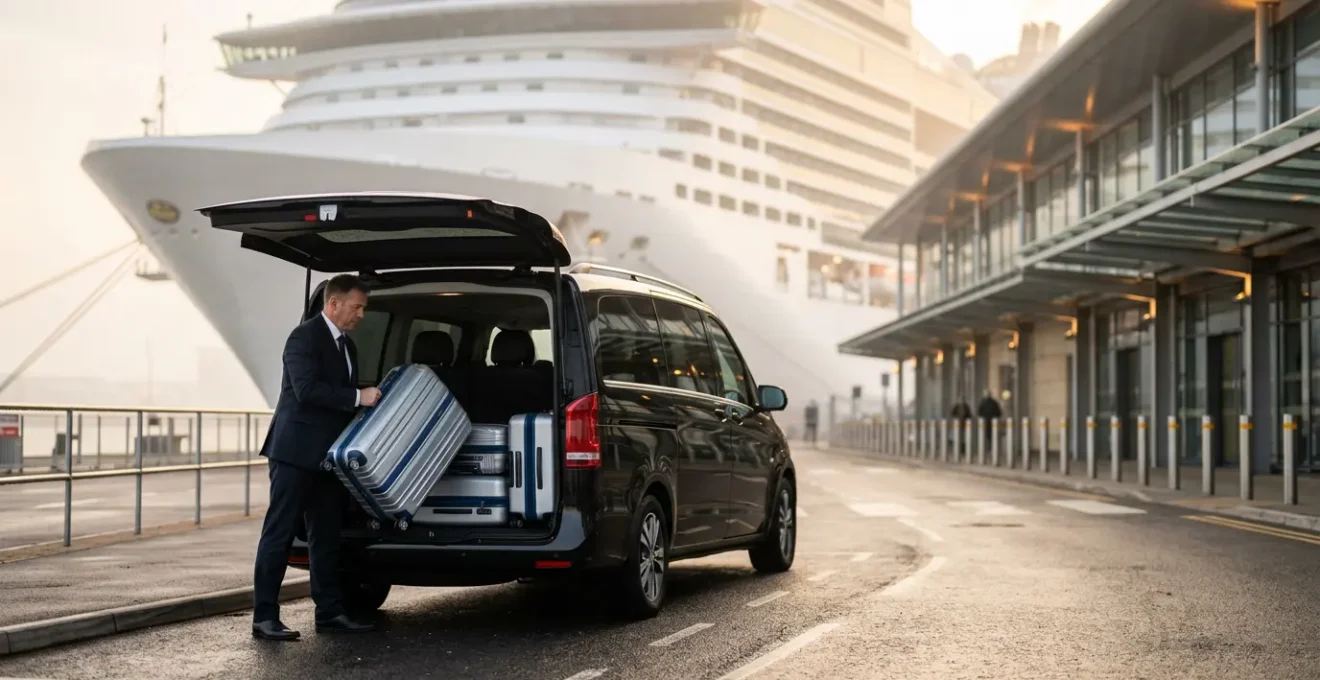
As the image illustrates, the handover is a precise moment. Your role is to ensure all bags are correctly tagged with the cruise line’s labels *before* you arrive. Upon arrival, wait for the official port porters to approach your vehicle. They are easily identifiable by their uniforms. Point out every piece of your luggage to them and watch as they take it. Only once you have a visual confirmation that all your bags are with the porters should you proceed to the check-in hall. Do not leave your luggage unattended on the curb under any circumstances.
Minibus or Multiple Cars: Which Is Better for a Family Reunion Cruise?
When travelling with a large group for a family reunion or celebration, the choice of vehicle is a strategic decision with significant risk management implications. The question is not just about cost or comfort, but about balancing coordination complexity against potential points of failure. The two primary options—a single large minibus or a convoy of multiple smaller cars—present very different risk profiles. A minibus offers simplified logistics but represents a single point of failure: if it’s delayed, everyone is delayed. Multiple cars introduce coordination challenges but provide built-in redundancy; a problem with one car doesn’t necessarily impact the entire group.
To make an informed decision, you must analyse the factors beyond the price. The following matrix, based on professional transfer logistics, breaks down the key considerations.
| Factor | Single Minibus (up to 16 passengers) | Multiple Cars (4-5 per vehicle) |
|---|---|---|
| Coordination Complexity | Simple – single point of contact | Complex – requires convoy management |
| Risk Profile | Single point of failure | Built-in redundancy |
| Luggage Capacity | Generous shared space | May require careful distribution |
| Cost Structure | Single fixed price | Multiple bookings, potential savings |
| Flexibility | All travel together | Groups can split if needed |
If you opt for the built-in redundancy of multiple cars, you must implement a “Coordinated Independence” strategy to prevent chaos. Designate a lead car, preferably with the most experienced traveller. All drivers and key passengers should use a shared location app like WhatsApp Live Location. Pre-set a regrouping point just before the terminal entrance to ensure you all arrive together. Finally, assign luggage to specific cars in advance and share all driver contact details across the group. This proactive management turns a potential logistical nightmare into a flexible and resilient travel plan.
The Terminal Gate Mistake That Drivers Make at Dover
While Southampton is the UK’s largest cruise port, Dover presents a unique navigational challenge that frequently traps inexperienced drivers, costing precious time. The Port of Dover operates a dual-system layout for ferries and cruise ships, and the signage can be deeply confusing. The critical mistake is failing to distinguish between the Eastern Docks (Ferry Terminal) and the Western Docks (Cruise Terminals). Standard GPS systems, often defaulting to the most common destination, will almost always direct drivers to the main ferry port.
Following this incorrect guidance leads to a significant detour. Analysis of a common navigation error at Dover shows that drivers who miss the specific, less obvious turn-off for the cruise terminals from the A20 are forced into a 15-20 minute loop through Dover’s congested town centre to get back on track. On a cruise day, with tight embarkation windows, this is an unacceptable loss of your time buffer. You must be proactive in preventing this. When booking, and again when the driver arrives, you must give explicit instructions.
Professional transfer guidelines provide the exact terminology needed to ensure clarity. As one guide from Southampton Cruise Terminal Guide states, this communication is non-negotiable:
Specifically tell your driver to head for ‘Western Docks, Cruise Terminal 1/2’ and to ignore any GPS that tries to route them into the main ferry port entrance
– Professional Transfer Guidelines, Southampton Cruise Terminal Guide
This single piece of communication is your primary tool for mitigating this specific risk. Do not assume your driver knows the difference. State the destination clearly: “Western Docks, Cruise Terminal.” It is a simple instruction that can save you from a stressful and entirely avoidable delay.
When to Book Your Pickup: The Reality of Customs Delays Upon Return
Planning your return transfer from the cruise terminal requires managing a major uncertainty: disembarkation time. Unlike your departure, where schedules are fixed, the time you actually walk out of the terminal can vary dramatically. Depending on the ship’s size, its arrival time, and the number of passengers, disembarkation can range from a swift 30 minutes to over two hours. Booking a chauffeur for a fixed time is a gamble; if you’re delayed, you risk extra waiting-time charges, and if you’re early, you’re left waiting. The professional solution is not a fixed time, but a flexible communication protocol.
Instead of guessing a pickup time, agree on a baseline with your driver (e.g., ship docking time + 90 minutes) and then implement a mandatory 3-Message Communication System. This keeps your driver informed in real-time and allows them to adjust their arrival, saving you money and stress. This system is a non-negotiable part of a professional transfer service. Before booking, confirm your driver’s grace period and any potential waiting time charges to ensure there are no surprises.
This proactive communication turns an unpredictable situation into a managed process, ensuring your driver is there precisely when you need them.
Action Plan: The 3-Message Communication System for Disembarkation
- Message 1: Text your driver as soon as you wake up on the ship. Provide your estimated disembarkation time based on the ship’s announcements.
- Message 2: Send an update text when you physically join the immigration queue. Include a rough estimate of the queue length (e.g., “Joining immigration queue, looks about 30 minutes long”).
- Message 3: Make a final call or text to your driver only after you have collected all of your luggage and are walking towards the terminal exit.
How to Note “Porter Service Required” on Your Chauffeur Booking?
Effective communication is the bedrock of a smooth transfer, especially when you have specific needs. Simply writing “need help with bags” in a booking form is insufficient and can lead to misunderstandings. If you or a member of your party has limited mobility or is travelling with an excessive number of bags, you must request porter service with precision. The goal is to provide the chauffeur company with a clear, actionable brief so they can prepare accordingly. This may involve the chauffeur assisting directly or coordinating with the official port porters upon arrival.
To ensure your needs are met, use the P.A.L. Method when making your booking. This structured approach removes ambiguity and provides a comprehensive picture of your requirements. It distinguishes between the need for simple luggage handling and genuine mobility assistance, allowing the service provider to allocate the right resources. This level of detail is a hallmark of a well-planned journey and demonstrates your commitment to a seamless operation.
The P.A.L. Method for clear communication is as follows:
- Pieces: Specify the exact number of all bags and distinct items. (e.g., “4 large suitcases, 2 carry-on bags, 1 garment bag”).
- Awkwardness/Dimensions: Detail any unusual, heavy, or oversized items. (e.g., “…plus 1 large ski bag and a box of medical equipment”).
- Lifting Assistance: Clearly state any mobility requirements. (e.g., “Passenger uses a walker and cannot lift any bags. Assistance is required from the car to the terminal entrance.”).
This level of detail ensures there are no surprises on the day. It also helps distinguish between a request for the chauffeur’s help with bags versus the need to ensure official terminal porters are engaged, a critical distinction for managing expectations and ensuring a safe, dignified transfer for passengers with mobility challenges.
Where Are the cleanest Service Stations on the M1?
The title of this section is a deliberate misdirection. When you are on a time-critical transfer to a cruise port, the cleanliness or amenities of a motorway service station are irrelevant. The only metric that matters is efficiency. A scheduled stop for a break or to use the facilities must be treated as a strategic “Buffer Consumption Checkpoint,” not a leisurely pause. Some service stations are designed for quick entry and exit, while others are “time-traps” designed to make you spend time and money.
An analysis of service stations on key cruise routes highlights this difference. Fleet Services on the M3, for example, is a functional stop with easy motorway access, allowing for an average stop time of just 12 minutes. In contrast, Beaconsfield on the M40, while having superior facilities, is a known time-trap with its sprawling shopping-complex layout, where a “quick stop” can easily stretch to 25 minutes or more. For a cruise transfer, the functional station is always the superior strategic choice. The 10-15 minutes saved by avoiding a time-trap are a valuable deposit back into your incident buffer.
Therefore, your strategy for service station stops must be disciplined:
- Choose stations based on their exit and re-entry efficiency, not their brand-name coffee shops.
- Use the stop as a communication checkpoint to update any other cars in your party on your ETA.
- While stopped, use a live traffic app to check conditions for the route ahead.
- Strictly limit the stop to a maximum of 15-20 minutes.
- Pre-identify a backup service station in case your primary choice appears congested from the motorway.
Key Takeaways
- Adopt a logistical mindset: your transfer is an operation, not a taxi ride.
- The 4-hour buffer for Heathrow-Southampton is a non-negotiable, structured safety net.
- Communication is a tool: use specific language for port navigation, special needs, and disembarkation coordination.
Where Exactly Will Your Chauffeur Wait at Portsmouth International Port?
While smaller than Southampton, Portsmouth International Port has its own logistical quirks that can lead to confusion and delays if not managed proactively. The primary challenge is that the port serves both cruise and ferry passengers, with pickup points that can be easily mixed up. The official drop-off and pick-up zone, located directly outside the main terminal building, becomes extremely congested on cruise days. This chaos makes finding your specific driver a stressful experience.
To avoid this, experienced professional drivers often bypass the main congested area. They will suggest an alternative, unofficial meeting point, such as the exit of the short-stay car park or near the pedestrian crossing. This allows for a much smoother and faster pickup. However, this only works if there is crystal-clear communication between you and your driver *before* you exit the terminal. You must have their mobile number and they must have yours.
The most critical point of confusion is confirming the exact terminal. A driver saying they are “at the terminal” could mean the ferry terminal or the cruise terminal. As official guidance from Portsmouth Port Transfer Guidelines highlights, you must seek absolute clarification:
Confirm with your driver whether they mean the cruise terminal pick-up point or the main ferry terminal building pick-up, as they are distinct and can cause confusion
– Portsmouth Port Transfer Guidelines, Professional Transfer Services Documentation
Upon disembarking, do not wander around looking for your driver. Stay inside the terminal, call your driver, and ask for their exact location, confirming landmarks. “I am at the exit of the short-stay car park, by the payment machine” is a clear instruction. “I am outside” is not. Taking control of this final communication ensures your journey ends as smoothly as it began.
By implementing these professional-grade protocols, you are not just buying a transfer; you are executing a plan. You are taking control of every variable possible to ensure that your holiday begins and ends not with a frantic rush, but with the calm confidence that comes from meticulous preparation. To apply this new mindset effectively, consider getting a personalised logistics plan for your next cruise transfer.