Successfully managing delegate transport is not about booking coaches; it’s about designing a frictionless, cost-controlled mobility system that enhances the event experience.
- Master cost control by blending “per hour” models for core movements with “per seat” options for flexibility, avoiding hidden fees for idle time.
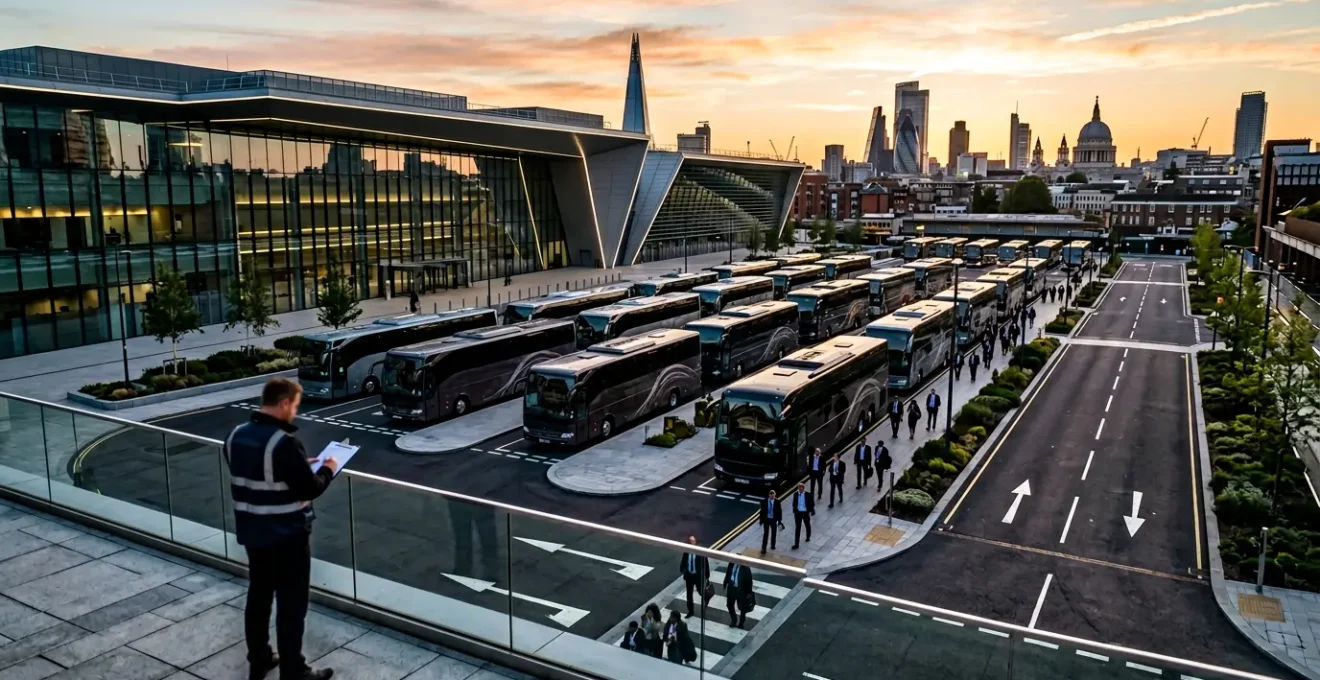
- Eliminate arrival chaos and venue queues by implementing a “virtual staging” protocol at the ExCeL coach park, calling vehicles in sequentially.
Recommendation: Implement a “Bus Captain” system—nominating one delegate per vehicle for headcounts—and a clear straggler protocol to ensure no attendee is ever left behind.
The moment 50 international delegates step off their planes for your conference at ExCeL London, your event has already begun. Their journey from Heathrow, their first impression of the shuttle, the wait at the venue door—these are not logistical afterthoughts; they are critical touchpoints that define the delegate experience. The smooth running of your entire congress can hinge on the perceived professionalism of these initial and final moments. For a seasoned MICE manager, the challenge is not simply booking a coach.
Many organisers stop at securing a vehicle and sending out a schedule. They focus on the ‘what’—coaches, timings, pickup points. However, this often leads to classic pain points: chaotic queues during arrival peaks, budget blowouts from unforeseen delays, a disjointed brand experience, and the dreaded “Keynote Finish” rush that leaves delegates feeling like cattle. The real task is to graduate from simple transport booking to sophisticated operational choreography. It’s about designing a complete mobility system that anticipates human behaviour and proactively eliminates every point of delegate friction.
This guide moves beyond the basics. We will not tell you to “book in advance.” Instead, we will deconstruct the strategic decisions a professional transport manager makes. The key is to shift your perspective: delegate transport is not a cost centre to be minimised, but a strategic tool that can be branded, sponsored, and precisely controlled to amplify the success of your event. We will explore the trade-offs between fixed and flexible services, the nuances of VIP handling, and the on-the-ground tactics required to master the unique environment of ExCeL London.
This operational playbook provides the frameworks and tactical protocols to transform your delegate transport from a potential liability into a seamless, memorable, and controlled part of your event’s success story. Explore the sections below to master each component of this vital system.
Summary: A Strategic Playbook for ExCeL Delegate Transport
- Loop Service vs On-Demand: Which Works for Flexible Congress Schedules?
- How to Add Corporate Branding to Delegate Shuttles?
- The “Keynote Finish” Rush and How to Manage the Exit Surge
- Segregating VIP Speakers from General Delegates Without Offense
- Per Seat or Per Hour: How to Control Congress Transport Costs?
- Staggered Arrivals vs Convoy: Preventing a Queue at the Venue Door
- How to Get from Terminal 3 to Terminal 5 in Under 20 Minutes?
- How to Move 20 Guests to a Country Wedding Without Losing Anyone?
Loop Service vs On-Demand: Which Works for Flexible Congress Schedules?
The foundational decision in your transport strategy is the service model. A continuous loop service, where shuttles run a fixed route between hotels and ExCeL at set intervals, offers predictability and high efficiency. It’s the workhorse for moving large numbers of people during predictable peak times, like the morning arrival for the opening session. Its strength is its simplicity and ability to achieve high vehicle utilisation, keeping per-delegate costs down during these core hours. However, its rigidity is its weakness. For a congress with multiple breakout tracks and flexible delegate schedules, a fixed loop can lead to empty buses running off-peak or frustrated delegates facing long waits.
Conversely, an on-demand model, using pre-booked cars or ride-sharing vouchers, offers ultimate flexibility. This is ideal for off-peak movements, airport transfers for speakers arriving at odd hours, or for delegates who value independence. While this eliminates wait times, it can become prohibitively expensive if used as the primary mode of transport, with industry data showing that the average per-delegate transport cost for corporate events can quickly escalate. The management overhead of coordinating dozens of individual trips also introduces complexity and potential points of failure.
The optimal solution for a modern congress is rarely one or the other, but a hybrid “Core & Flex” model. Utilise a fixed-loop shuttle service for the 90-minute peak windows at the start and end of each day. For the rest of the day, supplement this with an on-demand solution, such as a block booking of executive cars stationed at the venue or pre-paid vouchers with a preferred provider. This model provides cost-effective mass transit when you need it and personalised flexibility when you don’t, optimising both budget and the delegate experience.
Ultimately, mapping your event’s critical arrival and departure windows against delegate groups will reveal the most effective and cost-efficient transport architecture for your specific needs.
How to Add Corporate Branding to Delegate Shuttles?
Delegate shuttles are more than just a means of transport; they are high-visibility mobile billboards and a crucial extension of your event’s brand identity. Treating them as a generic, unbranded utility is a missed opportunity. Effective branding transforms the journey into a cohesive part of the event experience, starting from the moment a delegate steps on board. The key is to match the branding method to your event’s scale, budget, and lead time. This can range from simple, cost-effective solutions to high-impact, immersive takeovers.
For last-minute events or tighter budgets, magnetic signs on the vehicle’s exterior and dashboard cards with the event logo and transport coordinator’s contact number provide essential identification and a professional touch. A step up involves interior branding like custom headrest covers, which create a consistent visual environment for the delegate. For a more tech-savvy audience, a branded Wi-Fi splash page or looping sponsor content on in-vehicle digital screens can be highly engaging and even generate revenue.
For flagship, multi-day conferences where making a strong impression is paramount, vehicle wraps are the gold standard. A partial wrap can highlight the event name and key sponsors, while a full vehicle wrap offers a dramatic, unmissable statement. This level of branding requires significant lead time and investment but delivers the highest impact. As noted in industry case studies, a well-implemented shuttle branding program can even be sponsored, turning a transport cost centre into a revenue-generating asset that amplifies advertiser messaging while enhancing the delegate journey.
The following table breaks down the options, allowing you to make an informed decision based on your specific event goals.
This comparative data, based on an analysis of event transport solutions, shows a clear correlation between investment and impact.
| Branding Type | Cost Range | Lead Time | Impact Level | Best For |
|---|---|---|---|---|
| Magnetic Signs | £200-500 | 2-3 days | Low-Medium | Last-minute events |
| Dashboard Cards & Headrest Covers | £500-1,500 | 5-7 days | Medium | Interior brand presence |
| Partial Vinyl Wrap | £2,000-5,000 | 10-14 days | High | Multi-day conferences |
| Full Vehicle Wrap | £5,000-10,000 | 3-4 weeks | Maximum | Flagship events |
| Digital Elements (WiFi splash, screens) | £1,000-3,000 | 7-10 days | High | Tech-savvy audiences |
By strategically branding your shuttles, you reinforce your event’s message, enhance the sense of occasion, and create a seamless, professional experience from curb to conference hall.
The “Keynote Finish” Rush and How to Manage the Exit Surge
The final keynote speech ends, applause rings out, and suddenly all 50 of your delegates—plus thousands of others—are heading for the exit. This “Keynote Finish” rush is the single most challenging moment for transport coordination at a large venue like ExCeL London. Without a clear plan, it can descend into chaos, leaving a lasting negative impression. The goal is not just to move people, but to orchestrate a calm, controlled, and efficient dispersal. This requires proactive planning and clear communication, both with your drivers and your delegates.
The first step is to create a physical system of control at the venue exit. This involves setting up staged departure zones with clear, numbered signage corresponding to specific hotels or routes. Using retractable barriers to create distinct queuing lanes prevents a single mass of people from crowding the vehicle pickup area. An on-site transport coordinator, easily identifiable and equipped with a radio, acts as the crucial linchpin, directing delegates to the correct lane and calling vehicles forward only when their passenger group is assembled and ready to board. This prevents buses from idling and blocking the flow of traffic.
This organised process is a clear visual indicator of a well-managed event.
Furthermore, it’s crucial to leverage the venue’s own infrastructure. For ExCeL, this means factoring the Docklands Light Railway (DLR) and the Elizabeth Line into your planning. As is common practice for major shows, extra services are often scheduled to manage large crowds. In a statement on their operations, it’s been noted that during major shows, extra shuttle trains are run between the venue and Canning Town station, which connects to the Jubilee line. Announcing these public transport options to your delegates via the event app just before the keynote ends can help split the flow, easing pressure on your private shuttles.
During major shows with large visitor attendances, extra shuttle trains are run between the venue and Canning Town station, which connects with London Underground’s Jubilee line.
– Wikipedia contributors, ExCeL London venue operations
By combining physical staging, clear communication, and leveraging public transport, you can transform the potentially stressful exit surge into a final, positive demonstration of your event’s professionalism.
Segregating VIP Speakers from General Delegates Without Offense
Handling the transport for keynote speakers, C-suite executives, or other VIPs requires a delicate balance. You must provide an elevated, seamless experience that reflects their status, while simultaneously avoiding the creation of an obvious two-tier system that can feel alienating to general delegates. The key to success is not overt luxury, but discreet efficiency. The goal is for the VIP to feel effortlessly cared for, without their special handling being a spectacle.
This process begins by physically separating the points of interaction. Never have a VIP queue for a vehicle at the same main entrance as general attendees. Utilise a secondary, less-congested access point, such as the East entrance at ExCeL instead of the main West entrance. Brief drivers to use discreet terminology; the vehicle is not the “VIP car,” but the “Speaker Express” or is there for a “technical check transport.” This professional language maintains discretion. The vehicles themselves should be unbranded executive sedans or MPVs—clean, comfortable, and anonymous—rather than ostentatiously labelled coaches.
The most critical element, as highlighted by leading executive transport providers, is the human touch. Assign a dedicated host or a single point of contact from your team to manage all VIP movements. This person meets the speaker inside the venue, escorts them through private corridors or staff routes to the waiting vehicle, and communicates directly with the driver about ETAs and any delays. This seamless handoff, where the speaker is guided from stage to car without ever having to think about the logistics, is the hallmark of true VIP service. The value lies in the calm management of the unexpected and the feeling of being personally looked after.
Your Action Plan: Protocol for Discreet VIP Transport Separation
- Position VIP vehicles at a secondary entrance (e.g., East entrance at ExCeL vs. main West entrance).
- Brief drivers to avoid VIP terminology; use neutral phrasing like ‘Speaker Express’ or ‘Technical Check Transport’.
- Assign a dedicated host to meet speakers inside the venue and escort them through private corridors to the vehicle.
- Schedule VIP departures 10 minutes before general shuttle announcements to avoid overlap.
- Use unbranded executive vehicles (e.g., sedans, MPVs) rather than coaches labelled ‘VIP’.
By focusing on subtlety, personal contact, and operational separation, you can provide a flawless VIP experience that feels exclusive to the recipient but remains invisible and inoffensive to everyone else.
Per Seat or Per Hour: How to Control Congress Transport Costs?
Effectively controlling transport costs is a critical function of the MICE manager, and the choice of pricing model is at the heart of this challenge. The two primary models offered by coach operators are “per hour” and “per seat.” Understanding the fundamental differences and break-even points is essential to building a budget that is both realistic and defensible. Neither model is inherently better; the optimal choice depends entirely on the nature of your delegate movements.
The per-hour model is best suited for scenarios with a fixed schedule and high group cohesion. When you need to move all 50 delegates together from a hotel to ExCeL for the opening session, a coach hired for a set block of time is the most cost-effective solution. You pay for the vehicle’s time, regardless of whether it’s moving or waiting. The risk here is paying for excessive idle time. If your schedule has large, unpredictable gaps, you could be paying a premium for a coach that is simply parked. The break-even point for this model is typically around 80% utilisation; if the bus is full and running for most of the time you’ve hired it, you’re getting good value.
Conversely, the per-seat model (often executed through partnerships with on-demand services or individual car bookings) excels in situations with variable schedules and independent travel. It’s perfect for airport transfers where delegates arrive at different times, or for congresses where attendees create their own agendas. You only pay for the specific trips taken. The hidden cost here is coordination overhead and a lack of volume discount. Managing 50 individual bookings is far more complex than managing one coach, and the cumulative cost of individual trips can quickly surpass the cost of a single hourly-rate vehicle if demand is high.
This comparative analysis helps clarify the best-use cases for each model.
This breakdown, derived from a buyer’s guide for event planners, highlights the financial trade-offs involved.
| Model | Best Scenario | Cost Structure | Hidden Costs | Break-even Point |
|---|---|---|---|---|
| Per Hour | Fixed schedule, high cohesion | $1,200-1,800/day | Idle time, overtime | 80% utilization |
| Per Seat | Variable schedules, independent travel | $30-50 per trip | Coordination overhead | 35+ individual trips |
| Blended/Hybrid | Mixed requirements | Base rate + overage | Complexity management | 60% fixed, 40% variable |
For most large congresses, a blended approach is the most financially prudent. Use per-hour coaches for mass movements during peak times and supplement with a per-seat allocation for VIPs, speakers, and off-peak travel, thereby optimising your budget without sacrificing flexibility.
Staggered Arrivals vs Convoy: Preventing a Queue at the Venue Door
The first physical impression your event makes is at the front door of ExCeL. A convoy of three coaches arriving simultaneously might seem like an impressive show of force, but it’s an operational nightmare. It guarantees a bottleneck, creating a long queue for registration and security, and immediately puts your event on the back foot. The goal is a smooth, continuous flow of delegates into the venue, not a frustrating traffic jam. This is achieved through a “virtual staging” protocol that staggers vehicle arrivals with precision.
The principle is simple: instead of having all vehicles drive directly to the drop-off point, you establish a nearby holding area. At ExCeL, the vast official coach park is the perfect holding pattern, located just minutes from the main entrances. Your entire fleet waits here, out of sight. The on-site transport coordinator, or “marshall,” stationed at the West (or East) entrance acts as the air traffic controller. This marshall is the only person who can see the real-time flow of delegates at the door.
This is the central nervous system of the arrival operation.
Using a dedicated WhatsApp group with live location sharing or a simple phone call, the marshall “calls in” coaches one by one. A coach is only instructed to leave the holding park when the previous group has been dropped off and the entrance is clear. You can budget a 2-minute drop-off window for a simple arrival and a 10-minute window for a coach with significant luggage or accessibility needs. During peak arrival windows, this flow can be split by alternating between the West and East entrances, effectively doubling your capacity and keeping the delegate stream constant and manageable. This operational choreography is invisible to the delegate, who only experiences a swift, queue-free arrival.
This system turns a potential point of chaos into a demonstration of control and professionalism, ensuring the delegate journey from coach to conference floor is entirely seamless.
How to Get from Terminal 3 to Terminal 5 in Under 20 Minutes?
A common scenario for an international congress at ExCeL is having delegates arrive across multiple Heathrow terminals. A VIP lands at Terminal 5, while a larger group arrives at Terminal 3. Consolidating them for a single coach transfer is a classic MICE transport challenge. The “under 20 minutes” goal is ambitious but achievable, though it forces a critical decision between speed, cost, and risk. Choosing the wrong method can lead to lost delegates and a disrupted schedule before the event has even started.
The free inter-terminal transfer options are tempting on paper. The Elizabeth Line and Heathrow Express trains run between the terminals and are relatively quick (15-20 minutes). However, they introduce a high level of risk. This method requires delegates to navigate the airport, find the correct platform, and board the right train—a significant challenge for tired, first-time visitors who may not speak English fluently. The potential for a delegate to get lost is extremely high, making this option suitable only for experienced, independent travellers, not a managed group.
At the other end of the spectrum, a pre-booked meet-and-greet service offers the lowest risk. A dedicated representative meets the delegates, escorts them to a waiting vehicle, and drives them directly to the other terminal. This is the gold standard for VIPs and anxious travellers, offering complete peace of mind. However, it is the most expensive and often the slowest option once waiting and walking times are factored in. A Black Cab offers a good middle ground for small groups, providing a direct, low-risk transfer, but can be costly and subject to traffic variability.
This table quantifies the trade-offs, providing a clear decision-making framework.
This risk analysis, based on standard corporate event transport planning guides, is crucial for contingency planning.
| Transfer Method | Time | Cost per Delegate | Risk Level | Best For |
|---|---|---|---|---|
| Elizabeth Line (free) | 15-20 min | £0 | Medium (getting lost) | Experienced travelers |
| Heathrow Express | 15 min | £5.50 | Low-Medium | Time-conscious delegates |
| Pre-booked Meet & Greet | 20-25 min | £60-80 | Minimal | VIPs, first-time visitors |
| Black Cab | 20-30 min | £25-40 | Low | Small groups (2-3) |
For a group of 50, the most robust solution is to charter your own shuttle bus to perform the transfer. While not the fastest option, it is the only one that guarantees group cohesion and eliminates the risk of losing delegates, which should always be the top priority.
Key Takeaways
- Embrace the Hybrid Model: Combine fixed-loop shuttles for peak hours with on-demand services for off-peak flexibility to balance cost and delegate experience.
- Implement Virtual Staging: Use the ExCeL coach park as a holding area and call vehicles to the door one by one to prevent arrival bottlenecks.
- Treat Transport as a Brand Asset: Utilise vehicle wraps, headrest covers, and digital screens to extend your event’s brand and create sponsorship opportunities.
How to Move 20 Guests to a Country Wedding Without Losing Anyone?
While the context of a country wedding seems worlds away from a corporate congress at ExCeL, the core problem of delegate accountability is identical. The fundamental principles of ensuring no one is left behind are universal, whether they’re holding a champagne flute or a conference badge. The anxiety of a missing delegate is the same, and the solution lies in creating a simple, human-centric tracking and communication system. Relying solely on a driver to know if everyone is on board is a recipe for failure.
The most effective and low-tech solution is the “Bus Captain” system. For each vehicle, you nominate one reliable delegate to be the designated point of contact. This is not an onerous role; their sole responsibilities are to perform a quick headcount before every departure and to send a “we are all on board” message to the central transport coordinator via a simple WhatsApp group. This distributes responsibility, creates a sense of team cohesion, and provides the coordinator with real-time confirmation that every group is complete before the wheels start turning.
This system must be supported by a clear “Straggler Protocol” for when things inevitably go wrong. What happens if a delegate misses the shuttle? The answer must be communicated in advance. Every delegate should have the direct mobile number of the transport coordinator. A pre-saved link to the ExCeL London location on Citymapper or Google Maps should be included in the pre-event communication. Finally, a designated, highly visible meeting point (like the main information desk at the West entrance of ExCeL) should be established as the default “lost and found” for people. These simple contingency measures provide a crucial safety net and reduce panic for both the delegate and the organiser.
Ultimately, a successful transport system isn’t just about moving bodies; it’s about providing pastoral care on wheels. By implementing a Bus Captain system and a clear straggler protocol, you build a resilient and reliable network that ensures every single one of your 50 delegates arrives and departs safely and on time.
Frequently Asked Questions on Delegate Transport Management
What happens if a delegate misses the shuttle?
Establish a clear ‘Straggler Protocol’. This should include three key elements provided to all delegates in advance: 1) The direct mobile number for the on-site transport coordinator. 2) A pre-saved Citymapper or Google Maps link for public transport routes to ExCeL. 3) A designated, easy-to-find meeting point at the venue, such as the West entrance information desk, to rendezvous.
How do you track 50 delegates across multiple vehicles?
Implement a ‘Bus Captain’ system. Nominate one reliable delegate within each vehicle to be the designated point person. Their role is to conduct a simple headcount before each departure and send a confirmation message (e.g., “Coach 2 all aboard”) to the main transport coordinator via a group chat like WhatsApp. This simple delegation provides real-time accountability.
What’s the backup if a vehicle breaks down?
Your contract with the transport provider should include a clear emergency response plan. For an event with 50 delegates in two coaches, a good rule of thumb is to have a 20% vehicle redundancy plan. This could mean having a third vehicle on standby or, more commonly, a pre-negotiated agreement with the provider for an emergency replacement vehicle to be dispatched within a set timeframe, typically 30-45 minutes.