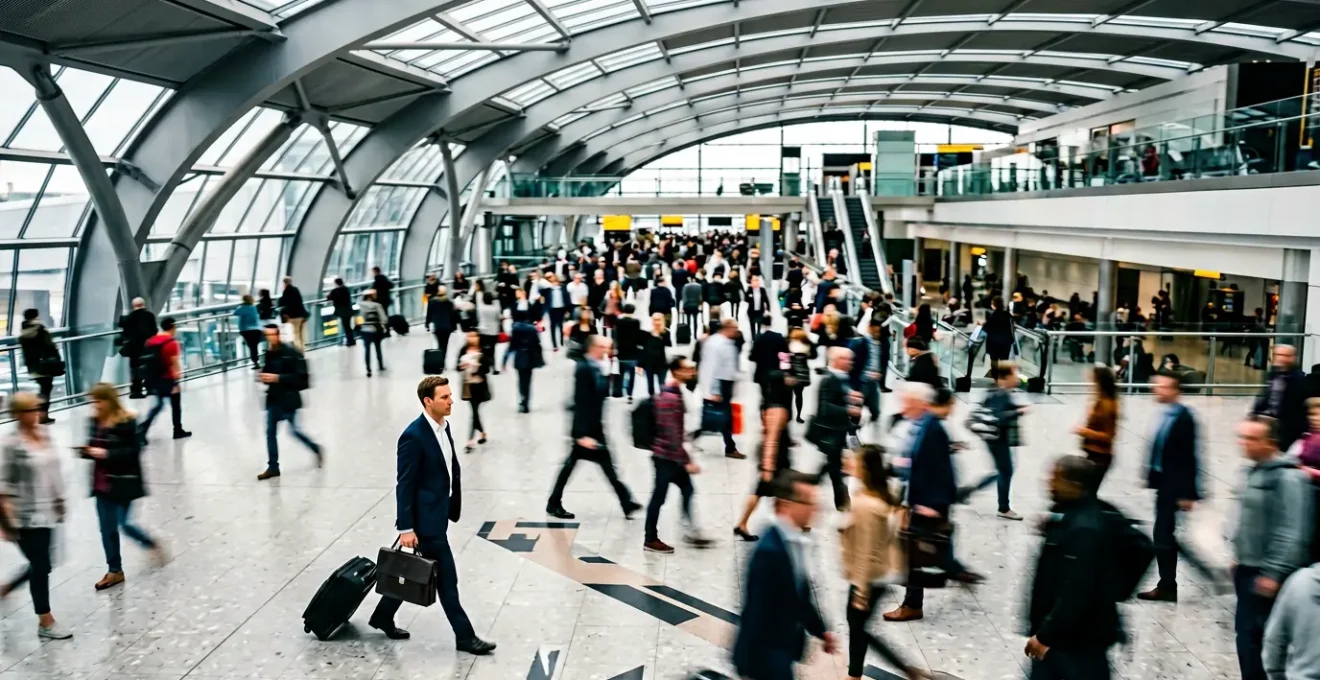
A seamless airport exit isn’t about luck; it’s a science of coordination and bypassing flawed systems.
- Arrival chaos is often a designed feature to increase retail “dwell time,” and it physiologically impacts you by raising cortisol levels.
- Mastering a communication protocol and understanding hidden terminal logic are more effective than just hoping your driver finds you.
Recommendation: Shift your mindset from a passive passenger to a strategic navigator who choreographs every step from the aircraft door to the car door.
For the frequent flyer, the descent into Heathrow, Gatwick, or Manchester should be a moment of relief. Instead, it often signals the start of the most stressful part of the journey: the arrival. You know the routine—the sluggish crawl through passport control, the anxious wait at the baggage carousel, and the final, chaotic search for a pre-booked driver amidst a sea of signboards and confused travelers. The standard advice to “book a meet and greet” or “follow the signs” feels hollow when you’re facing another 45-minute delay before even leaving the terminal.
This experience isn’t just frustrating; it’s a drain on your energy and focus, especially before a critical meeting. The typical approach of simply trying to move faster through the chaos is a losing battle. The system itself is riddled with inefficiencies, from poor mobile signal at the gate to signage designed to guide you through retail zones, not to the quickest exit. But what if the key wasn’t to fight the system, but to understand its hidden rules and create your own streamlined path through it?
This guide moves beyond the basics. We will not tell you to pack light or have your passport ready. Instead, we will dissect the anatomy of arrival chaos and equip you with a series of precise, actionable strategies. This is about transforming your arrival from a stressful ordeal into a seamless, controlled, and predictable process. It’s about mastering an “arrival choreography” that puts you in complete control, ensuring a swift and calm transition from the aircraft to your waiting vehicle.
This article provides a comprehensive framework for mastering your arrival experience. Discover the physiological impact of terminal chaos and learn the precise protocols to coordinate with your driver, navigate baggage claim efficiently, and bypass the hidden traps of airport design.
Summary: How to Navigate Heathrow Arrivals Without Losing 45 Minutes in Crowds?
- Why Does Arrival Chaos Spike Your Cortisol Levels Before a Meeting?
- How to Locate Your Driver at Gatwick North Terminal in Under 3 Minutes?
- Signboard or Text Message: Which Pickup Method Is Faster at Manchester Airport?
- The Baggage Hall Mistake That Delays Your Exit by 20 Minutes
- When to Switch on Your Phone: The Precise Moment for Seamless Coordination
- Why Do “Exit” Signs at Heathrow Sometimes Lead You Astray?
- In-Terminal Meet or Curbside Call: Which Is Better for VIPs?
- How to Guarantee a 5-Minute Terminal-to-Car Exit for VIP Guests?
Why Does Arrival Chaos Spike Your Cortisol Levels Before a Meeting?
That feeling of rising tension as you step into a crowded arrivals hall isn’t just in your head; it’s a measurable physiological response. The combination of noise, crowds, and navigational uncertainty triggers your body’s fight-or-flight mechanism. In these moments, your brain is flooded with a constant stream of micro-decisions: Which passport line is fastest? Where is the baggage carousel? Has my driver messaged me? This creates significant cognitive overload, a state of mental exhaustion that impairs decision-making and elevates stress.
The physical consequences are immediate and impactful. Research into airport environments shows that these stressors can lead to a 15-20% increase in blood pressure, with the stress hormone cortisol remaining elevated for hours afterward. This is the last thing you need before walking into an important business meeting. The chaos effectively sabotages your performance before your day has even truly begun, leaving you feeling frazzled and reactive rather than calm and in control.
Understanding this biological impact is the first step toward reclaiming your composure. The strategies that follow aren’t just about saving time; they are designed to minimize cognitive load and eliminate the uncertainty that triggers this stress response. By creating a predictable and choreographed exit plan, you prevent the cortisol spike from ever happening, ensuring you arrive at your destination focused and ready.
How to Locate Your Driver at Gatwick North Terminal in Under 3 Minutes?
The final 100 metres of your airport journey—locating your driver—can be the most frustrating. Vague meeting points and unreliable communication create what we call “coordination friction.” The key to eliminating this is a simple, non-negotiable communication protocol. The “Triple Ping Protocol” removes all guesswork and ensures you and your driver are perfectly synchronized, turning a potentially lengthy search into a sub-3-minute connection.
The protocol consists of three precise messages sent at key moments of your journey through the terminal:
- Ping 1: ‘Landed/Taxiing.’ Send this message the moment the plane touches down. This gives your driver the initial alert that you are on the ground and allows them to move towards the terminal from the holding area.
- Ping 2: ‘Through Passport Control.’ After clearing immigration, send your second message with an estimated time to the baggage hall. This is the most crucial update, as it provides a reliable ETA for the final meeting.
- Ping 3: ‘At Baggage Carousel [Number].’ Once you’ve arrived at the carousel, send your exact location. For the final 50 meters, share your WhatsApp live location to provide a moving dot on a map, making the final connection foolproof.
This disciplined communication replaces frantic searching with a precise, choreographed meet. It establishes a clear timeline and removes ambiguity for both you and your driver.
As the image illustrates, the result is a moment of calm recognition rather than a stressful search. By defining the process, you dictate the terms of your pickup, ensuring your driver is waiting at the pre-agreed spot at the exact moment you emerge, ready to assist with your luggage and lead you to your vehicle.
Signboard or Text Message: Which Pickup Method Is Faster at Manchester Airport?
The traditional image of a chauffeur holding a signboard is iconic, but is it the most efficient method in a modern, crowded airport? The choice between a visual cue (signboard) and a digital one (text message) depends on your priorities: visibility versus privacy and speed. While a text message can be faster for a seasoned traveler, it carries risks like poor signal or a dead phone battery. The signboard is reliable but can be slow if the driver is obscured by crowds or your name is misspelled.
However, an innovative hybrid approach, the “Photo-Sign Method,” is proving to be the most effective solution. This technique combines the best of both worlds, offering near-instant recognition with digital precision.
Case Study: The ‘Photo-Sign Method’
Premium car services at Manchester Airport have unofficially adopted a method that has reduced average pickup times from over 5 minutes to under 90 seconds. Before the passenger clears customs, the driver takes a photo of themselves holding the signboard at the exact, pre-agreed meeting point (e.g., “under the large clock next to Costa Coffee”). This photo is sent to the passenger, eliminating all ambiguity and providing a clear visual target to look for upon entering the arrivals hall.
This hybrid method is superior because it provides visual confirmation before you even begin looking. The table below, based on an analysis of pickup efficiency, breaks down the pros and cons of each approach, highlighting why the hybrid model offers the best balance of speed and reliability.
| Method | Best For | Time to Connect | Failure Risk |
|---|---|---|---|
| Traditional Signboard | First-time visitors, language barriers | 2-5 minutes | Name misspelling, driver obscured |
| Text Message | Repeat travelers, privacy needs | 30-90 seconds | No signal, dead battery |
| Hybrid Photo-Sign | All traveler types | Under 60 seconds | Minimal – visual + digital backup |
The Baggage Hall Mistake That Delays Your Exit by 20 Minutes
The baggage hall is a major time sink, but the biggest mistake is passive waiting. Most passengers plant themselves in one spot and stare at the point where bags emerge, ceding all control to the airline’s baggage handlers. A strategic approach, the “Baggage Hall Patrol,” can cut this wait time significantly and help you identify a problem long before the rest of the crowd.
This technique involves active observation and strategic positioning. Instead of standing still, you should:
- Walk slowly against the direction of the belt’s rotation. This increases the relative speed at which you see the bags, allowing you to spot yours up to 60 seconds earlier than those standing still.
- Stand at the carousel’s curve. Bags naturally separate from clusters as they navigate the turn, making them easier to identify and retrieve without having to push through a crowd.
- Position yourself “upstream” from the main congregation of passengers. This gives you first access to the bags before they reach the masses.
Equally important is knowing when to abandon the wait. If your priority-tagged bag doesn’t appear in the first 20% of bags, or if the carousel stops or shows the same five bags circulating for over three minutes, proceed immediately to the baggage service desk. Don’t wait for the belt to be empty; you’ve already lost valuable time. While VIP services report achieving baggage collection in just 5 minutes from deplaning by having staff wait for you, the “Baggage Hall Patrol” is the most effective solo strategy.
When to Switch on Your Phone: The Precise Moment for Seamless Coordination
The moment you switch on your phone is a critical, yet often overlooked, part of a seamless arrival. Most passengers wait until the plane reaches the gate and the seatbelt sign is off. This is a mistake. At that moment, 300+ other phones are simultaneously trying to connect to the cellular network, creating a “Network Surge.” This surge can delay your connection by several minutes, preventing you from sending that crucial first message to your driver.
The optimal moment to connect is during the final 5-10 minutes of taxiing to the gate. During this window, the aircraft is moving slowly on the ground, and you are close enough to the terminal to get a stable network signal. By connecting early, you bypass the network surge entirely, ensuring you have a solid connection and a fully charged phone (thanks to the in-seat USB power) the second the doors open. This allows you to initiate the “Triple Ping Protocol” without delay.
For the ultimate in efficiency and redundancy, advanced travelers employ the “Two-Device Gambit”:
- Primary Device (Phone): Keep this on airplane mode until the final taxi begins. This preserves its battery for critical coordination outside the terminal.
- Secondary Device (Tablet with eSIM/Laptop): Connect this device immediately upon landing. Use it to handle non-urgent emails and logistics during the taxi.
- Activation: Switch your primary phone’s connectivity on during the final approach to the gate, ensuring it’s ready for immediate use upon deplaning.
This strategy ensures you are always connected and that your most critical device has maximum battery for the journey ahead, eliminating technology as a potential point of failure in your arrival choreography.
Why Do “Exit” Signs at Heathrow Sometimes Lead You Astray?
If you’ve ever felt like you’re walking in circles at Heathrow while following “Exit” signs, you’re not imagining it. Airport wayfinding is not always designed for the most direct route. A core objective of terminal design is to maximize passenger “dwell time” in retail areas. Generic signs for “Arrivals” or “Exit” are often strategically placed to route you through these commercial zones, subtly encouraging spending.
This is a classic conflict between commercial intent and traveler intent. You want the fastest path out; the airport operator wants to expose you to the most shops and restaurants. Analysis of Heathrow’s wayfinding has shown that following specific transport signs, such as those for the “Heathrow Express,” “Underground,” or “Taxis,” provides a much more direct route. Opting for these specific signs can reduce walking time by up to 40% compared to following the generic “Exit” signage.
The ultimate system bypass is to observe and follow the flight crews. Pilots and cabin crew know the terminal’s back-of-house shortcuts and most efficient pathways that bypass the main passenger flows.
As depicted, following a crew member from a safe distance can lead you through less crowded corridors and directly to transport hubs. They are moving with purpose and are not influenced by retail distractions. This simple act of observation is a powerful way to override the terminal’s designed inefficiencies and reclaim your time.
In-Terminal Meet or Curbside Call: Which Is Better for VIPs?
For VIPs, high-net-worth individuals, or anyone requiring an added layer of security and privacy, the pickup strategy extends beyond simple speed. The choice between a driver meeting you inside the terminal versus a “curbside call” where you meet them at the pickup lane involves a trade-off between control, discretion, and efficiency. As one expert from a leading concierge service notes, the goal is to create a seamless security bubble.
For a true VIP experience, the goal is to maintain a bubble of privacy and security from the aircraft door to the car door.
– VIP Services Expert, Royal Airport Concierge Services
An in-terminal meet, while slightly slower, offers a controlled environment. The handover is private, secure, and protects the principal from public exposure. A curbside call is faster but exposes the individual in a public, less-secure space while they wait for the vehicle to arrive. For the highest level of security and privacy, a private terminal service is the ultimate option, completely bypassing the main terminal infrastructure.
The following table, based on an analysis of VIP pickup services, outlines the key differences, helping you make an informed decision based on your specific needs for security and privacy.
| Service Type | Security Level | Speed | Privacy | Cost Range |
|---|---|---|---|---|
| In-Terminal Meet | Maximum – controlled environment | 5-10 min slower | High – private handover | $500-1000 |
| Curbside Call | Lower – public space exposure | Fastest option | Moderate – visible exit | Standard fare |
| Private Terminal | Ultimate – bypasses main terminal | 5 minutes total | Complete privacy | $2000+ |
Key Takeaways
- Arrival stress is a physiological reality caused by cognitive overload; a structured plan is the antidote.
- Precise communication protocols, like the “Triple Ping,” eliminate coordination friction with your driver.
- True navigation mastery involves bypassing flawed systems, like following transport-specific signs instead of generic “Exit” signs.
How to Guarantee a 5-Minute Terminal-to-Car Exit for VIP Guests?
A true, guaranteed 5-minute exit from the terminal is the holy grail of airport arrivals. However, it’s crucial to understand that this is physically impossible within the confines of the standard passenger journey. No amount of priority passes or efficient walking can overcome the inherent delays of a public terminal. The only legitimate way to achieve this guarantee is through a complete system bypass: using a dedicated VIP service that operates outside the main terminal infrastructure.
Services like Heathrow VIP exemplify this model. The process involves meeting the passenger directly at the aircraft door and transporting them in a private vehicle across the tarmac to a separate, dedicated VIP building. Here, passport control and customs are handled in a private suite while a team member simultaneously collects any checked luggage. The passenger never sets foot in the main, public terminal. This is the “secret” to the 5-minute guarantee—it’s not about being faster within the system, but about using an entirely different system.
While this level of service comes at a premium, it is the only way to ensure absolute speed, security, and privacy. For those who can’t or don’t wish to use a full VIP terminal, a “zero friction” strategy combining several best practices is the next best thing to minimize delays and create the smoothest possible exit.
Your Action Plan for a Zero-Friction Exit
- Pre-enroll in trusted traveler programs like Registered Traveller (UK) or Global Entry to expedite immigration.
- Travel with hand luggage only whenever possible to completely eliminate the baggage claim variable, the single biggest potential delay.
- Pre-position your driver by providing them with the “Triple Ping Protocol” and a precise meeting point confirmed with the “Photo-Sign Method.”
- Where available and justified, use private terminal services, as this is the only method with a true time guarantee.
- Have rolling contingency plans for any disruption. Know the backup meeting point and have secondary contact methods ready.
To implement these strategies effectively, the next logical step is to review and upgrade the instructions you provide to your executive assistant or travel booker, ensuring these protocols become standard practice for all your future trips.