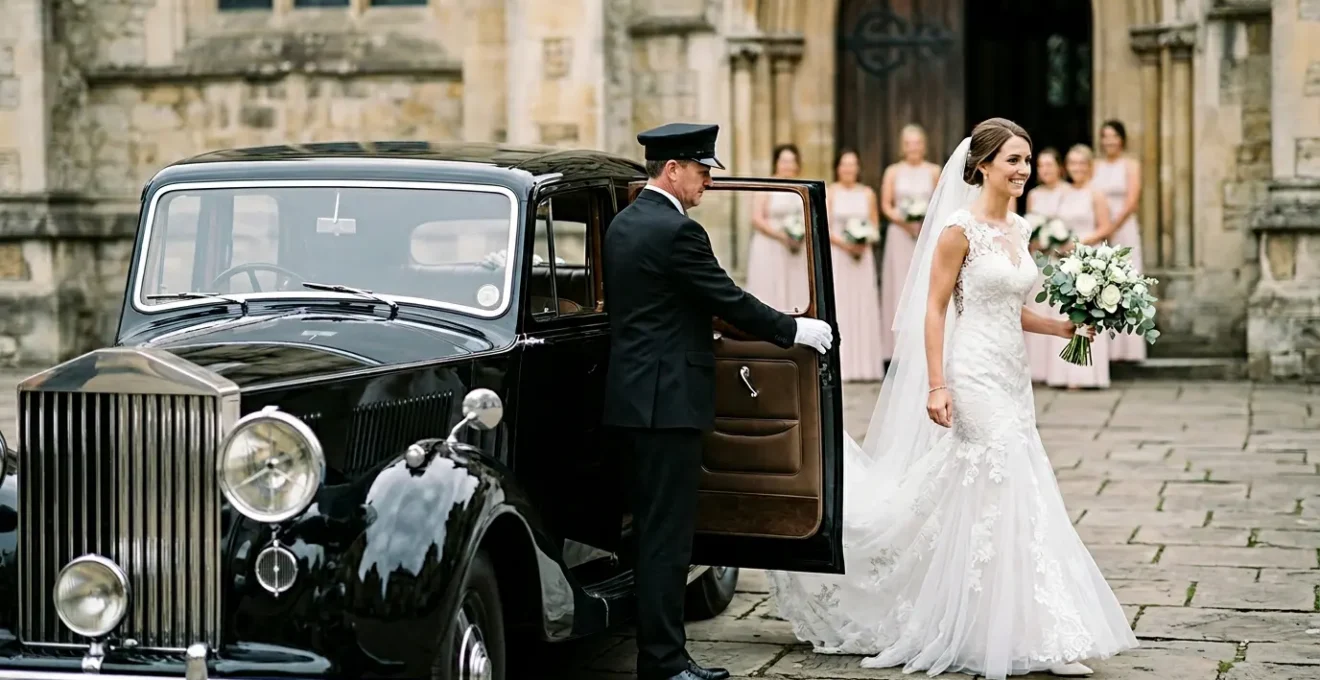
Contrary to popular belief, a bride’s perfect arrival isn’t about luck or just ‘leaving on time’; it’s a meticulously planned operation designed to eliminate every variable.
- Success depends on proactive risk management, from route reconnaissance to contingency plans for weather and vehicle choice.
- Precision extends beyond the car to micro-logistics, such as how to enter a vehicle gracefully in a large gown and what amenities are truly essential.
Recommendation: Adopt a coordinator’s mindset. Treat the journey as a mission with a single objective: a flawless, stress-free, and cinematic arrival.
The moment the wedding car glides to a stop and the bride emerges is a scene etched into memory. It’s a collective held breath, a crescendo of emotion and anticipation. For the nervous bride or wedding planner, however, this moment is the culmination of a high-stakes logistical exercise fraught with potential pitfalls. The common advice—book early, allow for traffic, pick a pretty car—is dangerously simplistic. It treats the journey as a mere trip from A to B, ignoring the myriad of variables that can turn a dream entrance into a stressful ordeal. While many couples focus on the aesthetics, the true art lies in the unseen preparation.
In 2024, 35% of couples booked professional wedding transportation, seeking to delegate this critical task. Yet, delegation is not absolution from detail. The secret to a perfectly timed arrival isn’t about hoping for the best; it’s about embracing a form of romantic, yet highly disciplined, operational planning. It involves thinking less like a passenger and more like an event coordinator responsible for a flawless execution. The goal is not just to arrive, but to arrive composed, radiant, and exactly on schedule, creating a moment that feels both effortless and utterly cinematic. This requires a shift in mindset: from simple transportation to precision-timed logistics.
This guide moves beyond the platitudes to arm you with the strategic framework a professional coordinator uses. We will dissect the critical decisions, from vehicle selection and contingency planning to managing the intricate ballet of moving guests, ensuring your journey to the altar is as perfect as the ceremony itself.
By dissecting each component of the journey with rigorous discipline, you can neutralize potential issues before they arise. The following sections provide a detailed roadmap for executing a flawless transportation plan, ensuring every moment is managed with precision and care.
Summary: Your Guide to a Perfectly Timed Wedding Arrival
- Vintage vs Modern: Which Car Suits a City Wedding Better?
- How to Enter and Exit a Low Sports Car in a Ballgown?
- Rain on the Wedding Day: Does the Driver Have Huge Umbrellas?
- Why Your Driver Must Drive the Route a Week Before the Wedding?
- Champagne and Tissues: What Amenities Are Critical for the Ride?
- Black, Silver, or White: Which Car Colour Commands Most Respect?
- One Coach or Three MPVs: Which Is Better for VIP Groups?
- How to Move 20 Guests to a Country Wedding Without Losing Anyone?
Vintage vs Modern: Which Car Suits a City Wedding Better?
The choice between a vintage Rolls-Royce and a modern Mercedes S-Class seems purely aesthetic, but for a city wedding, it’s a critical logistical decision. The romance of a classic car can quickly fade when faced with the realities of urban navigation. Operational discipline demands you look beyond the photo opportunity and analyze the vehicle’s performance capabilities. A vintage car often has a wider turning radius, making tight city corners and narrow venue entrances a significant challenge. Modern luxury vehicles, by contrast, are engineered for superior urban agility.
This isn’t just about driver skill; it’s about physics. To ensure a punctual, stress-free arrival, the vehicle must be suited to its environment. The table below breaks down the practical differences that directly impact your schedule. Notice the stark contrast in required buffer time—a crucial factor in precision timing.
This comparative data, based on an analysis of urban wedding transport, highlights the operational advantages of modern cars in a dense city environment.
| Feature | Vintage Cars | Modern Cars |
|---|---|---|
| Turning Radius | Wider (challenging in narrow streets) | Tighter (better urban navigation) |
| Speed Capability | Lower average speed | Higher/adaptable speed |
| Buffer Time Needed | 25-30% additional | 10-15% additional |
| Arrival Zone Access | Often restricted | Usually unrestricted |
| Climate Control | Limited/none | Full air conditioning |
Case Study: The Chicago S-Class Advantage
A Chicago-based wedding transportation service, having served over 500 weddings, reports that their modern Mercedes S-Class fleet consistently outperforms vintage models for city events. The modern cars navigate dense traffic and find alternative routes more effectively, contributing to a perfect record of arriving 15 minutes early, every time. This buffer isn’t luck; it’s the result of choosing the right tool for the job.
While a vintage car can be perfect for a countryside setting, a city wedding demands a vehicle that guarantees punctuality and adaptability. The most romantic arrival is one that is calm and on time, and a modern vehicle is often the more disciplined choice to ensure that outcome. This decision sets the foundation for your entire journey’s timing.
How to Enter and Exit a Low Sports Car in a Ballgown?
A sleek, low-slung sports car offers a dramatic, modern aesthetic, but it presents a unique logistical challenge: navigating entry and exit in a voluminous ballgown without sacrificing an ounce of grace. This is a moment of pure choreography where practice and technique are paramount. The goal is to make the action appear fluid and effortless, a task that requires a specific, disciplined method. An unpracticed entry can lead to a tangled dress, a loss of composure, and a flustered start to your grand entrance. This is a micro-detail where operational excellence shines.
The key is the “Back-In and Swivel” technique. This method is the industry standard taught by coordinators to ensure the bride’s elegance is maintained from the car to the aisle. It protects both the dress and the bride’s poise. The following steps break down this essential piece of wedding day choreography.
As this image demonstrates, the movement is controlled and supported. The role of the maid of honor or wedding planner is crucial here; they are not just watching, but actively managing the gown’s train to prevent it from catching or wrinkling. This is a team effort, executed with precision.
- Step 1: Back up to the seat, facing away from the car.
- Step 2: Gently sit down on the edge of the seat, gathering the bulk of your dress in your lap.
- Step 3: Place one hand on the door frame or a stable interior point for support.
- Step 4: In one smooth motion, swing both legs into the car together as you pivot your body to face forward.
- Step 5: Allow your designated helper (e.g., maid of honor) to carefully arrange the dress train inside the car after you are seated.
Mastering this small but critical detail is a testament to thorough preparation. It ensures your cinematic arrival is flawless from the very first moment the car door opens, transforming a potential logistical hurdle into a display of pure elegance.
Rain on the Wedding Day: Does the Driver Have Huge Umbrellas?
Rain is the most classic, uncontrollable variable on a wedding day, but its impact on your arrival is entirely controllable with professional foresight. The question is not *if* your driver has an umbrella, but what a comprehensive rain plan entails. A single, flimsy umbrella is a sign of amateurism. A professional chauffeur service operates with a disciplined, pre-prepared strategy to bridge the gap from vehicle to venue, ensuring the bride, her gown, and her composure remain immaculate. This is a critical component of variable elimination.
The first step is a time buffer. As wedding transportation experts recommend, adding a 10-20 minute padding specifically for weather-related delays is non-negotiable. Traffic slows, and the process of exiting the vehicle becomes more deliberate. Beyond this, a professional driver’s preparedness is evident in their “Rain Transition Kit.” This is not just about staying dry; it’s about ensuring safety and protecting the priceless gown from water, mud, and slips. It is a system designed to create a seamless, protected path.
A truly professional service will have the following on hand, turning a potential disaster into a minor inconvenience:
- Elegant Umbrellas: Large, sturdy white or transparent umbrellas that are not only functional but also photogenic.
- Non-Slip Mats: Placed at the vehicle’s exit to prevent slips on wet pavement, especially for high heels.
- Protective Floor Coverings: Dark towels or mats inside the car to shield the dress hem from wet shoes.
- Ground Mat: A large, absorbent mat placed on the ground at the precise exit point to protect the gown as the bride steps out.
- Venue Coordination: The driver will have already communicated with the venue to ensure the closest possible drop-off point, ideally under a covered reception area.
This level of preparation is the hallmark of a high-caliber service. It demonstrates a commitment not just to transportation, but to the overall success of the event. When you hire a service, you are hiring their ability to anticipate and neutralize problems, and rain is the most predictable problem of all.
Why Your Driver Must Drive the Route a Week Before the Wedding?
A GPS is a tool for amateurs; a professional relies on firsthand intelligence. Insisting your driver performs a full “route reconnaissance” at the exact same time and day of the week as your wedding is the single most important act of operational discipline you can enforce. This is not a casual drive-by. It is a meticulous data-gathering mission designed to identify and neutralize every potential obstacle that could delay your arrival. Relying solely on a digital map on the day-of is a gamble—one that a nervous bride or planner cannot afford to take.
The purpose of the trial run is to transform the unknown into the known. The driver isn’t just checking for traffic; they are mapping out a primary and secondary route, timing each leg, and documenting critical details. They are looking for time-specific issues a GPS won’t show: a school zone with 3 PM traffic, a street that becomes a farmer’s market on Saturdays, or a commercial block with heavy delivery truck activity. Most reputable wedding transportation services typically require a minimum 3-hour booking, which should inherently cover the time for such professional preparations.
This reconnaissance mission is about creating a predictable environment. It’s the difference between reacting to problems and having pre-planned solutions. An elite chauffeur will approach this task with a formal checklist.
Action Plan: Verifying Your Route Reconnaissance
- Points of Contact & Timing: Confirm the trial run is scheduled for the same day and time as the wedding to replicate traffic patterns accurately.
- Route & Obstacle Collection: The driver must document at least two viable routes and photograph potential obstacles like low bridges, narrow streets, or unpredictable intersections.
- Drop-Off Point Coherence: The driver must identify and confirm the *exact* drop-off point with the venue coordinator, ensuring it is clear and accessible. No ambiguity allowed.
- Signal & Communication Test: The driver should test mobile signal strength along the entire route to guarantee communication is possible at all times. A “digital handshake” test with the coordinator from the arrival point is mandatory.
- Contingency Plan Integration: Based on the reconnaissance, the driver must formulate a clear Plan B and Plan C, ready to be executed without hesitation if the primary route is compromised.
This rigorous preparation is the ultimate stress-reducer. It ensures that on your wedding day, the journey is not a source of anxiety but a smooth, controlled, and perfectly-timed glide toward your cinematic arrival. It is the core of professional execution.
Champagne and Tissues: What Amenities Are Critical for the Ride?
The amenities inside the wedding car are more than just a touch of luxury; they are a crucial part of the bride’s “bubble” of calm and composure before her grand entrance. While champagne is a celebratory classic, a truly professional service understands that the most critical amenities are those that provide practical and emotional support. This space is the final staging area before the main event, and it must be equipped to handle last-minute needs, both emotional and practical. The focus should be on creating a serene, controlled environment.
Think of the car’s interior as a personal support station. The journey, whether it’s 10 minutes or 40, is a rare moment of private reflection (or celebration with the bridal party) before the public ceremony begins. It’s a time for a deep breath, a final touch-up, or a quiet tear of joy. The right amenities facilitate this, ensuring the bride arrives not just on time, but also emotionally and physically ready. The goal is a seamless transition from passenger to bride.
As seen here, the presentation matters, but the function is paramount. A chilled bottle of water is often more valuable than champagne to stay hydrated and calm nerves. High-quality, lint-free tissues are not an afterthought but an absolute necessity for dabbing away happy tears without smudging meticulously applied makeup. These small items are tools for composure.
A well-equipped wedding car should always include:
- Bottled Water: Chilled and readily available. Hydration is key to feeling and looking fresh.
- Luxury Tissues: Soft, strong, and lint-free to handle emotional moments without a trace.
- A Small Mirror: For that final, reassuring check of hair and makeup.
- Mints: To ensure a fresh feeling upon arrival.
- Champagne: Properly chilled, for a celebratory toast if desired, but it should be an option, not the focus.
- An Auxiliary Port or Bluetooth: To play a personal, calming playlist, setting the emotional tone for the arrival.
These elements are not extravagant frills. They are the thoughtful, disciplined provisions that transform the wedding car from a simple vehicle into a sanctuary on wheels, ensuring the bride arrives feeling supported, composed, and utterly radiant.
Black, Silver, or White: Which Car Colour Commands Most Respect?
The color of the wedding car is a decision that extends far beyond personal preference; it has a direct and measurable impact on the day’s visual narrative, particularly the photography. While “respect” is subjective, in the language of wedding coordination, it translates to which color will best enhance the bride, complement the venue, and perform under the specific lighting conditions of the day. The disciplined choice is the one that produces the most consistently stunning photographs, the timeless records of your arrival.
A classic black car offers high contrast and drama, making the white of a wedding dress pop. However, in harsh midday sun, its reflective surface can be challenging for photographers. A traditional white car creates a seamless, bridal feel but can sometimes blend in with the dress. Silver is a modern, versatile choice that expertly manages bright light, while a warm champagne tone can add a layer of soft elegance. Your decision should be a coordinated effort with your photographer, who understands how these colors will interact with their camera and editing style. Some companies even offer a range of pricing, where the vehicle type and color influence the cost; for example, Chicago wedding limo packages can range from $400 to $1,500, partly based on the exclusivity of the vehicle.
To make a strategic, rather than purely emotional, choice, consider the following photographic factors.
| Car Color | Photographic Impact | Best Time of Day | Venue Backdrop Match |
|---|---|---|---|
| Black | High contrast, dramatic | Golden hour | Modern glass buildings |
| White | Classic bridal feel | Morning/afternoon | Rustic barns, green estates |
| Silver | Modern, manages harsh light | Midday high sun | Urban settings |
| Champagne | Elegant, warm tones | Any time | Historic venues |
Choosing your car’s color is an exercise in art direction. By aligning the vehicle’s color with your venue’s architecture and the day’s timeline, you are not just selecting a car; you are composing a key scene in your wedding story. This is how you ensure your cinematic arrival is captured perfectly.
One Coach or Three MPVs: Which Is Better for VIP Groups?
When transporting a group of 20-40 VIP guests, the choice between a single large coach and a small fleet of multi-purpose vehicles (MPVs) is a critical risk management decision. The convivial “party bus” atmosphere of a single coach is appealing, but from an operational standpoint, it represents a massive single point of failure. If that one coach gets a flat tire, encounters an unexpected road closure, or has a mechanical issue, 100% of your guests are delayed. The entire wedding timeline is jeopardized.
A disciplined coordinator will always prioritize risk mitigation. Splitting the group into three or four smaller MPVs is a strategically superior approach. This tactic immediately reduces the impact of any single vehicle’s delay from 100% to just 25% or 33%. It introduces redundancy and flexibility into your plan. If one MPV gets stuck in traffic, the others can be rerouted. This “distributed risk” model is the professional standard for ensuring guest groups arrive on time, especially for remote or country weddings where alternative routes are limited. The cost is often comparable for groups under 40, making the strategic benefits clear.
The following risk analysis, drawn from an assessment of wedding transport etiquette and logistics, quantifies the pros and cons of each approach.
| Factor | One Coach | Three MPVs |
|---|---|---|
| Single Point of Failure Risk | High (100% affected) | Low (33% affected) |
| Social Atmosphere | Communal party vibe | Intimate small groups |
| Coordination Complexity | Simple | Requires staggered departure |
| Flexibility | Limited | High (different routes possible) |
| Cost Efficiency | Better for 50+ guests | Better for 20-40 guests |
To manage the slightly higher coordination complexity of multiple vehicles, a professional will use a staggered departure strategy. The lead MPV departs at the scheduled time, with subsequent vehicles leaving in two-minute intervals. This simple technique prevents the entire convoy from getting caught in the same traffic snarl and allows the lead driver to communicate any obstacles back to the rest of the fleet, enabling real-time adjustments.
Key Takeaways
- A bride’s perfect arrival is a mission of precision, not a simple journey. Adopting an operational discipline mindset is key to eliminating stress.
- Vehicle choice is strategic. A modern car’s agility in a city or a vintage car’s aesthetic in the country directly impacts timing and photography.
- Anticipating variables is non-negotiable. This includes having a professional rain kit, practicing dress-and-car maneuvers, and conducting a full route reconnaissance at the same time and day as the wedding.
How to Move 20 Guests to a Country Wedding Without Losing Anyone?
Transporting 20 or more guests to a remote country venue is the ultimate logistical test. The risk of losing a car, dealing with missed turns, or having guests arrive late is incredibly high. The traditional method of handing out maps and hoping for the best is a recipe for chaos. The modern, disciplined solution is to create a closed-loop communication system and a clear convoy protocol. This transforms a scattered group of drivers into a single, coordinated unit, ensuring everyone arrives together and on time. This is where digital roll-call systems become invaluable.
The average investment in wedding transport is significant; The Knot Real Weddings Study reveals an average cost of $980. For that price, flawless execution is a reasonable expectation. The most effective method is to create a temporary WhatsApp or similar group chat for all transported guests and drivers. This becomes the central nervous system for the entire operation, allowing for real-time updates, location sharing, and immediate troubleshooting. This isn’t about micro-managing; it’s about providing a safety net that eliminates the anxiety of getting lost.
A professional guest transport plan follows a clear, actionable protocol:
- Digital Roll Call: Before departure, a coordinator conducts a roll call in the group chat to confirm everyone is present and ready.
- Real-Time Updates: Drivers post key milestones (e.g., “Convoy passing Junction 4,” “Approaching planned comfort stop”). This keeps everyone informed and synchronized.
- Live Location for Lost Cars: If a car takes a wrong turn, they can share their live location in the group for immediate, precise rerouting from the lead driver.
- Pre-Planned Comfort Stop: For longer journeys, a single comfort stop is scheduled at a specific service station with a clearly announced departure time to prevent stragglers.
- Lead Car & Sweep Car Protocol: The convoy is led by a “Lead Car” with the primary GPS and venue contact, and a “Sweep Car” at the rear ensures no one is left behind.
This system replaces guesswork with certainty. It provides peace of mind not only for the wedding planner but for every guest, allowing them to relax and enjoy the journey rather than navigating stressful country lanes. It is the epitome of modern, disciplined event coordination.
Begin implementing your digital roll call and convoy strategy now for absolute peace of mind. This structured approach is your final step in guaranteeing that every guest, and most importantly the bride, experiences a day defined by flawless execution and effortless elegance.