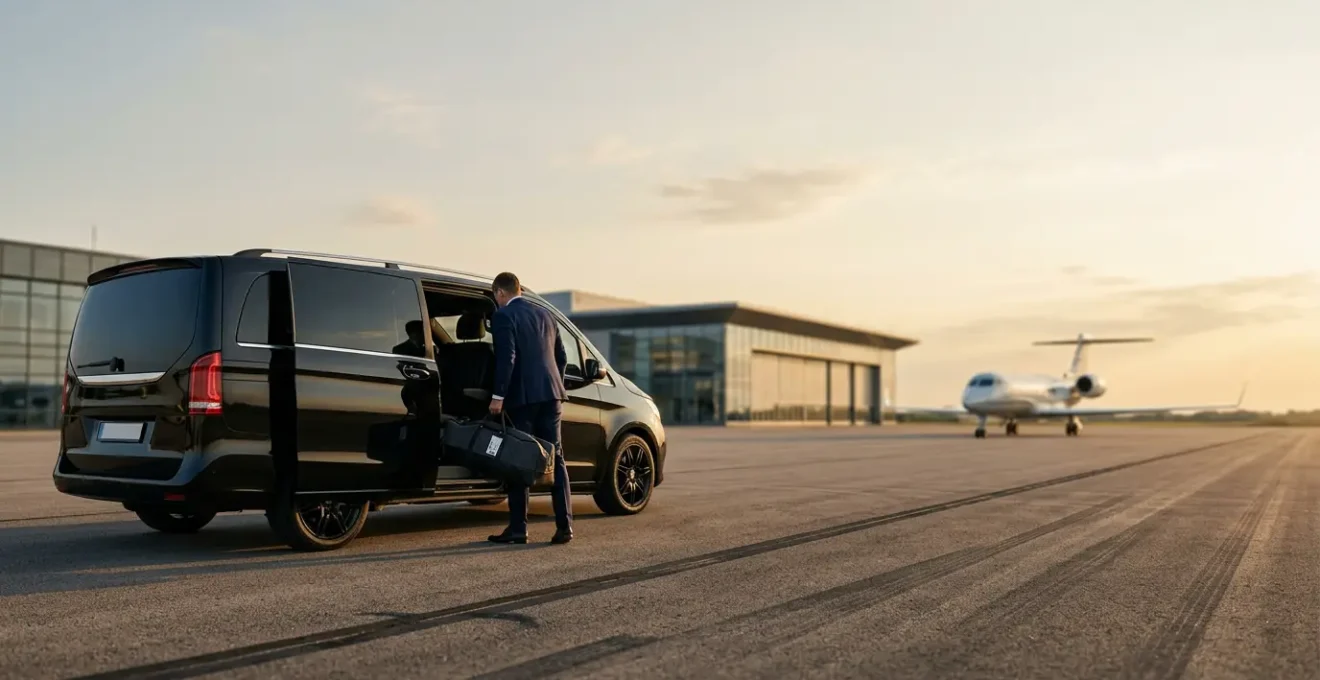
The critical mistake in high-end travel is choosing a vehicle for its badge, not its mission; standard luxury saloons are fundamentally unequipped for non-standard luggage.
- The “Illusion of Space” in cars like the S-Class means passenger comfort zones prevent the transport of items like skis or cellos.
- A “Logistics-First” approach, specifying a mission-specific vehicle like a Mercedes V-Class, is the only way to guarantee a seamless journey.
Recommendation: For any trip involving bulky or high-value items, bypass discussions of luxury brands and start with a clear manifest of all luggage, demanding a vehicle with confirmed, adequate cargo capacity like a Mercedes V-Class XL.
For the discerning traveller, the journey should be as seamless as the destination. You’ve chartered the jet and booked the chalet; the ground transfer from your London home to the private airfield should be a mere formality. Yet, this is often where the luxury experience fractures. The most common pitfall isn’t traffic or delays, but a fundamental misunderstanding of space and logistics. Families are frequently told to “book a luxury car” or “just use a roof box,” advice that actively creates the very stress and disruption you are paying to avoid.
The root of the problem is a passenger-centric view of transport. High-end saloons are engineered for comfort, not cargo versatility. When confronted with ski bags, art cases, musical instruments, or multiple hard-shell suitcases, their limitations become glaringly apparent. This guide moves beyond the platitudes to introduce a professional, ‘Logistics-First’ mindset. It’s an approach that anticipates friction points—from vehicle capacity and tarmac loading times to the hidden risks of equipment damage and customs regulations.
By understanding why standard solutions fail, you can adopt the strategies used by logistics experts to ensure your equipment, family, and peace of mind arrive intact. We will deconstruct the common errors and provide a clear framework for executing flawless, stress-free transfers every time.
This guide provides a detailed breakdown of the critical considerations for specialist transport. From selecting the right vehicle to navigating the intricacies of airfield protocols, the following sections offer a complete blueprint for a truly seamless journey.
Summary: A Guide to Stress-Free Specialist Transport
- Why Won’t a Standard S-Class Take a Cello Case?
- How to Book a Vehicle with a Ski Hatch or Roof Box?
- Soft Case vs Hard Case: Which Is Safer for Transporting Art?
- The Sharp Edge Mistake That Rips Leather Seats and Costs £500
- How Long Does It Take to Secure a Surfboard Properly?
- Saloon or Estate: Which Vehicle for 3 Large Hard-Shell Suitcases?
- Why Your Ham Sandwich Could Get Confiscated at Calais?
- How to Travel from London to Paris by Car Without Customs Headaches?
Why Won’t a Standard S-Class Take a Cello Case?
The core issue is the ‘Illusion of Space’. A luxury saloon like a Mercedes S-Class feels cavernous from the passenger seat, but it’s a carefully designed illusion. These vehicles prioritise passenger comfort with rigid, fixed bulkheads behind the rear seats and meticulously sculpted interiors that cannot be reconfigured. While perfect for executive travel, they are logistically hopeless for anything beyond standard suitcases. A typical 185cm ski bag or a full-size cello case simply won’t fit, as the maximum internal diagonal length is often less than 160cm.
This isn’t a design flaw; it’s a design choice. The vehicle is optimised for a different mission. The boot, while appearing generous, is a fixed box. A professional logistics approach requires moving beyond brand prestige and assessing the vehicle’s true utility. As an LCH study on the topic highlights, the boot of an S-Class offers just 510 litres of space. In stark contrast, a mission-specific vehicle like a Mercedes V-Class provides a minimum of 1,030 litres, expandable to a cavernous 4,630 litres with seats folded or removed. This volumetric difference is the key to a stress-free transfer, accommodating bulky equipment alongside luggage with ease. Furthermore, the V-Class’s large sliding doors are a critical advantage, eliminating the access problems that conventional car doors create on a busy, tight airfield tarmac.
The first step in any specialist transport booking is to discard assumptions based on a vehicle’s luxury status and adopt a mission-specific mindset. The cargo dictates the vehicle, not the other way around.
How to Book a Vehicle with a Ski Hatch or Roof Box?
The short answer, for high-end private airfield transfers, is that you don’t. While ski hatches and roof boxes are common solutions for personal family cars, they represent significant friction points in a professional, seamless transfer. A roof box, for instance, dramatically increases the vehicle’s height, creating a risk of rejection at FBO (Fixed-Base Operator) entrances with height restrictions. It also slows down the critical tarmac handover process significantly and exposes valuable equipment to both the elements and security risks.
The professional solution is to ensure all equipment travels securely inside the vehicle. This requires a specific communication protocol when booking, moving beyond a vague request for a “large car.” Your executive assistant or travel manager must provide a precise manifest: “We require transport for two 185cm hard-shell ski bags, two boot bags, and four large suitcases.” The request must then specify the vehicle type capable of handling this: “Please confirm a Mercedes V-Class Extra Long or equivalent vehicle with guaranteed in-cabin capacity for all listed items.” As Wheely notes, their XL Class provides generous space for larger items like skis, making it the appropriate choice. A verbal confirmation is insufficient; demand a written email acknowledgement that lists both the confirmed vehicle type and the specific luggage manifest you provided. This creates a clear documentation trail and places the responsibility for providing the correct asset squarely on the chauffeur service.
This table clearly illustrates why in-cabin transport is the only acceptable option for efficient and secure private airfield operations.
This comparison from a Top Gear analysis of the V-Class interior highlights the stark operational differences between using a roof box and opting for a purpose-built vehicle.
| Factor | Roof Box | In-Cabin (V-Class) |
|---|---|---|
| Loading Speed at Airfield | 10-15 minutes | 2-3 minutes |
| Height Restriction Risk | High (2.3m+ total) | None (standard height) |
| Security on Tarmac | Exposed/visible | Concealed/secure |
| Cargo Capacity | 400-600 liters | 1,030 litres in standard Long version, expandable to 4,630 litres with seats removed |
| FBO Access | May require special clearance | Standard access |
As the image demonstrates, the goal is a calm, organised, and secure loading process managed by a professional, which is only possible with the correct vehicle choice. The roof box introduces risk and delay, the exact opposite of a seamless experience.
Soft Case vs Hard Case: Which Is Safer for Transporting Art?
Whether you are transporting a painting, a vintage guitar, or a set of high-performance skis, the underlying principles of protection remain the same. The debate between soft and hard cases often misses the most critical point: internal security. A hard case provides superior protection against external impact, but it’s the movement *inside* the case that often causes the most damage during ground transport. An item rattling within a hard shell can suffer significant abrasion or impact damage. Therefore, the safer option is the one that best immobilises the contents.
For this reason, a high-quality, well-padded soft ski bag can often be superior, as it allows you to use soft goods like jackets and clothing to fill every void, creating a snug, movement-free cocoon. This internal packing protocol is paramount. For skis, this means placing them base-to-base, offsetting the bindings, wrapping the bindings individually, and using foam pipe insulation along the sharp edges. The goal is zero internal movement. The value of the equipment also dictates the level of preparation needed, not just for packing but for insurance. Specialist insurers like Travel Guard explicitly recommend that their Deluxe plan with its highest benefit limit for baggage is the appropriate choice when travelling with expensive ski equipment, treating it as a high-value asset akin to jewellery or art.
Ultimately, the choice of case is secondary to the packing methodology. A hard case is only as good as its internal padding and fit. For most flexible-shaped sports equipment, a premium soft case combined with a meticulous internal packing strategy offers a highly effective combination of protection and versatility.
The Sharp Edge Mistake That Rips Leather Seats and Costs £500
The focus on protecting your equipment often overlooks a costly and entirely avoidable risk: damage to the vehicle’s interior. A freshly tuned ski edge, a metal zipper on a bag, or even the plastic runner on the bottom of a suitcase can easily cause hundreds of pounds of damage to the fine leather seats and polished trim of a luxury vehicle. This is not the passenger’s responsibility to manage; it is a key differentiator of a truly professional chauffeur service. A top-tier service adopting a ‘Logistics-First’ approach will anticipate this risk.
The chauffeur should arrive with thick, clean, protective blankets as standard procedure for any journey involving skis or other hard-edged equipment. The absence of these materials is an immediate red flag, signalling a reactive, rather than proactive, service standard. It suggests a lack of experience with specialist transfers. As a case study by RolDrive chauffeur service notes, the value of a professional service is in transcending typical hassles and providing a seamless, stress-free journey. Preventing a £500 damage claim is part of that promise. The responsibility lies with the provider to supply the necessary protective measures to handle the declared cargo safely.
However, it’s wise to be aware of the myriad ways damage can occur, as it goes far beyond just the obvious sharp edges of skis. The following hidden risks are often overlooked.
| Risk Element | Damage Potential | Prevention Method |
|---|---|---|
| Metal Zippers | Deep leather scratches | Zip covers or fabric guards |
| Worn Buckles | Fabric tears, paint chips | Buckle padding or replacement |
| Plastic Runners | Scuff marks on trim | Runner caps or bag rotation |
| Boot Heel Plates | Puncture damage | Dedicated boot bags with reinforced bottoms |
| Pole Baskets | Ceiling liner tears | Pole tip protectors |
Recognising these risks empowers you to assess the quality of the service you’ve hired. A truly professional chauffeur will be prepared for all of them.
How Long Does It Take to Secure a Surfboard Properly?
Whether it’s a surfboard, a double bass, or a set of skis, the question of time is most critical at the destination: the private airfield. On the tarmac, every minute counts. A disorganised unload, with equipment being awkwardly manoeuvred out of a vehicle, can cause delays and draw unwanted attention. The goal is a 2-minute tarmac turnaround, a swift and elegant handover from vehicle to ground crew. This level of efficiency is not accidental; it is the result of a pre-staged loading configuration.
This process begins 24 hours before the journey. The chauffeur service must be pre-briefed with the exact equipment list and your preferred loading sequence. The equipment should be loaded into the vehicle in reverse order of how it will be unloaded. For example, ski bags should be positioned for a tails-first extraction to minimise handling and rotation on the tarmac. Smaller items like boot bags and helmets should be staged in a separate, quick-access compartment, not buried under larger suitcases. This turns the vehicle into a logistical asset, not just a mode of transport.
Assigning specific zones within the vehicle—skis on the left, suitcases on the right, personal carry-on items in door pockets—allows for a rehearsed and simultaneous unload. The chauffeur handles the heavy equipment, transferring it directly to the waiting ground crew trolley, while you manage your family and personal documentation. This choreographed approach transforms a potentially chaotic moment into a display of quiet efficiency, reinforcing the seamless nature of the private travel experience.
Saloon or Estate: Which Vehicle for 3 Large Hard-Shell Suitcases?
This question represents a classic trap that catches many families. On paper, a large estate car like a Mercedes E-Class, with 640 litres of boot space, seems perfectly adequate for three large suitcases. However, this calculation falls apart the moment non-standard luggage is introduced. This is the ‘estate car trap’. Once you add ski bags, boot bags, helmets, and hand luggage for a family of four, the total volume required easily exceeds the estate’s capacity by 300% or more. The reality of a ski holiday is that it is a logistics-heavy undertaking.
The choice is not truly between a saloon and an estate, as both are passenger-focused vehicles that suffer from the ‘Illusion of Space’. The real, functional choice is between a passenger car and a dedicated multi-purpose vehicle (MPV) or full-size SUV. The Mercedes V-Class, for instance, is the solution. It is specifically designed to handle both passengers and significant cargo without compromise. A family can enjoy a spacious, luxuriously appointed cabin with full leather seating while accommodating all their equipment in the rear. Even with all seats in place, the boot space ranges from an impressive 1,030 litres up to a massive 4,630 litres with the rear seats removed. This capacity ensures that three large hard-shell suitcases, plus all the associated ski gear, can be transported easily and securely inside the vehicle.
For any family trip involving more than just standard luggage, the correct starting point for vehicle selection must be a dedicated MPV. It is the only way to ensure a comfortable and stress-free journey without resorting to risky and inefficient solutions like roof boxes or trailers.
Why Your Ham Sandwich Could Get Confiscated at Calais?
The infamous “ham sandwich” rule, where personal products of animal origin can be confiscated at the EU border post-Brexit, is a stark reminder of an often-overlooked travel component: regulatory friction. While this specific rule applies to road travel, it serves as a powerful metaphor for the complex and often non-obvious regulations that govern private air travel. For the high-end traveller, these friction points are more likely to involve the equipment itself. For instance, what is the protocol for handing over luggage at a private FBO? The chauffeur can’t simply pull up to the jet; they must coordinate with FBO security, present ID matching the flight manifest, and transfer luggage to ground crew at a designated point. This requires advance communication between the chauffeur service and the FBO.
Similarly, certain items require special declaration even for ground transport. Lithium battery-powered ski boot heaters or avalanche airbags containing compressed gas canisters are two common examples. An inexperienced chauffeur service might not know to ask, leading to potential refusal of transport or complications at the airfield. A professional service, especially one familiar with London’s major private airfields like Farnborough, Biggin Hill, and Luton, will know the specific protocols of each FBO, have relationships with ground handlers, and proactively ask about potentially regulated items. They will guide you on the proper documentation and packaging required, ensuring these items don’t become a last-minute headache.
Just as you wouldn’t pack a prohibited food item for a cross-channel trip, you must ensure your specialist equipment is properly declared and handled for airside transit. This requires a chauffeur service with specific FBO experience.
Pre-Flight Ground Transport Safety Checklist
- Verify all electronic devices in ski boots are switched off and batteries removed if possible.
- Ensure avalanche safety equipment is properly documented with manufacturer specifications.
- Pack any sharp tools (ski tuning equipment) in checked luggage, not carry-on bags.
- Declare any pressurized containers (boot fitting foam, wax sprays) to the chauffeur in advance.
- Confirm the chauffeur has FBO contact details and your flight manifest information.
Key Takeaways
- The primary cause of transport stress is the ‘Illusion of Space’ in luxury saloons; they are not designed for bulky items.
- Adopt a ‘Logistics-First’ mindset: your luggage manifest must dictate the vehicle choice, not the brand. A Mercedes V-Class is the benchmark.
- Avoid roof boxes for airfield transfers; they introduce risks of height restrictions, slow loading, and poor security. True luxury is seamless, in-cabin transport.
How to Travel from London to Paris by Car Without Customs Headaches?
Navigating the journey from London to Paris by car without customs headaches requires meticulous planning and coordination. However, for the private jet traveller, the complexity of this ground-level coordination is magnified tenfold during the final, critical phase: the seamless airfield handover. The principles of smooth cross-border travel—correct documentation, clear communication, and synchronized timing—are the foundation of a successful FBO experience. If a family is travelling with staff in a separate vehicle, this coordination becomes even more crucial.
A successful multi-vehicle arrival at a private airfield is a ballet of precision. It demands synchronized departure times, constant communication between drivers, pre-arranged convoy positions, and a designated lead vehicle to handle all FBO communications. As experts in multi-vehicle coordination point out, the lead chauffeur manages the complete handover process with the ground crew, while any secondary vehicles remain in designated holding areas until cleared for approach. This prevents congestion at the jet-side and ensures a calm, orderly, and secure transfer of both passengers and luggage. The entire operation is predicated on the chauffeur service pre-registering with the FBO using your flight details and passenger manifest, a step that must be completed at least 24 hours in advance.
This level of logistical excellence is the ultimate expression of the ‘Logistics-First’ approach. It moves far beyond simply driving from Point A to Point B and becomes an integrated part of the private flight experience, ensuring the journey on the ground is as effortless and sophisticated as the journey in the air.
For your next journey involving specialist equipment, insist on a ‘Logistics-First’ approach from your transport provider. Start by providing a detailed manifest and demand a vehicle that serves the mission, ensuring your travel experience remains seamless from your front door to the aircraft steps.