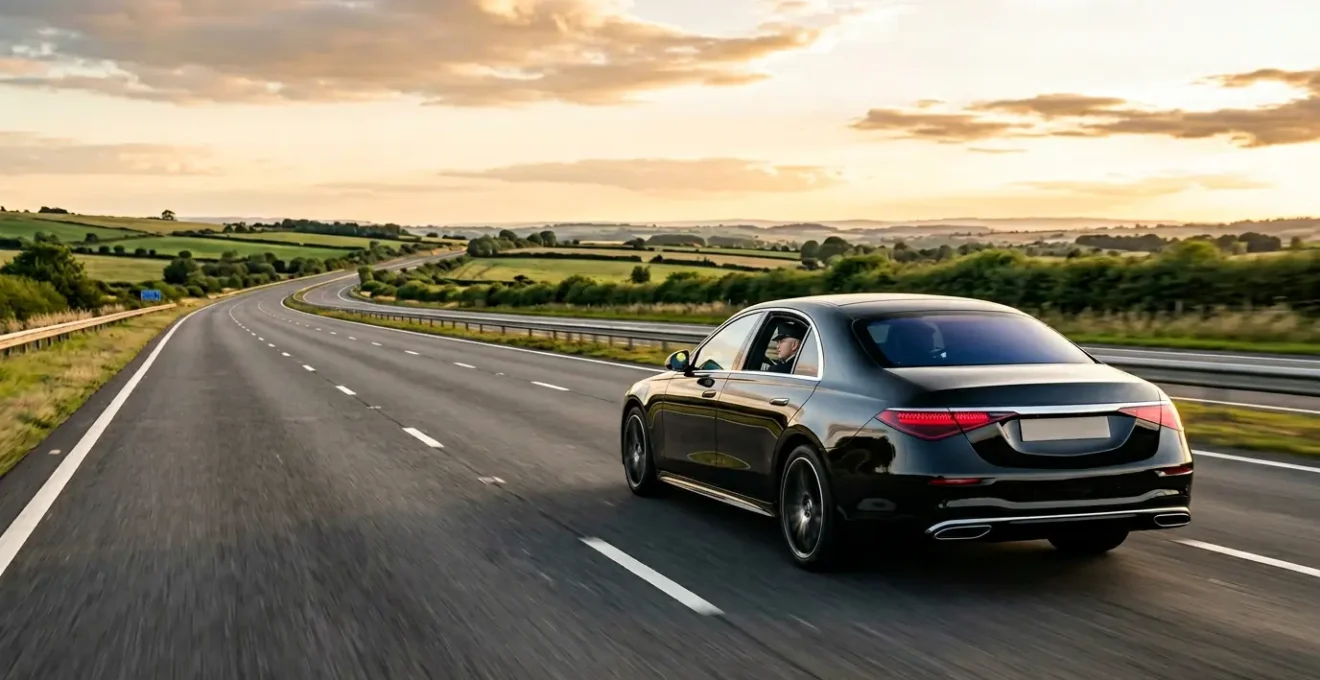
Contrary to popular belief, the value of a chauffeur drive from London to Edinburgh isn’t just avoiding hassle; it’s about transforming 7 hours of travel time into a strategic asset for productivity and well-being.
- The journey becomes a ‘personal bubble’ for deep work or true rest, eliminating the productivity loss common in airports and trains.
- When factoring in door-to-door time and the ability to work, the cost becomes competitive with first-class train travel for multiple passengers.
Recommendation: Re-evaluate long-distance UK travel not by cost per seat, but by the value of your time. A chauffeur service is an investment in focus and arrival readiness.
The prospect of a seven-hour journey from London to Edinburgh often conjures images of motorway fatigue, cramped train carriages, or the hurried stress of a short-haul flight. For the discerning traveller who values privacy and dislikes the impersonal nature of public transport, the debate between flying and taking the train feels like choosing between two equally unappealing options. The car, meanwhile, is often dismissed as a tiring ordeal, a necessary evil for those with excess luggage or a taste for the open road.
This common view, however, misses a crucial perspective. What if the journey itself wasn’t a liability to be endured, but an asset to be leveraged? The real question isn’t whether a private car is more comfortable—it inherently is. The deeper, more strategic question is whether that comfort can be translated into tangible value, turning dead travel time into productive hours or a period of genuine, restorative rest. This is where the chauffeur-driven experience fundamentally changes the equation.
This guide reframes the London to Edinburgh drive, moving beyond simple comfort to explore it as a strategic choice. We will dissect why a chauffeured journey is less draining than flying, analyse the true cost when productivity is factored in, and detail the specific amenities and strategies that transform a long drive into a personal, productive retreat on wheels.
To help you navigate this fresh perspective on long-distance travel, this article is structured to answer your most pressing questions. From financial sense to in-car essentials, each section provides a detailed analysis to help you make a more informed decision for your next inter-city trip.
Summary: Your Guide to a Smarter London to Edinburgh Journey
- Why a Chauffeur Drive Is Less Tiring Than a Short-Haul Flight?
- Where Are the cleanest Service Stations on the M1?
- Cost Per Mile vs Cost Per Seat: When Does Long-Distance Make Financial Sense?
- The Rear Seat Amenities Essential for Journeys Over 3 Hours
- How to Beat the “School Run” Traffic on Long Distance Departures?
- How to Fully Recline in a LWB Saloon Without Crushing Your Knees?
- Why Silence Is the Most Underrated Feature for Business Travelers?
- Car vs Train: Which Is More Reliable for London to Manchester Business Trips?
Why a Chauffeur Drive Is Less Tiring Than a Short-Haul Flight?
The answer lies in understanding the “stress delta”—the cumulative fatigue from multiple small stressors. A flight, though technically shorter in the air, involves a chain of stressful events: the journey to the airport, security queues, boarding calls, and the final transfer to your destination. Each step fragments your focus and drains mental energy. In contrast, a chauffeur service offers a seamless, door-to-door experience within a controlled environment. This uninterrupted transition is where its true value emerges, especially for executives.
This isn’t just a feeling; it’s a quantifiable loss of productivity. Research reveals that the constant interruptions and lack of privacy inherent in air and rail travel take a significant toll. According to a recent study, 86% of stressed business travelers lose at least one hour of productive time during their journey. This lost time represents a hidden cost that is rarely factored into travel comparisons.
The impact is particularly acute at senior levels. The same report highlights a stark reality for C-level executives: 45% reported losing between four to eight hours of productive time during a single business trip. This is the equivalent of an entire working day vanishing into the ether of travel logistics. A chauffeur-driven car transforms this lost time into a ‘personal bubble’, a sanctuary for focused work, confidential calls, or simply restorative quiet, ensuring you arrive not just at your destination, but in the right frame of mind to be effective.
Ultimately, the reduced fatigue comes from eliminating decision-making and environmental stressors, allowing your mental resources to be preserved for what truly matters upon arrival.
Where Are the cleanest Service Stations on the M1?
While a valid question for a self-drive trip, it fundamentally misunderstands the philosophy of a premium chauffeur service. The goal is not to find the “best of a bad bunch” among standard motorway service stations, but to bypass them entirely. A top-tier chauffeur journey reimagines comfort breaks, transforming them from a necessity into a curated part of the experience. The journey is managed as a service, not just a drive.
Instead of relying on crowded public facilities, a professional service leverages a network of superior alternatives. This pre-planned approach ensures that every stop enhances comfort and maintains the tranquil atmosphere of the vehicle. The focus shifts from basic needs to genuine refreshment and relaxation, making the journey itself part of the luxury experience.
This elevated approach to breaks is a core component of turning a long drive into a pleasant experience. A professional chauffeur firm will often incorporate the following strategies to ensure client comfort and privacy, effectively making the question of service station quality obsolete.
Your Action Plan: Upgrading Your Journey Breaks
- Pre-stock the vehicle: Ensure the car is equipped with your preferred premium refreshments and snacks before departure.
- Utilize boutique hotels: Leverage a curated network of boutique hotels or country houses for civilised and private comfort breaks.
- Schedule scenic stops: Plan strategic stops at scenic viewpoints or quiet country estates for a truly refreshing pause.
- Leverage onboard facilities: Make full use of onboard amenities like high-speed WiFi and personalised climate control to remain comfortable throughout.
- Plan for high-end farm shops: Identify premium farm shops or delicatessens just off the motorway for a superior alternative to standard service areas.
By reframing the concept of a “stop,” the journey becomes a seamless extension of your comfort zone, rather than a series of interruptions.
Cost Per Mile vs Cost Per Seat: When Does Long-Distance Make Financial Sense?
The standard comparison of travel costs—cost per mile or cost per seat—is often misleading for business travel. It fails to account for the most valuable commodity: productive time. A chauffeur service may appear more expensive at first glance, but its financial viability becomes clear when you shift the metric to “cost per productive hour”. The private, quiet environment allows for 5-6 hours of uninterrupted work, whereas the chaos of airports and trains might yield only one or two.
This approach is increasingly recognised in the corporate world. According to the 2026 Corporate Travel Behavior Report, 82% of companies now allow chauffeur services for business travel, acknowledging that the initial outlay is often offset by gains in executive efficiency and well-being. When an entire team needs to travel, the economics become even more compelling, often matching or beating the cumulative cost of first-class train tickets while providing unparalleled door-to-door convenience.
To illustrate this, let’s analyse the true cost of a one-way trip from London to Edinburgh for a group of three executives, factoring in the potential for productive work.
| Travel Method | Cost (One-Way) | Productive Hours | Door-to-Door Time |
|---|---|---|---|
| Mercedes E-Class Chauffeur | £1,146 | 5-6 hours | 7 hours |
| First-Class Train (3 passengers) | £1,200+ | 2-3 hours | 6-7 hours |
| Flight + Transfers | £900+ | 0-1 hour | 4-5 hours |
When viewed through this lens, the chauffeur service ceases to be an expense and becomes a strategic investment in business efficiency.
The Rear Seat Amenities Essential for Journeys Over 3 Hours
For any journey extending beyond three hours, the vehicle ceases to be mere transportation and must become a fully functional mobile environment. The quality of this “travel cocoon” is defined by its amenities, which are designed to support productivity, comfort, and relaxation. Modern luxury saloons, like the Mercedes S-Class, are engineered precisely for this purpose, with features that cater to the long-haul passenger.
Connectivity is paramount. While many modes of transport offer Wi-Fi, the reliability and privacy of a dedicated in-car network are superior. In fact, research shows that 42% of business travelers emphasize the importance of reliable WiFi access during their journeys. Beyond connectivity, the ability to create a personalized micro-climate, enjoy a high-quality sound system, and have access to power for all devices are not luxuries, but necessities for maintaining productivity and comfort over a long distance.
The most crucial amenities are those that transform the rear seat from a simple passenger space into an executive suite. These features work in concert to create an environment where you can work, relax, or hold a confidential meeting with ease.
As the image above illustrates, the right combination of technology and ergonomic design creates a truly productive workspace. Key features to look for in a long-distance chauffeur vehicle include:
- Individual Entertainment and Control: A large touchscreen, such as the 12.8-inch OLED display, allows for personal control over media and navigation.
- Advanced Seating Comfort: Ten different massage programs and active multicontour seats actively combat fatigue.
- Executive Rear Seat Packages: Features like warming cushions and 8-way luxury head restraints provide first-class comfort.
- Personalized Audio: Ear-level speakers integrated into the headrests allow for clear communication or private audio without headphones.
- Comprehensive Power Solutions: Onboard 240v power inverters and multiple charging stations are essential for keeping all devices operational.
These features are not merely about luxury; they are functional tools that enable you to use your travel time as effectively as possible.
How to Beat the “School Run” Traffic on Long Distance Departures?
The key to conquering traffic on a long-distance trip isn’t just about avoiding the “school run” or rush hour; it’s about leveraging professional-grade intelligence and strategic timing. While consumer apps like Waze or Google Maps are useful, professional chauffeurs operate on a different level. They utilize real-time traffic intelligence services, often subscription-based, which provide more granular data and predictive modelling than publicly available tools. This allows for proactive re-routing before a traffic jam even becomes a major issue.
The single most effective strategy, however, is timing. An early start from a major city like London is non-negotiable for a smooth journey north. As demonstrated by professional chauffeur practices, a departure before 7 AM can save up to two hours on a trip to Edinburgh. This tactic does more than just avoid the morning congestion around the M25; it creates a buffer against any unforeseen delays later in the journey.
Furthermore, an experienced driver’s local knowledge is an invaluable asset. When the M1 or A1(M) inevitably experience congestion, a seasoned professional will know the effective, scenic alternatives, such as routing through the A68 via Northumberland National Park—a route that is not only often faster in heavy traffic but also significantly more pleasant. This strategic knowledge transforms a potentially stressful situation into a smooth and efficient drive.
Ultimately, beating traffic is less about luck and more about a disciplined, intelligence-led approach that a professional service provides as standard.
How to Fully Recline in a LWB Saloon Without Crushing Your Knees?
The ability to fully recline in comfort is a hallmark of a true luxury travel experience, but it’s often a promise that falls short in standard vehicles. The secret lies not just in the seat itself, but in the vehicle’s architecture and advanced engineering. The solution is a combination of a Long Wheelbase (LWB) chassis and an Executive Rear Seat Package, which work together to create a first-class, lie-flat environment.
A Long Wheelbase model is the first prerequisite. These vehicles have an extended chassis specifically to increase rear passenger space. For example, the extended wheelbase configuration provides over 43 inches of rear legroom in a Mercedes S-Class. This generous space is the foundation upon which a true recline function can be built, ensuring that even the tallest passenger has ample room.
However, space alone isn’t enough. The magic happens with the Executive Rear Seat Package. This system electronically links the rear seat to the front passenger seat. With the touch of a button from the rear console, the front passenger seat glides forward and its headrest folds down, while an ottoman deploys from its base. Simultaneously, the rear seat reclines, allowing the passenger to achieve a near-lie-flat position with their legs fully supported. The W223 generation of the S-Class, for instance, increased rear legroom by a further 41mm, perfecting this seamless, automated process for maximum comfort without any compromise.
This intelligent design ensures that reclining is not an awkward shuffle, but a smooth, dignified transition into a state of complete relaxation.
Why Silence Is the Most Underrated Feature for Business Travelers?
In a world of constant notifications and ambient noise, true silence has become the ultimate luxury. For a business traveller, it is also a powerful productivity tool. The cabin of a premium chauffeured vehicle is engineered to be a sanctuary of quiet, a “cone of silence” that allows for deep concentration, confidential phone calls, or simply the mental space to decompress. This is a feature public transport, by its very nature, can never offer.
This premium experience directly correlates with effectiveness. As Dr. Jens Wohltorf, CEO and Founder at Blacklane, notes, the link between a quality travel environment and performance is undeniable. He states:
Almost all C-level executives (96%) said that premium experiences would positively contribute towards their productivity and success
– Dr Jens Wohltorf, CEO and Founder at Blacklane
This profound quiet is not accidental; it is the result of sophisticated acoustic engineering. Several layers of technology work in unison to isolate the cabin from the outside world, creating an environment that is often quieter than a library.
Key Technologies for a Silent Cabin
- Acoustic laminated glass: Special glass used for windows and the windscreen can reduce external wind and traffic noise by up to 9 decibels.
- Advanced sound-deadening insulation: The vehicle’s entire body structure is lined with specialised materials that absorb road noise and vibrations.
- Active noise-cancellation systems: Similar to high-end headphones, these systems use microphones to detect and cancel out low-frequency drones.
- Whisper-quiet climate control: The ventilation system is designed to operate almost silently, even at high power, maintaining comfort without intrusion.
By eliminating auditory distractions, the vehicle provides the mental clarity needed to be fully prepared and effective upon arrival.
Key Takeaways
- The true value of a chauffeur is not comfort, but the conversion of travel time into productive, uninterrupted hours.
- Strategic planning, from early departures to pre-vetted rest stops, eliminates the common stressors of long-distance driving.
- When measured by “cost per productive hour” instead of “cost per seat,” a chauffeur service becomes a financially sound investment for business efficiency.
Car vs Train: Which Is More Reliable for London to Manchester Business Trips?
While this article focuses on the London-Edinburgh route, the principles of reliability apply to any major UK inter-city journey, such as the common London to Manchester business trip. Punctuality is a top priority for most business travellers, and reliability is the foundation of punctuality. When comparing a chauffeur service to the train, it’s essential to look at the number of potential “points of failure.”
A train journey is subject to a complex web of interconnected systems. A single signal failure, staff strike, or track issue hundreds of miles away can cause a cascade of delays and cancellations. This makes the entire network fragile. In contrast, a chauffeur service has only one primary variable: traffic. And as discussed, this is a variable that a professional driver is highly equipped to manage and mitigate.
The comparison becomes even clearer when you break down the factors that contribute to a journey’s overall reliability, from schedule flexibility to door-to-door service. The following analysis, based on insights from a Business Traveller report on productivity, highlights the inherent advantages of a dedicated vehicle.
| Factor | Chauffeur Service | Train Service |
|---|---|---|
| Points of Failure | Single (traffic) | Multiple (strikes, signals, connections) |
| Schedule Control | Fully flexible | Fixed timetable |
| Privacy for Calls | 100% guaranteed | Limited/public space |
| Door-to-Door | Direct service | Requires additional transport |
| Weather Impact | Minimal with professional driver | Significant (delays/cancellations) |
For any traveller whose time is their most valuable asset, the control and predictability offered by a private chauffeur service make it the most reliable option for ensuring you arrive on time, every time.