The biggest risk in a post-Brexit London to Paris car journey isn’t traffic, but legal non-compliance.
- Personal car insurance is invalid for paid transport; only commercial ‘Hire and Reward’ with European cover is legal.
- Simple food items like meat or dairy in sandwiches are prohibited, risking confiscation and significant delays at the border.
Recommendation: Vet your transport provider by verifying their official Operator License and cross-border insurance policies, not just the driver’s credentials.
The journey from London to Paris by car seems deceptively simple—a direct, private, and comfortable alternative to air or rail. For those needing to transport valuable equipment, sensitive documents, or beloved pets, a door-to-door chauffeur service appears to be the ultimate solution. However, since the UK’s departure from the European Union, this familiar corridor has transformed into a complex regulatory landscape. The common advice to “book a crossing” and “check your passport” barely scratches the surface of the new reality.
The transit is no longer just a drive; it is a logistical operation governed by stringent legal requirements. Minor oversights, from the driver’s insurance policy to the contents of a passenger’s lunch, can lead to service failure, confiscation of goods, or being turned away at the border. The true key to a successful journey lies not in the choice between a ferry or the tunnel, but in understanding and mitigating the inherent legal and operational risks. This involves a shift in perspective: from viewing the service as a simple car ride to recognizing it as a cross-border professional service with a clear chain of responsibility.
This guide moves beyond the basics to provide a legal and operational framework for a seamless London-to-Paris chauffeur experience. We will dissect the critical compliance points that differentiate a professional, licensed operator from a high-risk direct driver arrangement, ensuring your journey is defined by security and efficiency, not by unforeseen customs headaches.
To navigate this complex topic effectively, this article breaks down the essential legal and logistical considerations into clear, manageable sections. The following summary outlines the key areas we will explore to ensure your cross-channel journey is fully compliant and stress-free.
Summary: A Guide to Compliant London-Paris Chauffeur Travel
- What Passport Rules Apply to Chauffeur Passengers Entering France?
- Eurotunnel vs Ferry: Which Is Faster for VIP Chauffeur Transport?
- The “Green Card” Myth: What Insurance Does Your Driver Actually Need?
- Why Your Ham Sandwich Could Get Confiscated at Calais?
- Door-to-Door London to Brussels: Is It Faster Than the Train?
- How to Calculate the Perfect Pickup Slot for Non-EU Arrivals?
- What Does a TfL Private Hire Operator License Actually Guarantee?
- Why Booking with a Licensed Operator Is Safer Than a Direct Driver?
What Passport Rules Apply to Chauffeur Passengers Entering France?
For British citizens entering France, the post-Brexit rules are stringent and non-negotiable. Your passport is the primary document, and it must meet two critical validity criteria. First, it must have been issued less than 10 years before the date you enter the Schengen Area. Second, it must have at least three months of validity remaining after the day you plan to leave. Failing to meet either of these conditions will result in denied entry at the French border. Furthermore, as a non-EU national, your passport will be stamped upon entry and exit to track your compliance with the 90/180-day rule, which limits UK citizens to a maximum of 90 days within any 180-day period across the Schengen zone.
The process is set to become more complex. The forthcoming EU Entry/Exit System (EES) will require non-EU nationals, including UK citizens, to register biometric data (fingerprints and a facial image) on their first crossing. While this is a one-time registration, the initial rollout is expected to cause significant delays. Professional chauffeur operators are already factoring this into their scheduling to ensure that journey times are not adversely affected. They also handle the submission of Advance Passenger Information (API) on your behalf, a mandatory requirement for all carriers, ensuring all necessary details are pre-lodged with border authorities for smoother processing.
This level of procedural diligence highlights the importance of operational compliance. A professional service does not simply drive you to the border; it manages the administrative burden to ensure your passage is as frictionless as possible, anticipating regulatory changes and their impact on your journey.
Ultimately, while the passenger holds the responsibility for their own documentation, a competent operator provides the essential framework and guidance to prevent easily avoidable entry refusals.
Eurotunnel vs Ferry: Which Is Faster for VIP Chauffeur Transport?
When evaluating the fastest method for a door-to-door chauffeur service from London to Paris, the total journey time is the only metric that matters. While a ferry crossing may appear cheaper, the Eurotunnel (LeShuttle) offers a decisive advantage in speed, efficiency, and privacy, making it the default choice for executive and high-stakes travel. The core difference lies in the crossing time itself: a mere 35 minutes for Eurotunnel versus a minimum of 90 minutes by ferry. This time saving is compounded by greater operational resilience and convenience.
The Eurotunnel is virtually immune to adverse weather conditions, which frequently cause delays or cancellations for ferry services. Departures are significantly more frequent, with up to four trains per hour at peak times, offering flexibility that ferries cannot match. Critically for VIP passengers, the Eurotunnel allows you to remain within the privacy and comfort of your vehicle for the entire crossing. This is not just a matter of comfort; it provides a secure, confidential, and productive environment. In contrast, ferry travel requires all passengers to leave their vehicles and move to public lounges, interrupting work and compromising privacy. For transport involving pets, this is a particularly vital benefit, as they can remain with you in the car.
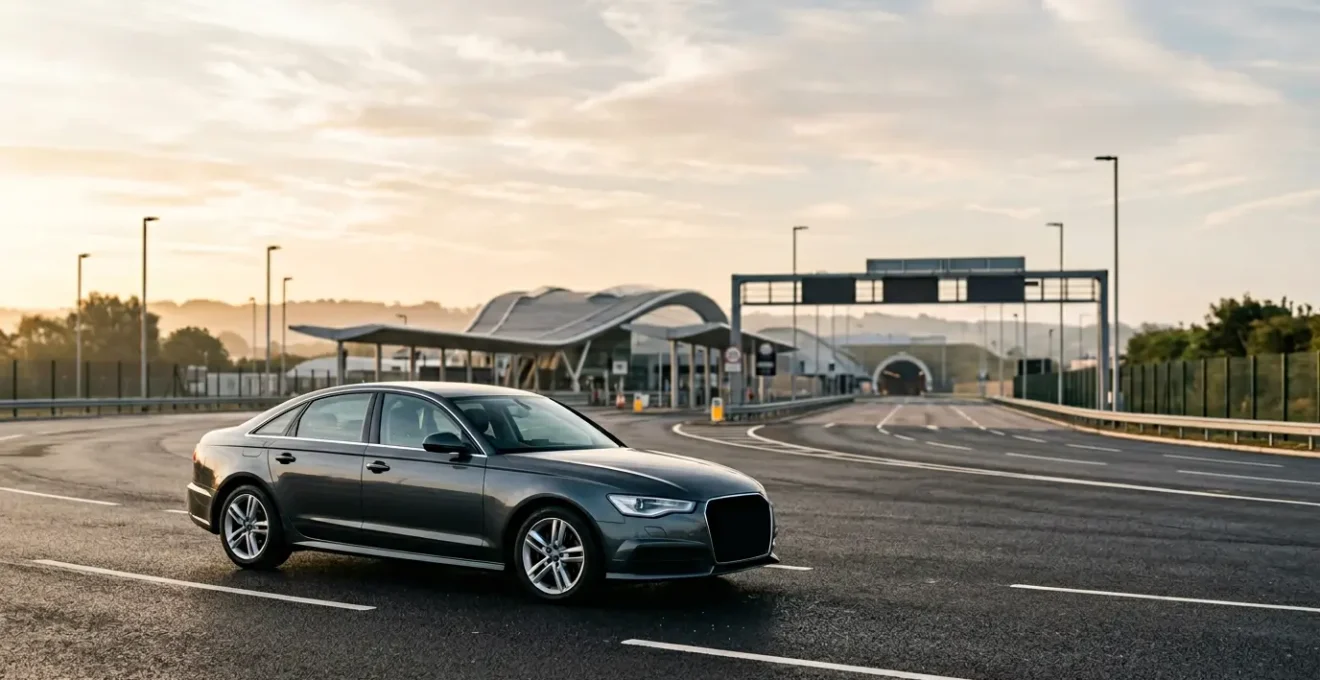
This image captures the scale and efficiency of the Eurotunnel loading process, where a luxury vehicle is poised to enter the shuttle, symbolizing the seamless transition between the UK and mainland Europe.
The following table, based on data from established travel analyses, breaks down the total time and qualitative differences, demonstrating why professional services overwhelmingly favour the tunnel for optimising door-to-door efficiency.
| Criteria | Eurotunnel (LeShuttle) | Ferry (Dover-Calais) |
|---|---|---|
| Crossing Time | 35 minutes | 90 minutes |
| Total Door-to-Door (London-Paris) | 5-6 hours | 7-8 hours |
| Frequency | Up to 4 departures/hour | Every 2-3 hours |
| Privacy During Crossing | Remain in vehicle | Must leave vehicle |
| Mobile Connectivity | 4G throughout journey | Limited at sea |
| Weather Resilience | Unaffected by weather | Subject to delays/cancellations |
| VIP Options | Flexiplus with priority boarding | Club lounges available |
| Typical Price Range | £59-£295 one way | £35-£150 one way |
For any journey where time, privacy, and predictability are paramount, the Eurotunnel is not merely an option but a strategic necessity for liability mitigation and service assurance.
The “Green Card” Myth: What Insurance Does Your Driver Actually Need?
A common misconception is that a UK driver is automatically insured for European travel. While a ‘Green Card’ is no longer required, the underlying insurance coverage is a critical point of legal liability. Standard personal car insurance is completely invalid for carrying paying passengers. For a journey to be legal, the vehicle must be covered by a specific type of commercial policy known as ‘Hire and Reward’ insurance. This is the first and most fundamental layer of compliance.
The second layer is ensuring this commercial policy explicitly includes European cover. Many UK-based ‘Hire and Reward’ policies only provide the minimum legal requirement in the EU, which is often just third-party liability. This leaves passengers and their belongings dangerously under-protected. A reputable operator will hold a fully comprehensive policy that extends full coverage to journeys in France and beyond. The final, crucial component is Public Liability Insurance. This separate policy protects passengers against injury and covers their property while in the care of the operator, an essential guarantee when transporting sensitive items.
As experts in European driving regulations confirm, relying on assumed coverage is a significant risk. As noted by industry specialists at RAC Drive in their comprehensive guide, the default level of cover can be inadequate. According to the RAC European Driving Guide 2024:
Most UK policies provide the minimum legal cover for driving within the EU, although this usually means third party only
– RAC Drive, RAC European Driving Guide 2024
Booking directly with a driver who operates on personal or inadequate insurance creates a massive liability for the client. In the event of an incident, you would have little to no legal recourse. A licensed operator’s adherence to this three-tiered insurance structure is a cornerstone of their duty of care.
Your Checklist: 3 Questions to Verify Insurance Compliance
- Does your operator have valid ‘Hire and Reward’ insurance? (Standard personal car insurance is invalid for commercial passenger transport).
- Does the insurance explicitly cover European travel including France? (This must be stated in the policy, not assumed).
- Can they provide proof of Public Liability Insurance? (This protects passengers and their belongings – request to see the certificate).
Insisting on evidence of these policies is not a matter of preference; it is a fundamental step in risk mitigation for any cross-border journey.
Why Your Ham Sandwich Could Get Confiscated at Calais?
Since Brexit, one of the most strictly enforced but commonly overlooked regulations concerns Personal Imports of Products of Animal Origin (POAO). Put simply, you are prohibited from bringing any meat or dairy products from the UK into the EU. This rule is absolute and applies to items as seemingly innocuous as a ham and cheese sandwich, a flask of milk for tea, or a pork pie. These items will be confiscated at the border, and failure to declare them can lead to fines and significant delays.
These rules are in place to protect the EU’s biosecurity and public health standards. While there are specific exceptions for limited quantities of powdered infant milk, infant food, or special medical foods, the general rule is a complete ban. This regulation poses a practical challenge for long journeys but also presents an opportunity for high-end service providers to demonstrate their operational awareness. A professional chauffeur service will not only warn clients of these restrictions in advance but will often provide an elegant solution. This proactive approach transforms a potential customs problem into a value-added element of the service.
This is a clear example of where a professional operator’s detailed knowledge of cross-border regulations provides tangible value and prevents a negative experience at the border control checkpoint.
Case Study: The Premium Chauffeur Service Compliant Travel Basket Solution
Imperial Ride, a luxury chauffeur service operating between London and Paris, pre-empts customs food restrictions by offering clients a complimentary ‘Continental Comfort Basket’ featuring EU-compliant premium snacks, artisanal chocolates from French suppliers, and beverages sourced from their Calais partners. This proactive approach transforms a potential customs headache into a value-added service, with clients appreciating both the forethought and the local French delicacies awaiting them for the journey.
The list of prohibited items is extensive, and ignorance of the law is not considered a valid excuse by border officials. The onus is on the traveller to be compliant.
Therefore, confirming your refreshments are EU-compliant before you reach the terminal is a small but critical detail in ensuring a seamless transit.
Door-to-Door London to Brussels: Is It Faster Than the Train?
When comparing a door-to-door chauffeur service with the Eurostar for a journey like London to Brussels, the analysis must extend beyond the raw travel time. While the train itself is faster, a private chauffeur often provides a more efficient and productive overall experience once all journey components are factored in. The key advantage of a chauffeur service is the elimination of “last mile” transit at both the origin and destination. There is no need to travel to and from train stations, saving a significant amount of time and logistical complexity.
Furthermore, a chauffeur-driven vehicle offers a completely private and secure environment for the entire duration of the journey. This allows for over four hours of continuous, productive work time in a comfortable setting, a stark contrast to the interrupted and public nature of train travel. The privacy aspect is also critical for confidential discussions or for passengers travelling with high-value goods. Luggage capacity is another major differentiator; a private vehicle offers virtually unlimited flexibility, whereas Eurostar has specific restrictions on the number and size of cases.
The interior of a modern executive vehicle is designed as a mobile office, prioritising comfort, connectivity, and productivity, as seen in this image.
While the train may arrive at its destination station slightly earlier, the total door-to-door time is often comparable, and in some cases, the chauffeur can be faster. The table below presents a realistic breakdown of the time investment for both options.
| Journey Component | Private Chauffeur | Eurostar Train |
|---|---|---|
| Door to Station/Start | 0 min (pickup at location) | 30-45 min |
| Check-in/Security | 45-60 min (Eurotunnel) | 30-45 min |
| Crossing/Travel Time | 35 min tunnel + 3.5 hrs drive | 2 hrs 20 min |
| Station to Final Destination | 0 min (direct to door) | 30-45 min |
| Total Door-to-Door | 5-6 hours | 4-5 hours |
| Productive Work Time | 4+ hours continuous | 2 hours (interrupted) |
| Privacy Level | Complete privacy | Public space |
| Luggage Flexibility | Unlimited | 2 cases + hand luggage |
When productivity, privacy, and door-to-door convenience are the primary goals, a professional chauffeur service presents a compelling and often superior alternative to rail travel.
How to Calculate the Perfect Pickup Slot for Non-EU Arrivals?
For airport pickups, particularly for passengers arriving on non-EU flights, calculating the correct pickup time is a science that balances precision with flexibility. A professional operator does not simply use the scheduled landing time. Instead, they employ a formulaic approach to determine the moment the chauffeur should be positioned in the arrivals hall, ensuring a seamless connection without unnecessary waiting for either party. The calculation begins with the flight’s actual landing time, which is tracked in real-time, not the scheduled time.
From there, a series of time buffers are added. These include allowances for aircraft taxiing (15-20 mins), immigration processing, and baggage reclaim. Immigration time is the most significant variable and is estimated based on the passenger’s nationality; a non-EU citizen can expect to wait anywhere from 35 to 60 minutes. Baggage reclaim adds another 20-30 minutes. Crucially, this calculation is dynamic. Operators factor in peak-hour congestion at the airport and are aware of systemic delays. For instance, the new Entry-Exit System implementation will require biometric checks that could add significant wait times, especially during the initial rollout phase.
This meticulous planning is part of an operator’s duty of care. It’s backed by a standard complimentary waiting period, typically 60 minutes, which begins from the moment the flight actually lands. This provides a generous cushion for unexpected delays at baggage or customs, ensuring the passenger is not penalised. The result is a highly optimised process that anticipates the passenger’s journey through the airport terminal.
Action Plan: Calculating the Perfect Pickup Slot
- Start with the scheduled flight arrival time.
- Add 15-20 minutes for aircraft taxiing and gate arrival.
- Add nationality-based immigration time: EU/UK citizens (15-20 min), US/Canadian (25-35 min), other non-EU (35-60 min).
- Add 20-30 minutes for baggage reclaim (or 45-60 min if arriving from outside the EU).
- Apply a peak hour adjustment: +15 min for morning arrivals (6-9am), +20 min for evening arrivals (4-7pm).
This systematic approach is a hallmark of a reliable service, transforming the potential chaos of an airport arrival into a predictable and stress-free experience.
What Does a TfL Private Hire Operator License Actually Guarantee?
In London, any legitimate chauffeur service must be managed by a company holding a Private Hire Operator License issued by Transport for London (TfL). This license is not a mere formality; it is a critical legal safeguard that provides a chain of responsibility and guarantees a baseline of safety and professionalism that an unlicensed, direct-to-driver booking cannot offer. The operator, not just the driver, is legally accountable for the entire journey.
The TfL license ensures several non-negotiable standards. It guarantees that all drivers have undergone enhanced DBS criminal background checks, a vital measure for passenger safety. It mandates that all vehicles are subject to regular, rigorous mechanical inspections to ensure they are roadworthy. Crucially, it forces the operator to hold the correct ‘Hire and Reward’ insurance, legally protecting you as a passenger. Furthermore, a licensed operator is required to maintain detailed records of every booking, providing a legal paper trail in case of any issues. They must also have an official complaints procedure, offering clients a formal channel for recourse.
This regulatory oversight extends to complex international compliance. As a transport compliance expert from the Commercial Transport Regulations Guide explains, the operator’s responsibilities go far beyond the UK border:
A licensed operator is responsible for ensuring the entire operation is legal, including complex issues like posting workers abroad (the French SIPSI system)
– Transport Compliance Expert, Commercial Transport Regulations Guide
The French SIPSI system is a mandatory online declaration for any company posting workers to France, including chauffeurs. An independent driver is highly unlikely to be aware of, or compliant with, this requirement, putting the entire journey at risk of legal challenges at the French border. The TfL Operator License acts as a guarantee that these complex layers of operational compliance are being professionally managed.
Choosing a licensed operator is therefore not about luxury, but about engaging a legally accountable entity that assumes the full duty of care for your safety and the compliance of your journey.
Key Takeaways
- For legal and safe cross-border travel, booking with a TfL-licensed operator holding comprehensive European insurance is non-negotiable.
- The Eurotunnel (LeShuttle) is strategically superior to ferries for VIP travel due to its speed, weather resilience, and enhanced privacy.
- Strict post-Brexit regulations, from passport validity to a ban on personal meat and dairy imports, require professional management to avoid border issues.
Why Booking with a Licensed Operator Is Safer Than a Direct Driver?
The decision to book a journey with a licensed operator versus a direct-to-driver arrangement is fundamentally a choice between a resilient, accountable system and a single point of failure. The safety and success of the journey are far better protected under an operator model due to built-in redundancy, regulatory oversight, and clear legal liability. A direct driver, often found through social media or informal networks, typically operates without the necessary commercial insurance, regulatory compliance, or backup infrastructure.
Consider the scenario of a vehicle breakdown or driver illness. A licensed operator has a fleet of vehicles and a team of drivers, enabling them to dispatch a replacement immediately to continue the journey. A sole trader has no such backup; the journey is simply cancelled, often with no recourse for the client. This risk is magnified on an international trip. Furthermore, operators are responsible for ensuring full cross-border compliance, including complex requirements like the French SIPSI registration. This is a level of administrative diligence that independent drivers frequently lack, creating a risk of being stopped and fined by authorities in France. Indeed, professional operators using Eurotunnel business accounts can access benefits like Flexiplus, which allows them to board any available train without a specific reservation, adding another layer of flexibility and risk mitigation that an individual cannot access.
The following risk assessment table clearly outlines the disparity in safety, reliability, and legal protection between the two models. It demonstrates that the lower price of a direct driver comes at the cost of significant, often unstated, risk.
| Risk Factor | Licensed Operator | Direct Driver |
|---|---|---|
| Vehicle Breakdown Coverage | Immediate replacement vehicle from fleet | Journey cancelled, no alternatives |
| Driver Illness/No-show | Backup driver dispatched | Service failure, no recourse |
| Insurance Coverage | Commercial insurance with full liability | Often only personal insurance (invalid) |
| Cross-Border Compliance | SIPSI registration, proper documentation | Frequently non-compliant, risk at border |
| Payment Protection | Traceable transactions, invoices, VAT receipts | Cash only, no paper trail |
| 24/7 Support | Control center monitoring journey | Driver’s personal phone only |
| Legal Accountability | Company duty of care, regulatory oversight | Personal arrangement, limited recourse |
To guarantee a compliant and seamless transit, the next logical step is to engage a fully licensed and insured operator who can demonstrate their adherence to these critical safety and legal standards for your journey.