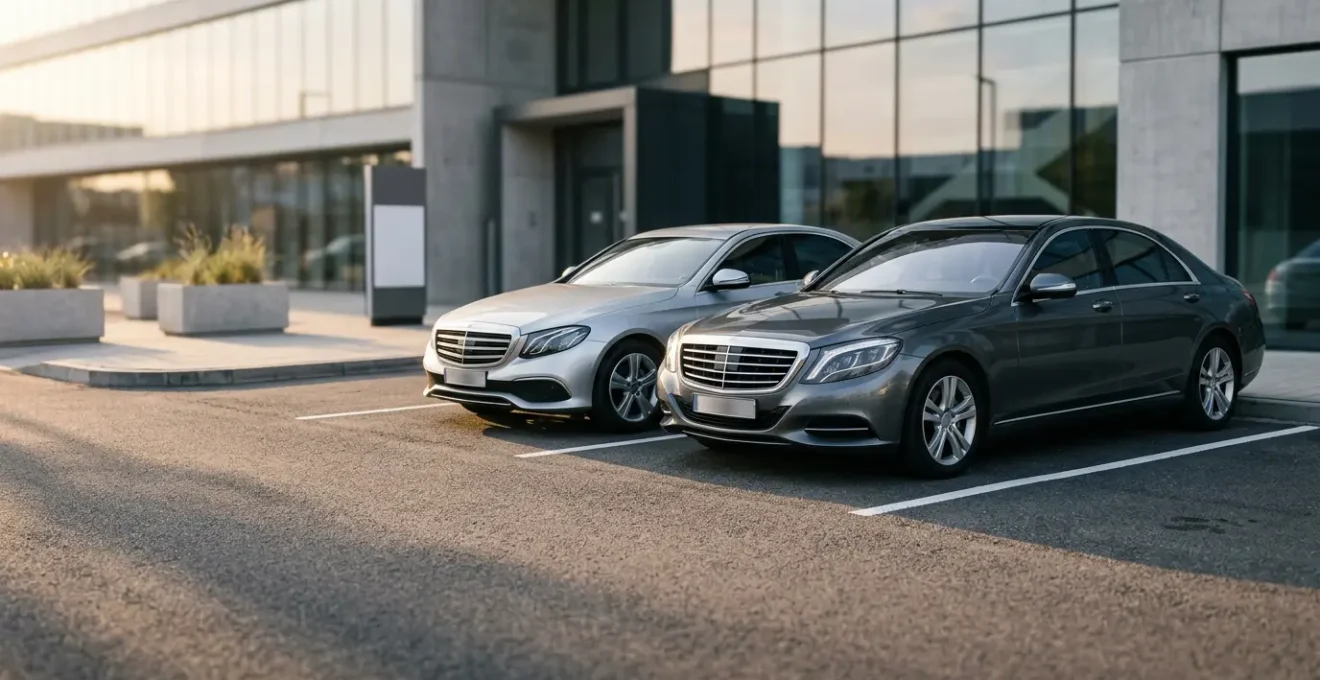
The choice between an E-Class and an S-Class is not about luxury, but about defining a clear, defensible, and cost-effective travel policy for your mid-level executives.
- The E-Class delivers the necessary professional image and comfort for most scenarios, representing the default standard for business-class ground travel.
- The S-Class is a justifiable upgrade only for specific use cases: accommodating taller passengers, ensuring maximum pre-meeting productivity on longer journeys, or aligning with top-tier client expectations.
Recommendation: Define vehicle tiers in your travel policy based on journey duration, passenger needs, and the meeting’s strategic importance, rather than seniority alone.
For any corporate travel manager, balancing executive expectations with fiscal responsibility is a constant challenge. When it comes to ground transport, the debate often crystallises around two vehicles: the Mercedes-Benz E-Class and its flagship sibling, the S-Class. The common wisdom is simple: the S-Class is more luxurious and therefore “better.” This perspective, however, is unhelpful when crafting a defensible and scalable travel policy. The real question isn’t which car is superior, but which car represents the appropriate, justifiable expense for a specific tier of employee and journey type.
Thinking in terms of air travel provides a useful analogy. The E-Class is your “Business Class”—a significant step up from standard, providing a comfortable and productive environment for the majority of professional needs. The S-Class is “First Class”—an exceptional experience reserved for situations where the return on investment is clear and measurable. This article moves beyond a simple comparison of features. It provides a pragmatic framework for travel policy architects to define when the standard E-Class is sufficient and when the premium for an S-Class is a strategic necessity, not an indulgence.
This guide will dissect the critical decision points, from passenger comfort and booking protocols to the tangible ROI of a superior travel experience. By analysing the specific use cases and potential pitfalls, you will be equipped to build a clear, cost-effective, and consistent executive car policy.
Summary: E-Class vs. S-Class: A Pragmatic Guide for Your Executive Travel Policy
- Why Is an E-Class 20% More Expensive Than a Standard Minicab?
- How to Adjust the Climate Control in the Rear of an E-Class?
- BMW 5 Series vs Mercedes E-Class: Which Has Better Rear Legroom?
- The “Standard Car” Category Mistake That Gets You a Prius Instead of a Mercedes
- When to Choose a Saloon Over an MPV for a Solo Trip?
- How to Book a Premium Chauffeur in London Without Hidden Surcharges?
- Is the Extra £20 for LWB Worth It for a 30-Minute Trip?
- Why Tall Passengers Struggle in Standard Wheelbase Vehicles?
Why Is an E-Class 20% More Expensive Than a Standard Minicab?
From a purely budgetary standpoint, a 20% premium for an E-Class over a standard minicab can seem like an unnecessary expense. However, this view overlooks the fundamental purpose of executive transport. The cost difference isn’t for a mere badge; it’s an investment in consistency, professionalism, and a controlled environment. A standard minicab service offers basic point-to-point transit, but the vehicle quality, driver professionalism, and overall experience can be highly variable. This variability introduces risk, which is unacceptable in a corporate travel policy designed to support business objectives.
The Mercedes E-Class, since its conceptual inception in the 1950s, has been engineered as an executive vehicle. It provides a baseline of quality that a travel policy can rely on. This includes a quiet cabin conducive to work or confidential calls, superior ride comfort that reduces travel fatigue, and a professional image that aligns with corporate standards. The premium paid is effectively an insurance policy against a negative travel experience that could impact an executive’s performance or the company’s reputation.
Therefore, the policy justification is clear: the E-Class is not a “luxury” but the established benchmark for “business class” ground travel. The 20% premium buys a standardised, reliable service that eliminates the gamble associated with non-executive vehicle categories. It ensures the employee arrives at their destination prepared and in a professional mindset, which is the primary ROI of any business trip.
How to Adjust the Climate Control in the Rear of an E-Class?
While it may seem like a minor detail, the ability to control the cabin environment is a crucial component of passenger comfort and, by extension, productivity. An environment that is too warm or too cold can be distracting and stressful, hindering an executive’s ability to prepare for a meeting. The Mercedes E-Class typically features rear climate controls, allowing for a degree of personalisation. However, effective policy and communication are more important than the hardware itself.
The most professional and efficient approach is to empower the chauffeur. The passenger should not have to hunt for buttons or divert their attention from their work. A well-trained chauffeur will proactively ask about temperature preferences at the start of the journey. For a travel manager, ensuring that a chosen chauffeur service includes this level of proactive service in their standard protocol is a key differentiator. It shifts the responsibility from the passenger to the service provider, which is the goal of premium transport.
For executives who prefer direct control, the rear climate panel is usually located on the back of the center console. It allows for adjustments to temperature and fan speed for the rear cabin zone. However, the best practice remains clear communication with the professional at the wheel. The following protocol should be part of any executive’s travel routine.
Action Plan: Ensuring Passenger Comfort
- Communicate preferences to the chauffeur before the journey begins.
- Specify exact temperature preference (e.g., ’21 degrees, please’).
- Request airflow adjustment if needed for optimal comfort, such as directing vents away from the face.
- Utilize the rear climate control panel located in the center console for minor adjustments if necessary.
- Leverage a controlled environment to enhance cognitive function and reduce stress before meetings.
BMW 5 Series vs Mercedes E-Class: Which Has Better Rear Legroom?
When defining the “Business Class” tier of a travel policy, the main contenders are the Mercedes E-Class and the BMW 5 Series. From a passenger comfort perspective, rear legroom is a critical metric. A cramped posture can lead to discomfort and fatigue, especially on longer journeys across a city like London. While both vehicles are designed for executive comfort, a direct comparison reveals subtle but important differences.
Generally, the BMW 5 Series offers a marginal advantage in rear legroom over the standard E-Class. However, the difference is often less than an inch and can be influenced by the position of the front seats. The key takeaway for a travel policy architect is that for most passengers of average height, both vehicles provide a comparable and adequate level of comfort. The choice between them is often a matter of brand preference or supplier availability rather than a significant difference in passenger space.
The more important distinction lies between this entire category and the next tier up. As a comparison of executive saloons highlights, the real jump in passenger space comes with the S-Class. This is where the policy decision becomes critical.
| Model | Rear Legroom | Wheelbase | Passenger Focus |
|---|---|---|---|
| Mercedes E-Class | 36.2 inches | 115.7 inches | Mobile office posture |
| Mercedes S-Class | 43.8 inches | 126.6 inches | Chauffeur-focused comfort |
| BMW 5 Series | 36.5 inches | 117.1 inches | Relaxed lean-back comfort |
As experts note, the S-Class offers a truly different experience: “Rear legroom in the S-Class is a luxurious 43.8 inches, compared to about 36 inches in the E-Class—plenty for adults, but not quite the same level of stretch-out comfort.” This data confirms that while the E-Class and 5 Series are peers, the S-Class occupies a separate category defined by chauffeur-driven luxury. Your policy should reflect that the standard executive tier is well-served by either an E-Class or 5 Series, with the S-Class reserved as a specific, justified upgrade.
The “Standard Car” Category Mistake That Gets You a Prius Instead of a Mercedes
One of the most significant risks in corporate travel procurement is category ambiguity. Booking a vehicle under a vague descriptor like “Executive Car” or “Premium Saloon” can lead to major service failures. Many booking platforms and service providers use these terms loosely, often with an “or similar” clause that can result in a standard hybrid like a Toyota Prius arriving to collect a senior manager. While a Prius is a perfectly functional vehicle, it lacks the professional image, cabin comfort, and quiet environment expected from executive transport.
This scenario undermines the very purpose of paying a premium for a professional car service. It creates a poor experience for the executive and reflects poorly on the company’s travel policy. To mitigate this risk, a travel policy must be unequivocally precise in its language. It should abandon generic terms in favour of clearly defined vehicle classes that are communicated to all approved suppliers.
A robust policy should categorise vehicles into distinct tiers to ensure the service delivered matches the service booked. This simple act of standardisation eliminates ambiguity and protects the company from paying an executive rate for a standard service. The rule should be to always book by class, not by a generic description.
- Standard/Eco Category: Toyota Prius, Hyundai Ioniq. Suitable for general employee transit, not executive travel.
- Business/Executive Category: Mercedes-Benz E-Class, BMW 5-Series, Audi A6. The default for all manager-level and executive travel.
- First/Luxury Category: Mercedes-Benz S-Class, BMW 7-Series, Audi A8. Reserved for C-suite, key clients, or specific use cases defined in the policy.
Your policy should also mandate that any supplier must provide written confirmation of the specific vehicle model or, at minimum, the guaranteed vehicle class prior to the journey. This eliminates loopholes and ensures accountability.
When to Choose a Saloon Over an MPV for a Solo Trip?
For a solo executive traveller, the choice between a saloon (like an E-Class or S-Class) and a Multi-Purpose Vehicle (MPV) (like a Mercedes V-Class) should be straightforward. From a policy perspective, a saloon is almost always the correct and more fiscally responsible choice. An MPV is designed for group travel, offering space for 5-7 passengers. Using such a large vehicle for a single person is inefficient in terms of fuel, operational cost, and physical footprint in congested urban environments.
Beyond the practicalities, the choice of vehicle also sends a signal. A sleek, professional saloon projects efficiency, purpose, and discretion. An under-occupied MPV can appear wasteful or less professional. The primary role of the E-Class is to function as a premium executive saloon, perfectly suited for owner-drivers or, in this context, as a chauffeur-driven vehicle for one or two passengers. The S-Class elevates this with a focus on rear-seat luxury, but it remains a saloon designed for individual comfort, not mass transit.
The only logical exception for booking an MPV for a solo traveller would be the need to transport an unusually large amount of luggage or equipment that would not fit in the boot of a saloon. In all other scenarios, the saloon is the designated tool for the job. The significant difference in capital cost, where an S-Class can represent nearly double the investment of an E-Class, already signifies a major step-up in service level; escalating further to an MPV without a clear capacity-based need is unjustifiable.
How to Book a Premium Chauffeur in London Without Hidden Surcharges?
Booking a premium chauffeur service in a major hub like London can be fraught with pricing complexities. A low initial quote can quickly inflate with hidden surcharges for waiting time, parking, congestion charges, or out-of-hours travel. A robust travel policy must prioritise pricing transparency to ensure budget predictability and avoid post-trip invoicing disputes. The most effective strategy is to partner exclusively with providers who offer a clear, all-inclusive pricing model.
An all-inclusive rate should, by default, cover all foreseeable costs associated with the journey. This typically includes a set amount of waiting time for airport pickups, all tolls and congestion fees, and fuel. Gratuity is another area of ambiguity; a truly transparent provider will state upfront whether gratuity is included in the rate or left to the passenger’s discretion. Your policy should mandate that all quotes must explicitly detail what is and is not included.
The value of such a service goes beyond mere transport. As noted by premium providers, their higher rates reflect a comprehensive service standard. As one firm states, “Our chauffeurs are trained in professional etiquette, defensive driving, and route optimization so your trip is smooth, discreet, and punctual. Whether you request Mercedes S-Class hire… our chauffeurs handle logistics, luggage, and timing so you can focus on work or relax in privacy.” Paying a fixed, transparent price is an investment in this level of service, where the chauffeur acts as a mobile executive assistant, managing the journey’s friction points. This level of care from a provider like Elite Town Car Services is what a premium fee should guarantee.
Therefore, the policy directive is simple: favour suppliers who provide flat-rate airport transfers and clear hourly rates with no hidden fees. Requesting a sample invoice or a rate card during the supplier vetting process is a crucial step in ensuring there are no surprises.
Is the Extra £20 for LWB Worth It for a 30-Minute Trip?
On the surface, authorising an extra £20 for a Long Wheelbase (LWB) vehicle, typically an S-Class, for a short 30-minute trip seems like a poor return on investment. The incremental cost appears high for a benefit that is only enjoyed for a brief period. However, the decision should not be based on trip duration alone, but on the strategic importance of the passenger’s arrival condition. For a routine transfer, it is likely unjustifiable. But for a high-stakes meeting, that £20 can be a critical investment in performance.
A standard wheelbase saloon can feel restrictive for taller individuals, even on a short journey. The inability to stretch out can create physical and mental friction. The LWB S-Class, which can have a wheelbase 6–10 inches longer than the E-Class, with that extra space dedicated almost entirely to the rear cabin, eliminates this friction. It allows the passenger to sit in a relaxed posture, review documents comfortably, or simply gather their thoughts without distraction.
The “Comfort ROI” here is about ensuring a key executive or client arrives focused, calm, and ready to perform. As one analysis of the passenger experience puts it, a polished and comfortable ride “protects emotional balance and guides people through heavy schedules with ease.” The extra £20 isn’t buying 30 minutes of luxury; it’s buying a pristine mental state upon arrival. If the outcome of the subsequent meeting has significant financial implications, this small premium becomes a negligible and highly logical expense. The policy should therefore empower those booking travel to make this value judgement based on the context of the trip, not just a rigid cost-per-minute calculation.
Key Takeaways
- Standardise on the E-Class as the default vehicle for all routine mid-level executive travel to ensure cost-effectiveness and a professional standard.
- Define clear, written policy exceptions for upgrading to an S-Class, such as for passengers over 6’2″ (188cm), journeys exceeding 90 minutes, or travel to high-stakes client meetings.
- Always book by specific vehicle class (e.g., ‘Business Saloon’, ‘First Saloon’) with approved suppliers to avoid the “or similar” clause and prevent service failures.
Why Tall Passengers Struggle in Standard Wheelbase Vehicles?
The issue of passenger height is a matter of ergonomics and duty of care that a travel policy must address. While a standard wheelbase saloon like the Mercedes E-Class offers a respectable amount of space, it can be genuinely restrictive for individuals over 6’2″ (188cm). This is not a matter of preference but of physical reality. Forcing a tall executive into a space where their knees are pressed against the front seat is not only uncomfortable but also unprofessional and can negatively impact their perception of the company’s travel arrangements.
The core of the problem lies in the raw dimensions. The E-Class provides around 36.2 inches of rear legroom. In contrast, an S-Class offers a significantly more generous space, as data shows that with 43.8 inches of rear legroom, the S-Class is vastly more comfortable for rear passengers. This difference of over seven inches is transformative, allowing a tall passenger to sit comfortably without compromise. It also allows for a more productive journey, as it provides ample space to use a laptop or review documents.
Furthermore, the S-Class is engineered not just for more space, but for a superior ride quality. It is widely regarded as having the smoothest, most insulated ride in its category, isolating the passenger from road imperfections and noise. This combination of ample space and a serene environment makes it the definitive tool for ensuring a key passenger, regardless of height, arrives at their destination feeling refreshed and focused. From a policy standpoint, specifying an S-Class for demonstrably tall passengers is a reasonable adjustment and a clear demonstration of the company’s commitment to employee well-being.
Frequently Asked Questions on Mercedes E-Class or S-Class: Which Saloon Fits Your Junior Executive Budget?
Is waiting time included in the quoted price?
For premium services like a Mercedes S-Class chauffeur, airport transfers are often quoted at flat rates that include a set amount of waiting time. For hourly hire, which might start at $150 per hour with a 2-hour minimum, waiting time is part of the booked duration. Always confirm the specific allowance in writing before booking.
Are there surcharges for late-night or early-morning travel?
Most top-tier chauffeur services incorporate all hours of operation into their standard rates to provide pricing clarity. However, it is a critical best practice to always confirm this explicitly before finalizing a booking, as some providers may apply a surcharge for travel outside of core business hours.
Is gratuity included or expected?
This varies by provider. Many premium services include gratuity within the quoted price to provide an all-inclusive, seamless experience for corporate clients. A travel policy should require suppliers to clarify their gratuity policy in writing to avoid ambiguity for the passenger.