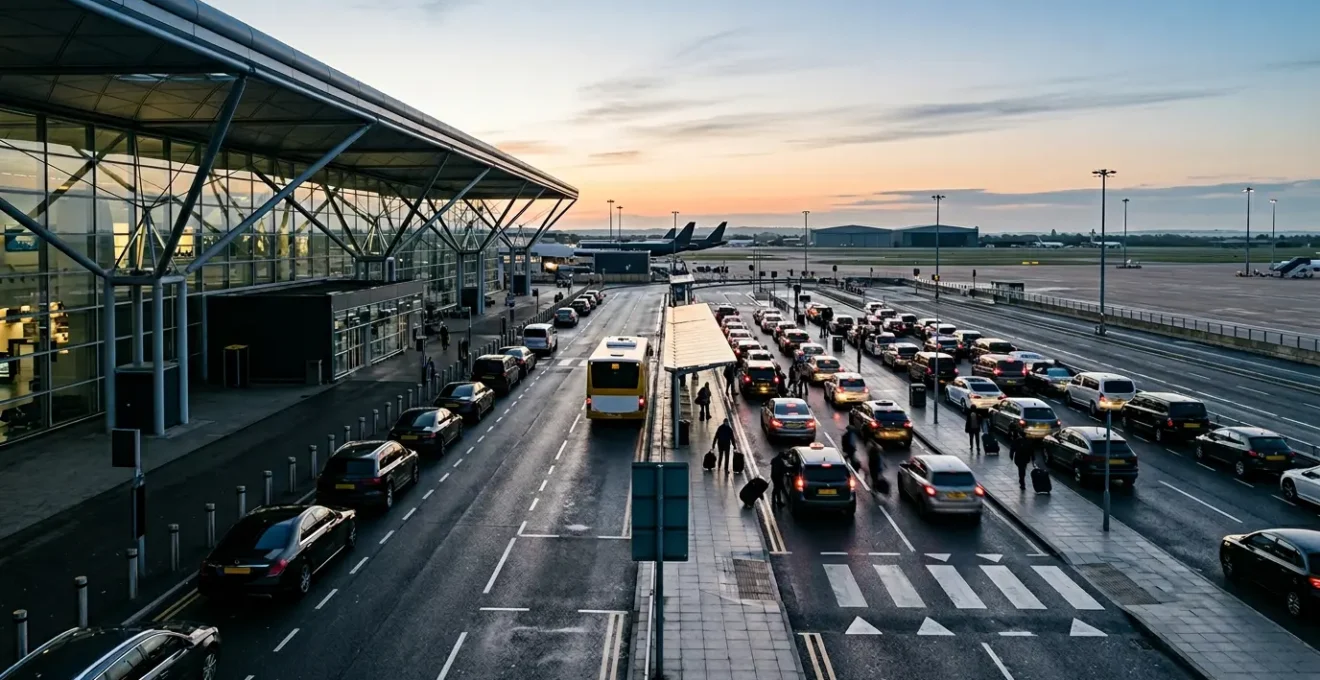
For a critical Stansted Airport transfer, pre-booking a specialist service is systematically more reliable and often more cost-effective than relying on an on-demand app.
- On-demand app pricing is designed to surge by up to 2.5x during peak airport hours, eliminating perceived savings.
- Pre-booked services offer a fixed price and a dedicated vehicle, representing guaranteed capacity versus the probabilistic availability of a marketplace.
Recommendation: Shift your analysis from comparing base fares to evaluating the total cost of failure. For a journey where punctuality is non-negotiable, securing a pre-booked transfer is the logical, data-supported choice.
It’s 4 AM. The house is dark, the suitcases are by the door, and a knot of anxiety is tightening in your stomach. Your flight from Stansted departs in three hours. You open your ride-hailing app, confident in the convenience you’ve been sold, only to be met with the dreaded message: “No cars available.” This scenario is more than an inconvenience; for the Essex-based commuter or traveller, it’s a recurring nightmare born from a fundamental misunderstanding of how on-demand transport models operate.
The common advice is to “plan ahead,” but this vague platitude fails to address the core issue. The choice is not simply between booking now or booking later. It’s a choice between two entirely different economic systems: the logistics-driven model of a specialist transfer agency versus the free-market, gig-economy model of an on-demand app. One sells you a guaranteed, predictable service; the other sells you a chance at securing a service, subject to real-time market forces.
But what if the true key to a stress-free airport transfer isn’t just about avoiding last-minute panic, but about understanding the systemic reasons why one model is built for reliability and the other is built for volatility? This analysis moves beyond anecdotal evidence to provide a data-driven breakdown of the two approaches. By dissecting the mechanics of surge pricing, cancellation risks, and true cost-effectiveness, we can definitively answer which method truly saves you time and stress when it matters most.
This article provides a logical framework for making the optimal transport decision for your Stansted airport journeys. Below is a summary of the key analytical points we will cover to help you navigate the complex choice between pre-booked reliability and on-demand uncertainty.
Summary: A Transport Analyst’s Guide to Stansted Travel
- Why Do On-Demand Prices Surge by 200% on Monday Mornings?
- How to Guarantee Your Morning Airport Transfer 7 Days in Advance?
- Specialist Agency or App: Who Is Less Likely to Cancel on You?
- The Last-Minute Booking Error That Leaves You Stranded at 4 AM
- When to Finalize Your Return Leg: Before Departure or Upon Landing?
- Why Are UK Airports Charging £5 Just to Drop You Off?
- Cost Per Mile vs Cost Per Seat: When Does Long-Distance Make Financial Sense?
- How to Manage Transport Logistics When Business Schedules Shift Hourly?
Why Do On-Demand Prices Surge by 200% on Monday Mornings?
Surge pricing isn’t a bug in the on-demand system; it’s a core feature designed to balance supply (drivers) and demand (riders). However, this model systematically penalizes travellers during time-critical moments like early morning airport runs. The price you see is not based on distance, but on an algorithm’s real-time calculation of scarcity. For Stansted, this creates a perfect storm. There’s a high, predictable demand for flights between 4 AM and 6 AM, but a low supply of drivers willing to make a long-distance trip that often results in an unprofitable, empty return journey to London.
The result is aggressive, algorithm-driven price hikes. Analysis shows that for early morning Stansted transfers, it’s common to see surge multipliers of 1.5x to 2.5x. A journey with an estimated base fare of £70 can instantly inflate to £175. This isn’t just a London phenomenon; research confirms that predictable peak surge pricing occurs at airports and train stations during morning and evening commuter hours. The system is designed to extract the maximum price from those who have no other choice. Ultimately, the “convenience” of on-demand is an illusion that evaporates precisely when you need it most, replaced by a punitive pricing model that exploits your lack of alternatives.
How to Guarantee Your Morning Airport Transfer 7 Days in Advance?
The antidote to on-demand volatility is not just booking early, but booking a service that operates on a different model: guaranteed capacity. When you pre-book with a specialist airport transfer agency, you are not just signaling your intent to travel; you are purchasing a confirmed slot in a logistics schedule. This fundamentally changes the nature of the transaction from a probabilistic hope to a contractual certainty. The price is fixed, the vehicle is allocated, and the driver is assigned, often 24-48 hours in advance.
This “locked-in” rate offers more than just budget predictability; it provides complete financial protection against the algorithmic whims of surge pricing. Whether market demand spikes to 2x or 3x the normal rate due to a train strike or bad weather, your pre-agreed price remains unchanged. This isn’t a feature; it’s the foundation of the business model. Professional services build their reputation on reliability, and that begins with honoring the price quoted at the time of booking. It transforms the journey from a stressful gamble into a managed, predictable component of your travel plan.
This level of professionalism and planning ensures that your journey begins smoothly. The focus is on service delivery, not market exploitation. By choosing a pre-booked service, you are opting out of the on-demand lottery and investing in the logistical certainty required for a critical journey like an early morning flight.
Specialist Agency or App: Who Is Less Likely to Cancel on You?
A confirmed booking is worthless if the driver cancels at the last minute. This is where the structural differences between a specialist agency and an on-demand app become most apparent. For an app-based driver, a long-distance run to Stansted can be economically unattractive, especially if it means a long, unpaid return journey. They are independent contractors who can, and often do, decline or cancel rides that don’t fit their personal profit algorithm. If they get a more lucrative, shorter trip request while en route to you, their incentive may be to cancel your booking, leaving you stranded.
A specialist agency, conversely, has its reputation tied to every single ride. Drivers are often employees or long-term contractors whose performance is measured by reliability. A human dispatcher actively manages the schedule and can reroute vehicles to cover unforeseen issues like traffic, ensuring a backup is always available. The system is designed with redundancy in mind. This table illustrates the fundamental differences in reliability between the two models, based on an analysis of airport transfer services.
| Factor | Specialist Agency | On-demand App |
|---|---|---|
| Fixed Pricing | Guaranteed rate locked at booking | Surge pricing 1.5x-2.5x at peak times |
| Driver Commitment | Driver pre-assigned 24-48 hours ahead | Driver assigned when available |
| Cancellation Risk | Low – reputation tied to every ride | Higher – drivers can decline long routes |
| Backup System | Human dispatcher can reroute vehicles | User must restart booking process |
| System Outage Impact | Phone lines and local dispatch continue | Service unavailable during server issues |
The data is clear: an on-demand app outsources the risk of cancellation to the user, who must restart the booking process in a high-stress situation. A specialist agency internalizes that risk, building systems to guarantee service delivery because its entire business model depends on it.
The Last-Minute Booking Error That Leaves You Stranded at 4 AM
The risk of a transport failure is amplified for early flights from Stansted because the public transport alternatives are severely limited. For anyone needing to be at the airport before 5:00 AM, a private vehicle is often the only viable option. For example, the first Stansted Express train from Liverpool Street doesn’t arrive until after 5:00 AM. This lack of a reliable backup dramatically increases the cost of failure; a cancelled taxi doesn’t just mean a delay, it could mean a missed flight.
Even when pre-booking, small data entry errors can lead to catastrophic failures. The most common is the AM/PM mistake when using a 12-hour clock, booking a ride for 4 PM instead of 4 AM. Another frequent issue is relying on imprecise GPS pin drops instead of manually entering the full address and postcode. These are not just user errors; they are failures in the booking system’s design to proactively prevent common mistakes. A professional service often has a human review process that can catch such anomalies, but with a fully automated system, the responsibility falls entirely on the user.
To mitigate these risks, a rigorous verification process is not just recommended; it’s essential. Adopting a pilot’s mindset of checking and double-checking is the only way to ensure your booking is truly secure.
Your Pre-Flight Booking Verification Checklist
- Use the 24-Hour Clock: Always input times in 24-hour format (e.g., 04:00) to eliminate any ambiguity between AM and PM.
- Verify the Address Manually: Type your full street address and postcode. Do not rely on GPS pins, which can be inaccurate by several houses.
- Confirm Driver Assignment: A booking confirmation is not enough. Ask for a ‘driver-assigned’ confirmation 24 hours prior to your journey. This confirms a specific person and vehicle are allocated to you.
- Check the Time Zone: When booking from abroad, ensure your confirmation email shows the correct local pickup time (BST/GMT), not the time zone you are currently in.
- Include Flight Monitoring: Confirm that the service includes flight number monitoring. This allows the driver to automatically adjust pickup times for your return leg if your flight is delayed, without you needing to contact them.
When to Finalize Your Return Leg: Before Departure or Upon Landing?
The logic of securing your departure transfer with a pre-booked service applies with equal, if not greater, force to your return journey. While it may seem flexible to “wait and see” and book a car upon landing, this approach reintroduces all the risks you sought to avoid. After a long flight, the last thing any traveller wants is to be faced with the on-demand lottery: navigating a crowded arrivals hall, comparing fluctuating app prices, and hoping a car is available. This is a moment of high fatigue and low patience, making you a prime target for surge pricing.
The most effective strategy is to book your return journey as a round trip with your initial departure booking. A professional transfer service will request your return flight number specifically for monitoring purposes. This is a critical feature: it means the company takes on the responsibility of tracking your flight’s arrival time. If your flight is delayed by three hours, the driver’s schedule is automatically adjusted. You do not need to make frantic calls from a different time zone. You can simply land, collect your luggage, and know that a vehicle is waiting.
Booking on landing is a false economy. The potential for small savings is dwarfed by the certainty of a pre-arranged, flight-monitored pickup. It represents the final piece of the puzzle in creating a seamless, stress-free airport logistics plan, allowing your journey to end as smoothly as it began.
Why Are UK Airports Charging £5 Just to Drop You Off?
The introduction of drop-off fees at Stansted and most other major UK airports is a source of frustration for many travellers. While it can feel like another charge in a long list of travel expenses, understanding the logic behind it is key for a transport analyst. These fees, typically around £5, serve a dual purpose for the airport authority: revenue generation and traffic management. Airports are complex commercial enterprises, and like parking, these fees contribute to their non-aeronautical income streams, which help fund airport maintenance and development.
More importantly, these charges are a tool to manage the chronic congestion that plagues airport forecourts. By putting a price on kerbside access, airports create a financial incentive to minimize dwell time, encouraging quick drop-offs and reducing traffic jams. It also aims to nudge travellers towards more sustainable transport options like airport coaches and trains, which use consolidated drop-off points. While the charge is unavoidable for those using private transfers, it’s a known, fixed, and predictable cost. Unlike the wild, unpredictable swings of surge pricing, this £5 fee can be budgeted for and is typically included in the transparent, all-in quote from a professional pre-booked service. It is a predictable part of the system, not a last-minute surprise.
Cost Per Mile vs Cost Per Seat: When Does Long-Distance Make Financial Sense?
For solo travellers, the per-seat cost of the Stansted Express often appears to be the most economical choice. However, this calculation breaks down as soon as you add more passengers or significant luggage. The financial logic must shift from comparing a single ticket price to analysing the total cost of the vehicle. A private transfer has a fixed cost per mile for the vehicle, regardless of whether there is one passenger or four. A train, by contrast, has a fixed cost per seat. This distinction is the key to identifying the financial tipping point.
As the following cost comparison for different group sizes shows, a private transfer rapidly becomes more cost-effective for groups or families. Once you have three or more passengers, the total cost of individual train tickets often exceeds the cost of a single, comfortable, door-to-door private vehicle.
| Transport Type | Cost Structure | Best For |
|---|---|---|
| Private Transfer (4 seats) | £110 fixed for vehicle | Groups of 2-4 with luggage |
| MPV Transfer (6 seats) | £125 fixed for vehicle | Families/groups 4-6 people |
| Minibus (8 seats) | £150 fixed for vehicle | Large groups, cost per person drops significantly |
| Stansted Express | £21 per person | Solo travelers or couples without much luggage |
| On-demand (surge) | £60-175 variable | Last-minute single travelers willing to risk price |
The economic advantage becomes even clearer with larger groups. As Mile5 Transport Analysis highlights in its guide:
For a journey from Cambridge to Stansted, a pre-booked 8-seater minibus at a fixed £120 becomes cheaper than the Stansted Express (£21/person) once you have 6 or more passengers.
– Mile5 Transport Analysis, Stansted Airport Guide 2026
This demonstrates that for any group larger than a couple, a purely financial analysis, even before considering convenience and door-to-door service, often favours a pre-booked private transfer.
Key Takeaways
- On-demand surge pricing is a feature, not a bug, designed to exploit scarcity during peak airport hours.
- Pre-booking a specialist service provides guaranteed capacity at a fixed price, eliminating financial and logistical risk.
- The true cost of transport must include the cost of failure; a missed flight is infinitely more expensive than the premium for a reliable transfer.
How to Manage Transport Logistics When Business Schedules Shift Hourly?
For the business traveller whose schedule is in constant flux, the idea of pre-booking might seem counterintuitively rigid. However, seasoned executives and their travel managers understand that managing uncertainty requires a structured, multi-layered strategy, not a reliance on last-minute luck. The core principle is redundancy. It’s not about choosing one service over another, but about establishing a hierarchy of trusted options. The foundation of this strategy for any critical journey, like getting to the airport, remains a flexible pre-booked service.
Many professional car services catering to corporate clients offer flexible booking terms, allowing cancellations or time changes up to an hour before pickup. This provides a safety net that on-demand apps cannot match. The next layer of the strategy involves establishing corporate accounts with one or two vetted backup services. This ensures priority access and pre-negotiated rates if the primary plan changes. On-demand apps are relegated to the third and final tier of this hierarchy—an emergency backup for non-critical, short-distance urban trips, but never for a journey where punctuality is paramount.
Ultimately, managing dynamic logistics is about control. It’s about knowing you have a dedicated account manager you can call, a guaranteed vehicle from your primary provider, and a vetted backup on standby. This proactive, layered approach is the hallmark of professional travel management. It replaces the anxiety of reactive, last-minute booking with the confidence of a resilient and adaptable logistics plan.
For your next critical airport journey, the logical next step is to shift your mindset from simply ‘booking a ride’ to ‘managing your logistics’. Analyze your options not by their advertised base fare, but by their guaranteed performance, their cancellation policies, and their ability to mitigate the high cost of failure. Invest in certainty, not chance.