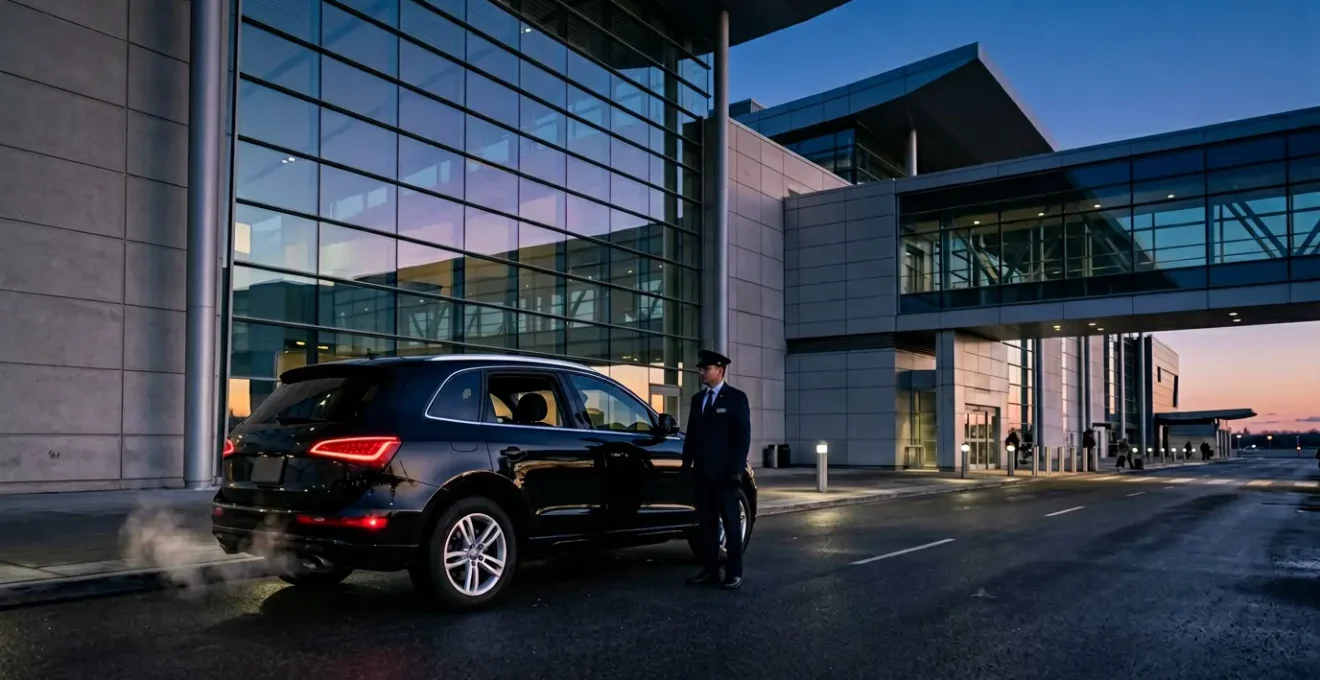
A sub-5-minute terminal exit is not a luxury; it is a security protocol achieved through systemic orchestration, not just premium services.
- Proactively neutralize failure points like luggage claim and security queues with dedicated, pre-planned protocols.
- Leverage technology for real-time driver coordination and data-driven exit strategy selection.
Recommendation: Shift from reactive problem-solving to building a proactive “zero-friction” system for every airport transit, treating time as your most critical security asset.
For an executive protection officer, the airport is a high-risk environment where every second of public exposure increases the threat profile. The goal is simple: transition the principal from the sterile zone of the aircraft to the secure bubble of the vehicle in the shortest time possible. Many rely on fast-track passes and pre-booked cars, only to find their VIP waiting curbside, exposed and frustrated. This common failure stems from a fundamental misunderstanding. Speed is not a product you buy; it’s a system you engineer.
Standard operating procedures often focus on individual components—the meet-and-greet agent, the premium lane, the driver—without orchestrating them into a single, seamless maneuver. This article rejects that fragmented approach. We will not rehash the basics. Instead, we will dissect the anatomy of a truly efficient airport exit, guided by a single principle: the Zero-Friction Protocol. It’s a proactive strategy focused on identifying and neutralizing every potential point of failure before the aircraft’s wheels touch the tarmac.
This protocol transforms your role from a reactive escort to a master of logistics. It’s about leveraging intelligence, technology, and counter-intuitive strategies to control every variable. The objective is to make the five-minute exit not an ambitious target, but a repeatable, guaranteed outcome. Time, in this context, is a weapon, and mastering it is the ultimate expression of professional security.
This guide provides a detailed breakdown of the critical systems you must implement to achieve this standard of excellence. We will explore the precise tactics for navigating security, coordinating ground transport, managing luggage, and even optimizing multi-stop schedules in a congested urban environment.
Summary: The VIP’s 5-Minute Airport Exit Protocol
- Why Does Fast-Track Security Sometimes Take Longer Than the Standard Lane?
- How to Coordinate Driver Arrival with “Wheels Down” Notifications?
- Main Exit or VIP Gateway: Which Is Safer for High-Profile Clients?
- The Luggage Belt Error That Adds 30 Minutes to Your VIP’s Exit
- What Are the 3 Signals Your Driver Needs to Start the Engine Before You Exit?
- The “Too Dark” Mistake That Actually Attracts Paparazzi Attention
- In-Terminal Meet or Curbside Call: Which Is Better for VIPs?
- How to Execute a 5-Stop Meeting Schedule in Central London Without Delays?
Why Does Fast-Track Security Sometimes Take Longer Than the Standard Lane?
The term “fast-track” is a misnomer; it is merely a priority queue, not a guaranteed-speed lane. Its efficiency is contingent on passenger volume and preparedness, factors outside your control. During peak travel times, these lanes often become congested with infrequent premium travelers who are less organized than seasoned flyers. The result is a bottleneck that can easily be slower than a well-chosen standard lane. A Zero-Friction Protocol replaces blind faith in signage with active intelligence and dynamic decision-making.
The core principle is real-time lane analysis. This involves treating the security checkpoint not as a single barrier but as a series of options to be assessed on the spot. An experienced officer evaluates lane population, passenger profiles (families with strollers vs. solo travelers), and the efficiency of the agents on duty. This assessment, made in seconds, is far more reliable than any airport marketing promise. The illusion of exclusivity is a common failure point; your protocol must be based on observable reality.
Ultimately, your team’s preparation is the only variable you truly control. Regardless of the lane chosen, having all electronics, liquids, and documents pre-organized for immediate presentation is non-negotiable. The goal is to be the most efficient party in any queue, thereby minimizing your time in the system. Relying on a “premium” service to compensate for a lack of personal preparedness is a foundational error in executive protection.
Action Plan: Real-Time Lane Choice Strategy
- Check the MyTSA app or airport-specific equivalent 30 minutes before arrival for live wait time intelligence.
- Observe both fast-track and standard lanes upon approach; count the number of individuals and assess their visible level of preparedness.
- Identify and avoid lanes with a high concentration of family groups or travelers fumbling with electronics and luggage.
- Select the lane with the shortest physical queue and the highest observed throughput, regardless of its “premium” status.
- Ensure all VIP items are pre-organized in clear pouches for swift removal and screening, making your transit through the checkpoint seamless.
How to Coordinate Driver Arrival with “Wheels Down” Notifications?
The classic “wheels down” text message is an obsolete and unreliable trigger for driver dispatch. It fails to account for taxi time to the gate, deplaning delays, or immigration queues. A five-minute exit demands a far more sophisticated system of systemic orchestration. Modern protocols leverage integrated flight tracking technology that gives the driver and the entire security detail a shared, live-updating operational picture. This is not just about tracking a flight; it’s about predicting the principal’s arrival at the terminal door.
Leading transport platforms demonstrate this capability by integrating real-time flight data directly into the driver’s application. These systems automatically adjust pickup times based not on scheduled landing, but on the aircraft’s actual gate arrival and historical data for passenger disembarkation at that specific terminal. This creates a predictive arrival algorithm, allowing the driver to move into position with precision. Geofencing technology further refines this, alerting the driver to enter the final pickup zone only when the principal’s own device (or that of the lead officer) crosses a pre-defined perimeter near the exit.
This digital handshake between the protection officer, the driver, and airport infrastructure eliminates the guesswork. The vehicle is not just waiting; it is staged, started, and climate-controlled, ready for an immediate “go” the second the principal steps outside. The communication is silent, digital, and seamless, reducing the cognitive load on the officer and presenting an image of effortless efficiency to the client.
Main Exit or VIP Gateway: Which Is Safer for High-Profile Clients?
The choice between a private VIP gateway and the main public exit is a critical risk assessment, not a matter of preference. The perceived security of a dedicated VIP terminal can be a dangerous illusion. As a security protocol expert noted in a recent VIP Terminal Security Analysis, “A publicly known VIP gateway can be a honey pot for threats, whereas a well-timed, low-profile exit through a crowded main door can offer superior ‘safety through anonymity’.” This counter-intuitive insight is the cornerstone of a dynamic exit strategy.
A predictable route is a vulnerability. If a high-profile individual is known to always use a specific FBO or VIP suite, that location becomes a predictable target for paparazzi, protestors, or more serious threats. The main exit, while seemingly chaotic, offers a crowd to blend into. With a proper advance team to sterilize the immediate curbside area and a precisely timed vehicle arrival, a swift exit through the main doors can be both faster and more secure by denying adversaries a fixed, low-traffic target.
The decision must be data-driven, weighing the principal’s profile against the current threat intelligence and the logistical realities of the airport. For heads of state requiring total control, a private terminal is non-negotiable. For a business executive seeking to avoid notice, anonymity may be the superior security tool.
The following matrix, based on a comprehensive analysis of VIP exit strategies, provides a clear framework for this critical decision.
| Exit Type | Privacy Level | Security Control | Speed (Minutes) | Best For |
|---|---|---|---|---|
| VIP Terminal | Maximum | Complete | 3-5 | Heads of state, celebrities avoiding paparazzi |
| Private Suite | High | High | 5-7 | Business executives, moderate-profile individuals |
| Main Exit (Sterilized) | Low-Medium | Variable | 2-4 | Low-threat scenarios with advance security sweep |
| Service Corridor | Medium | Medium | 4-6 | Unexpected threats, backup option |
The Luggage Belt Error That Adds 30 Minutes to Your VIP’s Exit
The single greatest point of failure in any airport exit is the luggage carousel. It is an uncontrolled environment with an unpredictable timeline, and it is a complete showstopper for a sub-5-minute exit. The Zero-Friction Protocol dictates that the principal must never wait for, or even see, their checked baggage. The solution is not to simply hope the bags come out first; it is to implement a system that decouples the VIP’s exit from the luggage retrieval process entirely.
This is achieved through the One-Bag Protocol, a system where a dedicated luggage handler from the security team takes full responsibility. This process begins 48 hours before travel by pre-registering all baggage details with airline VIP services. Distinctive, non-branded luggage tags—ideally with encrypted QR codes for tracking—are used to ensure rapid identification. With prior authorization, the handler meets the bags plane-side or is the first person at the carousel, often before the VIP has even cleared immigration.
Once secured, the luggage is routed to a secondary vehicle via a separate service corridor exit. The principal proceeds directly from the gate to the primary vehicle, completely unencumbered. This bifurcation of personnel and assets is the only way to guarantee the luggage variable is eliminated. This is a premium service, and it represents a significant investment; a complete luggage forwarding service can cost upwards of $4,500 per visit at exclusive terminals. However, this cost completely removes the single biggest source of delay and public exposure from the equation.
Action Plan: The One-Bag Protocol
- Designate a dedicated luggage handler from your security team; the VIP never touches their own bags post-flight.
- Pre-register all baggage details with the airline’s executive services at least 48 hours prior to travel.
- Utilize distinctive, non-branded luggage tags with encrypted QR codes for immediate identification by the handler.
- Secure plane-side baggage access authorization with ground staff for the designated handler.
- Route the luggage handler and all bags to a secondary vehicle via a service corridor, entirely separate from the VIP’s exit path.
What Are the 3 Signals Your Driver Needs to Start the Engine Before You Exit?
A silent, professional exit requires that the vehicle is running, climate-controlled, and ready for immediate departure the moment the VIP arrives. The driver cannot rely on a visual cue of the principal exiting the terminal; this is too late and introduces delay. A robust protocol uses a three-tier notification system that creates a cascading sequence of alerts, ensuring the driver is in a state of full readiness at the precise moment of egress.
This system moves from digital to human to environmental triggers. Signal 1 is the Digital Handshake. The moment the principal clears the final checkpoint (customs or security), the protocol officer sends a pre-formatted, encrypted message via a dedicated app. This is the “approaching exit” alert. Signal 2 is the Visual Confirmation. A dedicated curbside spotter, who has line-of-sight on the exit doors, provides a discreet visual signal—either a specific hand gesture or a low-lumen colored light—the instant they see the principal. This confirms the target is moving and seconds away. The driver, seeing this signal, starts the engine.
Signal 3 is the Geofence Trigger. As a fail-safe and for ultimate precision, geofencing technology provides the final command. When the officer’s or principal’s device crosses a predetermined digital perimeter just inside the terminal exit, it automatically sends an “Engine On” command to the vehicle’s system or driver’s app. This ensures the car is ready within seconds of the door opening, even if visual signals are missed.
The “Too Dark” Mistake That Actually Attracts Paparazzi Attention
The instinct for privacy often leads to a critical error in vehicle preparation: excessively dark window tints. While it seems logical to make the vehicle’s interior completely opaque, this tactic is counterproductive and actually increases risk and unwanted attention. From a security perspective, impenetrably blacked-out windows function as a giant signpost that screams “high-value target inside.” This was a key finding highlighted by a celebrity security specialist in a recent analysis of private terminal protocols.
Impenetrable, fully blacked-out windows scream ‘high-value target’ and provoke aggressive flash photography.
– Celebrity Security Specialist, Private Terminal Security Protocols
This overt declaration of importance challenges photographers and can incite more aggressive behavior. They will use high-powered flashes in an attempt to “punch through” the tint, creating a barrage of light that is disorienting for the principal and can create a chaotic scene. Furthermore, it completely blinds your security detail. The driver and any officers inside the vehicle lose all situational awareness of the immediate exterior, preventing them from identifying potential threats on approach.
The correct strategy is to use a legal, high-quality tint that allows for one-way visibility. The goal is to provide privacy from casual observation while still allowing the security team to see out clearly. This lower-profile approach makes the vehicle blend in with other executive transport and is less of a direct challenge to photographers. It allows your team to maintain crucial visibility of their surroundings, turning the vehicle into a mobile observation post rather than a blind box. Anonymity and awareness are superior to overt, and ultimately ineffective, concealment.
In-Terminal Meet or Curbside Call: Which Is Better for VIPs?
The decision of where to greet the principal—deep within the terminal or at the curbside—is a strategic choice that directly impacts time efficiency and the client’s experience. The core factor in this decision is the concept of Cognitive Load Transfer. Your primary role as a protocol officer is to absorb the mental burden of navigating a complex and stressful environment, allowing the principal to move through it with zero friction or decision-making. The greeting point determines how much of that load you can effectively transfer from them to you.
For a first-time visit to an airport or during a heightened threat level, an in-terminal meet is mandatory. Greeting the principal at the gate or immediately after customs allows you to take 100% control of navigation, documentation, and communication. A curbside call, conversely, places the entire burden of finding the correct exit and pickup point on the VIP. This is only acceptable on a familiar, routine route where the principal can navigate on autopilot. Even then, it introduces risk and potential delay.
A superior hybrid strategy, as demonstrated by services like Royal Airport Concierge, uses a pre-defined, low-traffic “greeting point” just after the final checkpoint but before the main public hall. This approach has been shown to be highly effective. A case study at JFK Terminal 4, for instance, showed this method could reduce VIP public exposure time by 60% while maintaining full navigation support and achieving sub-3-minute terminal-to-vehicle transitions.
The following decision matrix provides a clear guide for selecting the appropriate greeting strategy based on the specific scenario.
| Scenario | Recommended Method | Cognitive Load Transfer | Time Efficiency |
|---|---|---|---|
| First-time airport visit | In-terminal meet (mandatory) | 100% to protocol officer | Medium |
| Weekly familiar route | Curbside call | Minimal | Maximum |
| Security threat present | In-terminal meet by security | Complete transfer | Variable |
| Multi-terminal connection | Hybrid greeting point | Partial transfer | High |
| Late night arrival | In-terminal meet | 100% to protocol officer | High |
Key Takeaways
- Speed is a security metric: The fastest exit is the safest, minimizing public exposure and denying opportunities for threats to materialize.
- System over services: An orchestrated, multi-layered protocol consistently outperforms isolated premium services that create single points of failure.
- Eliminate, don’t manage: The ultimate goal is to entirely remove variables like luggage waiting from the equation, not just to speed them up.
How to Execute a 5-Stop Meeting Schedule in Central London Without Delays?
Once the VIP is clear of the airport, the challenge shifts to navigating a congested urban environment like Central London. A traditional approach, moving the principal between five different locations, guarantees delays and multiplies security exposure. The most effective strategy, used by top-tier executives, is a paradigm shift in thinking: move the meetings, not the principal. This is the “Static Hub, Dynamic Spoke” model.
This protocol involves establishing a single, secure, and well-appointed location for the day—a day-use suite at a five-star hotel like The Dorchester or a private members’ club. This becomes the “hub.” All other parties travel to meet the principal. A case study of this strategy in action found that it can reduce security exposure by 80% and eliminate 2-3 hours of wasted travel time in a typical day. A Fortune 500 CEO reported completing eight back-to-back meetings using this model, a feat impossible with a traditional mobile schedule.
However, when movement is unavoidable, a granular and proactive routing plan is essential. This is not simply about using a GPS app. It requires a system of time-blocking with asymmetric buffers. You must build in disproportionately large buffers for journeys known to be problematic (e.g., crossing the Thames during rush hour) while allowing for tighter timings on more predictable routes. This plan must be dynamic, supported by a remote dispatcher monitoring live traffic and a motorcycle scout deployed ahead of the motorcade for real-time route intelligence. This ground truth is invaluable for making last-minute detours to pre-validated alternative routes.
Action Plan: Time-Blocking with Asymmetric Buffers
- Block a minimum of 45 minutes for any cross-Thames journey scheduled between 3:30 PM and 6:30 PM.
- Allow only 10 minutes of travel time for same-district movements (e.g., Mayfair to St. James’s) before 2:00 PM.
- Deploy a motorcycle scout 15 minutes ahead of the main vehicle to provide real-time route intelligence and obstruction warnings.
- Establish and pre-validate three alternative routes for every critical journey segment in your itinerary.
- Maintain a remote dispatcher with access to live traffic cameras and protest alerts to provide strategic routing commands.
Begin today by auditing your current airport transit and urban travel procedures against this zero-friction framework. Identify your single biggest time sink—be it luggage, security, or driver coordination—and engineer a protocol to eliminate it completely. This proactive, systems-based approach is the definitive line between amateur and elite executive protection.