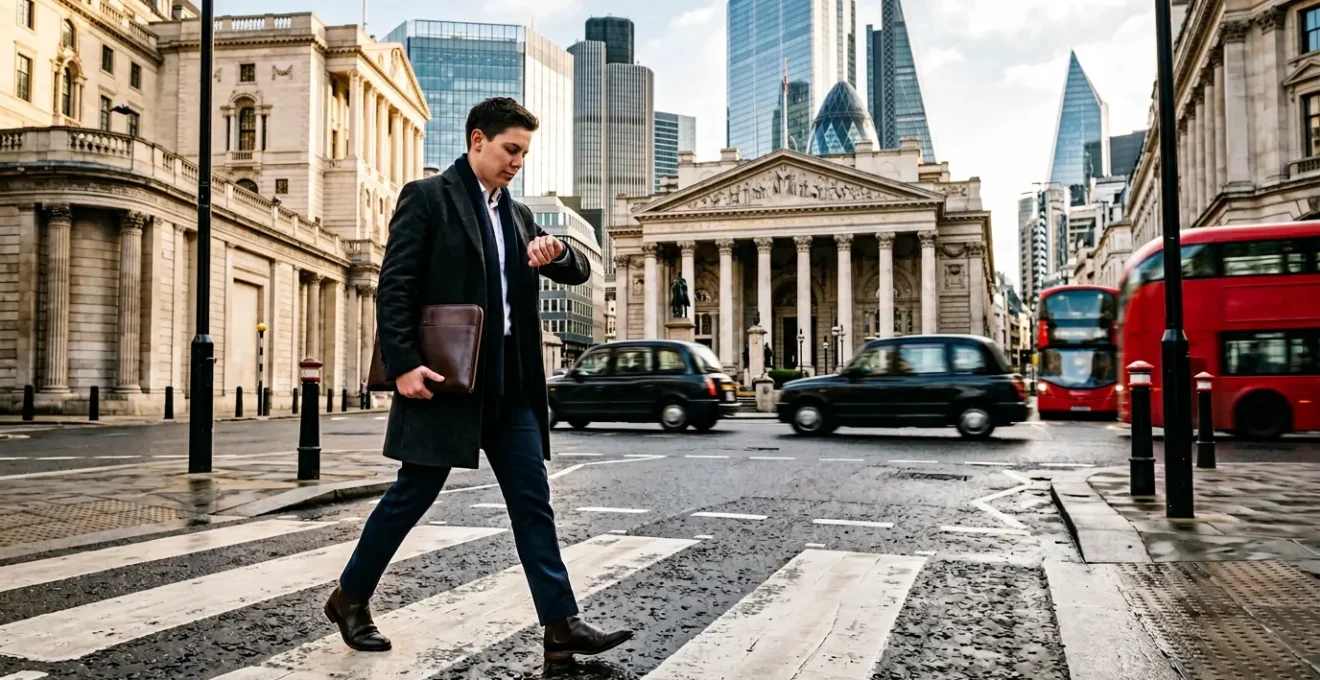
Executing a flawless multi-stop meeting day in London isn’t about luck or faster cars; it’s about applying a rigorous logistics protocol.
- Strategic sequencing and mode-switching (Transit Arbitrage) can cut journey times by up to 50% in peak traffic.
- Micro-planning drop-off points using ‘Geospatial Intelligence’ eliminates critical ‘last-mile’ delays from car to boardroom.
Recommendation: Adopt a ‘logistics operator’ mindset to transform travel from a time-sinking liability into a strategic, competitive asset.
For the high-stakes executive, a five-stop meeting day across Central London is a chessboard. Each move, from The City to Mayfair, from Canary Wharf to Soho, is a calculated risk. Yet, most professionals approach this complex logistical challenge with the tools of a tourist: a rideshare app and a hopeful glance at the traffic map. The result is predictable: blown schedules, added stress, and missed opportunities, all because of a single gridlocked junction on Regent Street or a misjudged parking bay in Knightsbridge.
The standard advice—”take the Tube,” “avoid rush hour”—is fundamentally incompatible with the reality of an executive’s day, which demands door-to-door efficiency and operates squarely within peak hours. The truth is, navigating London’s transport network is not a travel problem; it’s an operations management challenge. The key to success lies not in finding a mythical “fastest route” but in thinking like a logistics expert, actively managing variables to eliminate what we call Logistical Friction—the countless small delays that aggregate into major disruptions.
This guide breaks that paradigm. We will move beyond passenger-level thinking and provide you with an operator’s playbook. You will learn the principles of strategic sequencing, the financial calculus of vehicle choice, and the tactical decisions that turn a chaotic journey into a seamless, controlled execution. This is about mastering a dynamic system of time, cost, and energy to build an itinerary that is not just efficient, but resilient.
To navigate this complex urban landscape effectively, we’ve structured this guide to address the most critical logistical hurdles an executive faces. The following sections provide a detailed breakdown of the strategies and tactics required to master your London itinerary.
Summary: The Executive’s Guide to London Logistics
- Why Scheduling Mayfair After The City Is a Traffic Nightmare?
- Wait and Return vs Drop and Pick Up: Which Is More Efficient in Soho?
- The Congestion Charge Mistake That Adds Hidden Costs to Your Bill
- How to Minimize Walking Time from Car to Boardroom Entrance?
- When to Abandon the Car: The Traffic Signal That Means “Walk”
- Why Is the A4 Always Gridlocked on Monday Mornings?
- Which Taxis Can Use Bus Lanes and When Can Private Hire Cars?
- How Expert Drivers Avoid the M25 Car Park During Friday Rush Hour?
Why Scheduling Mayfair After The City Is a Traffic Nightmare?
The most common and costly mistake in London itinerary planning is ignoring the city’s fundamental tidal flow. Think of Central London not as a static map but as a dynamic system with a powerful east-west pulse. Between 7:00 AM and 9:30 AM, the city’s gravity pulls everything eastward into the financial heart of The City and Canary Wharf. Attempting a westbound journey from The City to Mayfair during this window is like swimming against a powerful current; you are fighting the commute of hundreds of thousands of people.
Conversely, from 4:00 PM to 6:30 PM, the tide reverses. The flow is overwhelmingly westward as workers depart. A late afternoon meeting in Mayfair followed by a dash to a dinner in Shoreditch (east) puts you directly in the path of this exodus. The strategic error is treating London’s geography as simple distance. The 4-mile journey from Bank to Hyde Park Corner isn’t a fixed variable; its “cost” in time can fluctuate by 300% depending on the direction and time of day. This isn’t just an inconvenience; it has a real economic impact, with a recent report stating that in 2024, the vehicle congestion cost London an estimated £3.85 billion.
The expert logistician’s first principle is therefore Sequence for Flow. Group morning meetings in the East (The City, Canary Wharf, Shoreditch). Use the midday lull (11:00 AM – 1:00 PM) for cross-town movements. Cluster your afternoon appointments in the West (Mayfair, Knightsbridge, Soho). By aligning your itinerary with the city’s natural rhythm, you eliminate the single largest source of delay before the car has even started.
Wait and Return vs Drop and Pick Up: Which Is More Efficient in Soho?
The narrow, bustling streets of areas like Soho present a classic logistical dilemma: for a 60-minute meeting, is it more efficient to have your driver wait or to arrange a separate pick-up? The answer is not universal; it’s a strategic calculation based on time, meeting duration, and location. This is the tactical choice between “Wait and Return” and “Drop and Pick Up”. A “Wait and Return” offers the advantage of immediate departure, eliminating the 5-10 minute friction of re-booking and waiting for a new vehicle. However, it incurs waiting charges and can be impossible in areas with aggressive traffic enforcement.
“Drop and Pick Up” eliminates waiting fees but introduces new risks: vehicle unavailability during peak demand and the challenge of coordinating a precise rendezvous point in a crowded area. For a seasoned operator, the decision is data-driven, not instinctual. The key is to have a decision matrix that accounts for these variables. In Soho, where pedestrian flow and delivery vehicles create constant congestion, the calculus becomes even more critical.
Case Study: The Soho Navigation Challenge
A major consultancy firm tested both strategies for their Soho office meetings over three months. The results provide a clear operational blueprint. For meetings under 45 minutes during the lunch-hour peak, “Wait and Return” proved superior, saving an average of 15 minutes per trip due to the immediate availability of the vehicle upon the meeting’s conclusion. However, for extended afternoon sessions exceeding 90 minutes, a coordinated “Drop and Pick Up” strategy reduced transport costs by a significant 40% while only adding an average of 8 minutes to the total journey time, provided the team used designated pick-up zones and precise location-sharing protocols.
This illustrates a core principle: the optimal strategy changes with the context of the meeting. A short, critical meeting demands the time efficiency of “Wait and Return,” whereas a longer, more flexible session allows for the cost efficiency of “Drop and Pick Up.”
As the visual demonstrates, the challenge in areas like Soho is the contrast between the narrow, congested internal streets and the broader, more accessible peripheral roads like Regent Street or Shaftesbury Avenue. An effective “Drop and Pick Up” strategy relies on using these peripheral arteries as designated rendezvous points, minimizing the time the vehicle needs to spend navigating the chaotic core.
The Congestion Charge Mistake That Adds Hidden Costs to Your Bill
For the executive, London’s zone charges—the Congestion Charge and the Ultra Low Emission Zone (ULEZ)—are not just fees; they are financial variables to be managed. The most common mistake is viewing them as an unavoidable, flat-rate cost of doing business. The reality is that poor planning can double or even triple these costs through penalties and inefficient routing. The primary error is assuming your journey is “outside” the zone when a single wrong turn or a GPS reroute takes you across the boundary for even a few seconds, triggering the full day’s charge.
Furthermore, these charges are not static. For instance, planning for 2026 and beyond requires acknowledging that the daily Congestion Charge will increase to £18 per day from January 2026. This requires a proactive financial strategy, not a reactive payment. A professional approach involves a pre-trip audit to verify every detail. This includes not just the route, but the compliance status of the specific vehicle assigned for the journey. A last-minute vehicle swap by a car service from a compliant electric car to a non-compliant diesel model can add an unexpected £12.50 ULEZ charge to your bill.
The solution is to treat zone charges as a line item in your logistical plan, requiring its own checklist. This moves the responsibility from a hopeful assumption to a verified protocol, preventing costly surprises and ensuring financial control over your travel budget. Effective management is about foresight and verification.
Your Pre-Trip Financial Checklist for Zone Charges
- Verify the vehicle’s ULEZ compliance status directly with the provider before confirming the booking.
- Use the official TfL Journey Planner to check if any part of your planned route, including potential detours, enters the Congestion Zone.
- Calculate the total potential daily charges: Congestion Charge + ULEZ fee (if the vehicle is non-compliant).
- Request a ‘Fully Inclusive Zone Estimate’ from your car service provider in writing, confirming they cover all charges.
- Review the pros and cons of setting up Auto Pay; it offers convenience but can lead to charges for unintentional zone entries.
How to Minimize Walking Time from Car to Boardroom Entrance?
The most overlooked source of “Logistical Friction” in an executive’s schedule is the “last 500 yards”—the journey from the car door to the meeting room chair. A driver dropping you at the building’s main postal address instead of the specific visitor entrance can easily add 10-15 minutes of walking, navigating unfamiliar corporate campuses, and passing through the wrong security checks. This is wasted time and energy that erodes the precision of your schedule. Winning this part of the journey requires moving beyond basic addresses and embracing what we call Geospatial Intelligence.
This means conducting digital reconnaissance before the journey begins. It involves using tools like Google Maps’ Street View to visually identify the optimal drop-off point—the one with the closest physical access to the correct entrance. It means cross-referencing this with the building’s official website, which often specifies a dedicated entrance for visitors or deliveries that is far more efficient than the grand main entrance. This intelligence is then converted into a precise, actionable instruction for your driver, including a dropped pin and the exact name of the entrance (e.g., “Canada Square entrance, not the DLR concourse entrance”).
Case Study: Canary Wharf Drop-Off Optimization
A financial services firm in Canary Wharf implemented this exact protocol. They reduced the average time from car arrival to meeting room entry by a staggering 12 minutes. By using Street View, they identified that a secondary entrance on Canada Square offered the closest possible vehicle access. This insight was combined with a new policy of pre-registering all visitors 24 hours in advance with building security, which eliminated a further 8 minutes of processing time at reception. The combined effect of precise drop-off instructions and security pre-clearance transformed a typical 18-minute car-to-boardroom transition into a seamless 6-minute process.
This level of micro-planning is not obsessive; it is the hallmark of an executive who values their time. It treats the entire journey, from origin to the boardroom table, as a single, integrated logistical operation.
The goal is to achieve the scene depicted: a perfect, frictionless transition from vehicle to building. This precision isn’t accidental; it is the direct result of meticulous digital reconnaissance and clear communication, turning a potential point of delay into a display of efficiency.
When to Abandon the Car: The The Traffic Signal That Means ‘Walk’
The most counter-intuitive yet powerful move in a logistician’s playbook is knowing when to abandon the primary asset. In London, your executive vehicle can quickly transform from an asset to a liability—a comfortable but stationary prison. The expert operator has a pre-defined “Go/No-Go” framework for making a “Hybrid Transit” decision: abandoning the car to complete a critical journey segment on foot or via the Tube. This is not a panicked reaction; it’s the execution of a pre-planned contingency.
The decision is triggered by a convergence of specific data points, not a vague feeling of being “stuck.” Is the live ETA suddenly escalating? Is the destination now within a walkable distance? Are you on a known “choke point” like Park Lane or the Embankment during an incident? Is there a Tube station within a two-minute walk? If multiple conditions are met, the Hybrid Transit Protocol is activated. This involves instructing the driver to proceed to the destination and meet you there, while you take the faster, more direct route.
This strategy, known as Transit Arbitrage, exploits the fact that for short distances in a gridlocked city core, human or rail speed can far exceed vehicle speed. The key is to make the decision early and decisively, based on clear signals. The amateur waits, hoping the traffic will clear. The professional has already analyzed the variables and is two stops down the Jubilee line, arriving at the next meeting cool, calm, and on time. The framework for this decision should be simple and clear:
- Check 1: Has the live map ETA for your journey suddenly increased by 15 minutes or more?
- Check 2: Is your final destination less than 1 mile (1.6 km) away?
- Check 3: Are you currently on a known gridlock route such as Euston Road, Park Lane, or Victoria Embankment?
- Check 4: Is there a Tube or Elizabeth Line station within a 2-minute walk from your current position?
If the answer is “YES” to three or more of these checks, it’s time to execute the protocol. This proactive, data-led approach is what separates strategic transport management from simply being a passenger.
Why Is the A4 Always Gridlocked on Monday Mornings?
The notorious Monday morning gridlock on the A4 heading into London is not a random event; it’s a predictable convergence of three distinct traffic flows. Understanding this allows a strategist to avoid the trap. First, you have the international arrivals from Heathrow, London’s primary global gateway located at the road’s western end. Second, you have the standard commuter traffic from the affluent western suburbs. Third, you have the school run traffic, which adds a significant and often underestimated volume of vehicles to local sections of the route.
This triple-threat converges precisely between the hours of 7:00 AM and 9:30 AM, creating a bottleneck that can turn a 30-minute run into a 90-minute crawl. The key choke point is the Hogarth Roundabout, where these flows collide with local traffic from Chiswick and the A316. An expert driver doesn’t just “check the traffic”; they understand these underlying dynamics and employ a strategy called Time-Gating. This involves precisely timing a departure to hit a narrow window of opportunity or choosing a bypass route before even joining the main flow.
For instance, a departure from Heathrow before 7:00 AM offers a clear run. Waiting until after 9:45 AM misses the worst of the convergence. If a 9:30 AM meeting in Knightsbridge is unavoidable, a departure time of 7:15 AM is optimal, accepting some delay but building in enough buffer to be robust. The ultimate pro move, when live data shows the M4/A4 corridor is already saturated, is to use the A40/A312 northern bypass—a longer route in miles but often shorter in time. This is proactive navigation, not reactive driving.
Which Taxis Can Use Bus Lanes and When Can Private Hire Cars?
In the battle against London’s congestion, a vehicle’s ability to use bus lanes is a game-changing strategic advantage. However, a critical misunderstanding exists regarding which vehicles are granted this privilege. The rule is simple and absolute: only licensed London taxis (Black Cabs, or Hackney Carriages) are permitted to use the vast majority of bus lanes. Private Hire Vehicles (PHVs), which include services like Uber, Bolt, and pre-booked executive chauffeurs, are strictly forbidden. This single distinction can create a 50% time differential on the same journey during peak hours.
This operational difference is the foundation of an advanced Transit Arbitrage strategy. A savvy executive might use a comfortable, pre-booked executive car for a long journey from an airport, but then switch to a hailed or app-booked Black Cab for a critical cross-town segment, such as from Paddington to Bank. The Black Cab’s ability to bypass traffic queues on roads like Victoria Embankment or across Waterloo Bridge can save 10-20 minutes, a significant return on the slightly higher fare.
A time-motion study highlighted this dramatically: during morning rush hour, a Black Cab completed the journey across Waterloo Bridge in just 8 minutes using bus lanes, while a private hire vehicle, confined to regular traffic, took 19 minutes. This isn’t a minor variance; it’s a decisive operational advantage. The “Black Cab Leg” strategy—using one specifically for the most congested parts of a journey—is a standard tool for time-critical itineraries.
The following table, based on data from transport guides and as seen in a comparative analysis of London transport options, clarifies the key operational differences:
| Feature | Black Cab (Hackney Carriage) | Private Hire (Uber, Chauffeur) |
|---|---|---|
| Bus Lane Access | Yes (most lanes) | No |
| Can Be Hailed on Street | Yes | No (pre-book only) |
| Driver Navigation | ‘The Knowledge’ (mental map) | GPS/Apps |
| Red Route Stopping | Often permitted to pick up/drop off | Highly restricted |
| Journey Time Advantage | Up to 50% faster in peak hours | Subject to standard traffic |
Key Takeaways
- Think like a logistician: Your goal is not to travel, but to execute a mission with precision, eliminating ‘Logistical Friction’ at every step.
- Master Transit Arbitrage: Know when to switch transport modes—from private hire to Black Cab or even the Tube—to gain a decisive time advantage on critical journey segments.
- Embrace Geospatial Intelligence: Move beyond basic addresses. Use digital tools to micro-plan drop-offs and entry points to win the ‘last 500 yards’ of your journey.
How Expert Drivers Avoid the M25 Car Park During Friday Rush Hour?
The M25 on a Friday afternoon is not a road; it’s a collective gamble. For the executive needing to get to Gatwick or Heathrow for an end-of-week flight, getting trapped in the “world’s largest car park” is a catastrophic failure. Expert drivers and logistics planners don’t leave this to chance. They have a pre-defined set of rules and alternative routes, treating the M25 not as a primary route, but as a route of last resort during the peak Friday exodus (3 PM – 7 PM).
The core principle is Proactive Evasion. This starts with monitoring traffic conditions not on the M25 itself, but at its key junctions. For example, if heading to Heathrow and junctions 12-15 show red on the traffic map, the decision to divert is made *before* joining the motorway. The expert driver will exit the M25 early at Junction 15 and use the parallel A4/M4 local roads, a slower but more predictable route. The bailout trigger is a hard rule: if average speed drops below 20mph for more than five consecutive minutes, exit at the next available junction and switch to parallel A-roads. It is a known fact that the M25 is a 117-mile motorway with 31 junctions, offering multiple points for strategic retreat if you plan ahead.
For journeys to Gatwick from the west, the professional’s choice is often to avoid the M25 southern section entirely. A proven strategy, validated by chauffeur services analyzing their own data from platforms like LondonTraffic.org, is the “Go Long to Go Fast” principle. This involves using the A217/A24 southern bypass route. While this adds approximately 8 miles to the journey, it saves an average of 35 minutes compared to the gridlocked M25 on a Friday evening, with a reported 78% success rate for maintaining a schedule during peak times. This is the essence of professional logistics: choosing predictability over the illusion of the “shortest” route.
To consistently execute flawless multi-stop days in London, you must shift your mindset from that of a passenger to that of a chief logistics officer. Every decision, from route sequencing to vehicle choice and drop-off coordination, is a strategic input that determines the success of your mission. Start implementing these logistical protocols today and reclaim absolute control of your London schedule, turning travel time from a liability into your competitive edge.