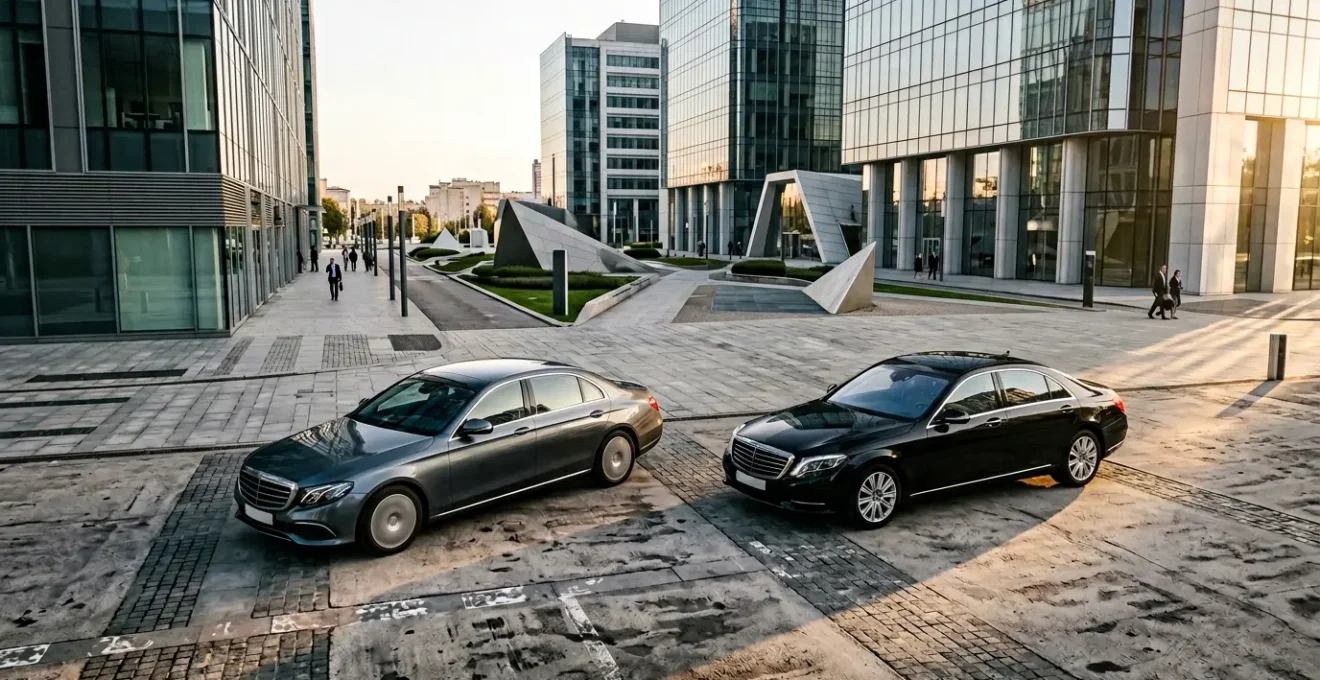
The V-Class offers executive comfort, but for a production crew with equipment, the Sprinter provides superior operational flow and prevents costly logistical friction.
- A standard 7-seater MPV lacks the dedicated cargo space for both a full passenger load and professional gear.
- The Sprinter’s greater height is a significant liability for underground parking, requiring pre-travel checks to avoid access issues.
Recommendation: Prioritise the Sprinter for equipment-heavy location shoots and the V-Class for talent transport where parking access is guaranteed and luggage is minimal.
As a production manager, moving a six-person film crew across London is a daily exercise in precision logistics. The choice of vehicle seems simple on the surface: a luxurious Mercedes V-Class for comfort or a practical Mercedes Sprinter for space. This common-sense approach, however, often overlooks the critical factor that defines a smooth production day: operational flow. The real question isn’t about passenger comfort versus cargo capacity; it’s about which vehicle minimises spatial friction for your entire mobile unit—people and equipment included.
While the V-Class projects an executive image perfect for client-facing roles or talent transport, its limitations can introduce costly delays when dealing with camera cases, lighting kits, and sound gear. Conversely, the Sprinter’s cavernous interior can be a godsend for equipment, but its sheer size can become a logistical nightmare in a city of tight streets and low-clearance car parks. The decision must therefore move beyond a simple feature comparison to a strategic assessment of your team’s entire workflow from curb to location.
This guide abandons the generic “luxury vs. space” debate. Instead, we will analyse the V-Class and Sprinter through the lens of a production manager. We will explore the hidden spatial realities of luggage capacity, the strategic value of seating layouts for on-the-go briefings, the critical impact of vehicle height on location access, and the practicalities of loading expensive gear without damaging a premium interior. The goal is to equip you with a logistical framework to choose the vehicle that functions as a seamless extension of your production, not a source of friction.
This article breaks down the key logistical considerations a production manager must evaluate when choosing between a V-Class and a Sprinter. Explore the topics below to make an informed decision that enhances your operational efficiency.
Summary: V-Class or Sprinter: A Logistical Comparison for Production Teams
- Why Can’t 7 People Fit in a 7-Seater if They Have Luggage?
- Conference Style or Forward Facing: Which Layout Is Best for Briefings?
- Luxury MPV vs Minibus: At What Point Do You Lose the “Executive” Feel?
- The Height Restriction Mistake That Gets Vans Stuck in Hotel Carparks
- How to Load Equipment Safely Without Scratching the Leather Interior?
- How to Ensure Uniformity When Booking 10 Cars for a Roadshow?
- One Coach or Three MPVs: Which Is Better for VIP Groups?
- How to Move 20 Guests to a Country Wedding Without Losing Anyone?
Why Can’t 7 People Fit in a 7-Seater if They Have Luggage?
The term “7-seater” is one of the most misleading in vehicle logistics. For a production manager, it promises a solution that it rarely delivers. The fundamental issue is one of shared space: the volume designated for the third row of seats is almost always the same volume required for meaningful luggage. When you have six or seven passengers, you have virtually zero cargo capacity. For a film crew, whose “luggage” consists of bulky Pelican cases, tripods, and equipment bags, this is an immediate operational failure. The vehicle can carry the people or the gear, but not both.
The Mercedes V-Class, even in its extra-long configuration, exemplifies this problem. While it’s a superb people carrier, its utility diminishes drastically with each occupied seat. With all seats in place, the luggage area is a shallow space behind the last row. A real-world test shows the V-Class can handle up to nine standard suitcases, but a film crew’s equipment is anything but standard. The Sprinter, by contrast, is designed with a clearer separation of functions. Its van-based architecture provides a vast, dedicated cargo area even when configured for nine passengers. The total cargo volume is often four times that of a V-Class, making it the only viable single-vehicle option for a fully-equipped team.
Case Study: The Airport Transfer Fallacy
A production team booked an 8-seater V-Class for an airport pickup for a 6-person crew with standard filming equipment. While the passengers fit comfortably, the luggage bay could only accommodate personal bags and two small camera cases. The remaining three large equipment cases had to be transported in a second vehicle, negating the cost and efficiency benefits of booking a single large van. A 9-seater Sprinter, with its vastly larger dedicated cargo volume of 191 cubic feet, would have handled the entire load with ease.
Ultimately, a production manager must redefine vehicle capacity not by the number of seats, but by the required “payload” of both people and equipment. For any crew larger than four people with gear, the V-Class ceases to be a single-vehicle solution and becomes a dedicated—and expensive—talent shuttle.
Conference Style or Forward Facing: Which Layout Is Best for Briefings?
The interior layout of a crew vehicle is not just about comfort; it’s about transforming travel time into productive time. The choice between a conference-style layout (vis-à-vis seats) and a traditional forward-facing arrangement directly impacts your team’s ability to collaborate, brief, and prepare en route. This turns the vehicle from a simple people-mover into a mobile headquarters, a core tenet of efficient production logistics.
The conference layout, a signature feature of the V-Class, is excellent for fostering collaboration. It allows the director, DP, and producer to hold face-to-face discussions, review call sheets, or conduct impromptu briefings around a central table. This setup is invaluable for maintaining team cohesion and ensuring everyone is aligned before arriving on set. However, it’s not without its drawbacks. Some individuals are more prone to motion sickness when facing backward, and the open-plan nature can make it difficult for individuals to do focused solo work on a laptop.
This image highlights the collaborative potential of a conference-style seating arrangement inside an executive van.
Forward-facing seats, standard in most Sprinter conversions, are better for individual focus and passenger comfort over long distances. Each team member has their own space, reducing distractions and minimising motion sickness. While this layout is less conducive to group discussion, the superior acoustics of a larger, open-plan Sprinter can still allow for clear communication from the front to the back. When choosing, consider the primary function of the travel time: is it for collaborative briefing or for individual prep and decompression?
Luxury MPV vs Minibus: At What Point Do You Lose the “Executive” Feel?
The “executive feel” is a crucial factor when transporting clients, agency representatives, or high-profile talent. It’s an intangible asset built on comfort, brand perception, and a seamless experience. The Mercedes V-Class is the undisputed champion in this category, functioning as a discreet, high-end limousine that happens to have more seats. Its plush leather, refined interior, and car-like handling create an environment of quiet luxury. But where is the tipping point where practicality overtakes perception?
The moment that executive feel is lost is the moment friction enters the experience. It’s not about the vehicle model itself, but the journey. A VIP stuck waiting while equipment is awkwardly unloaded, or a vehicle that cannot access the private underground entrance of a five-star hotel, immediately shatters the illusion of luxury. Here, the Sprinter, often perceived as more utilitarian, can paradoxically offer a more executive experience if it enables a smoother logistical flow. The ability to discreetly handle all passenger and luggage needs in one go, without fuss, is its own form of luxury.
As industry experts note, the choice is highly contextual. In a review comparing the two vehicles, CarsGuide Australia highlighted the V-Class’s premium positioning:
The Mercedes-Benz V-Class, and in particular the Mercedes-Benz V220d, lives up to the notion of a luxury people-mover – for the most part… But if you need to be seen to be offering the most luxurious people-mover you can buy, then you really ought to be looking at the V-Class
– CarsGuide Australia, Mercedes-Benz Sprinter vs Mercedes-Benz V-Class Review
The key for a production manager is to define what “executive” means for a specific journey. If it’s about pure passenger comfort for a short, luggage-free trip, the V-Class is unbeatable. If it’s about a seamless, stress-free logistical operation from start to finish, a well-appointed Sprinter often provides a more holistically “premium” service.
The Height Restriction Mistake That Gets Vans Stuck in Hotel Carparks
Of all the logistical oversights a production manager can make, few are as public and frustrating as arriving at a location only to find your vehicle is too tall for the car park. This single detail, often overlooked during booking, can derail a schedule and compromise security. This is the most significant operational difference between a V-Class and a Sprinter, and it demands an access-first planning approach.
The critical threshold for most underground and multi-storey car parks in London and across Europe is 2.0 metres (approximately 6.56 feet). The Mercedes V-Class, with a standard height of around 1.9 metres or 6.25 feet, comfortably clears this restriction. This allows for discreet and secure drop-offs directly at basement-level hotel lobbies or production offices. It’s a key part of its appeal as an executive vehicle, offering seamless point-to-point transitions away from public view.
This image illustrates the stark reality of a height restriction barrier, a critical obstacle for larger vehicles like the Sprinter.
The Mercedes Sprinter, however, stands at a standard height of around 2.4 metres or nearly 8 feet, making it incompatible with the vast majority of covered car parks. This forces crews to load and unload on the street, exposing expensive equipment to the elements and public view. It complicates logistics, requiring a clear plan for kerbside management and potentially longer walks to the final destination. While a Sprinter’s space is a major asset, it is completely negated if the vehicle cannot get close to where it needs to be.
Your Pre-Travel Height Clearance Checklist: Avoiding Access Issues
- Confirm total vehicle height: Request the exact height from the rental company, including any roof-mounted accessories like antennas or climate control units.
- Verify destination restrictions: Actively call the hotel, venue, or car park to confirm their maximum height clearance. Do not rely on website information alone.
- Check for modifications: Ask if the specific vehicle you’re booking has a raised roof or other modifications that alter its standard height.
- Get it in writing: Request written confirmation of the vehicle’s specifications and the destination’s clearance to avoid disputes.
- Default to V-Class for uncertainty: If you cannot get a definitive answer on height restrictions, booking a V-Class guarantees sub-2-metre clearance and eliminates risk.
How to Load Equipment Safely Without Scratching the Leather Interior?
The challenge of loading equipment into a high-end vehicle is a classic case of conflicting priorities. You need the vehicle’s capacity, but you must also return it in pristine condition to avoid hefty damage fees. This is where the fundamental design philosophies of the V-Class and Sprinter become most apparent. A V-Class is a luxury car adapted for more passengers; a Sprinter is a commercial workhorse adapted for more comfort.
Loading heavy, hard-edged flight cases into a V-Class is a high-risk activity. Its interior is appointed with Nappa leather, polished trim, and plush carpeting—materials not designed to withstand the rigours of production equipment. The risk of scratches, tears, and scuffs is extremely high, creating unnecessary stress for the crew. While optional rubber mats can offer some protection, the V-Class lacks robust, integrated solutions for separating passengers from cargo. Every loading and unloading sequence becomes a delicate, time-consuming operation.
The Sprinter, on the other hand, is built for this kind of work. Its commercial DNA means durability is a core feature. Many are equipped with tough, durable fabric seats, wood or composite flooring in the cargo area, and, most importantly, the option for a full-width, solid cargo partition. This completely isolates the passenger cabin from the equipment bay, allowing gear to be loaded quickly and securely without any risk to the interior. As one test demonstrated, a Sprinter can handle immense loads without issue when proper protocols are followed.
Professional Loading Protocol: The Sprinter Durability Test
During a review of a 2025 model, a Sprinter was loaded with 1.4 tonnes of cargo. By using quilted moving blankets to protect surfaces and employing a “last-in, first-out” loading strategy, the team was able to transport the entire load without a single scratch or mark on the interior. The optional cargo partition was cited as the key feature for ensuring complete separation and safety.
This table clearly shows the difference in design focus, highlighting the Sprinter’s built-in advantages for handling equipment.
| Feature | V-Class | Sprinter |
|---|---|---|
| Interior Materials | Nappa leather (delicate) | Durable fabric options |
| Cargo Protection | Limited partition options | Full-width partition available |
| Boot Liner | Optional rubber mat | Standard wood cargo floor |
| Maintenance | Premium care required | Commercial-grade durability |
How to Ensure Uniformity When Booking 10 Cars for a Roadshow?
For a multi-city roadshow or a large-scale event, consistency is key. Presenting a uniform fleet of vehicles projects an image of professionalism and meticulous planning. However, achieving this uniformity can be surprisingly difficult, especially when dealing with a model as versatile as the Mercedes Sprinter. The challenge lies in navigating the vast sea of customisation options available.
The Sprinter isn’t a single vehicle; it’s a platform. There are over 1,700 possible configurations available from the factory, covering different lengths, roof heights, engine types, and interior layouts. This doesn’t even account for the thousands of aftermarket conversions. Booking “ten Sprinters” from different suppliers could result in a mismatched fleet of varying ages, specifications, and interior quality. This inconsistency can detract from the premium experience you’re trying to create.
To ensure a uniform fleet, a production manager must become ruthlessly specific in their booking process. A detailed technical rider is non-negotiable. This document should go far beyond “Mercedes Sprinter” and specify the exact requirements for every vehicle. Key points to include are:
- Exact Model and Year: Specify the desired trim level (e.g., Passenger Van 2500) and a narrow range for the model year to ensure consistent technology and design.
- Seating and Layout: Define the exact number of seats and the required configuration (e.g., 9 forward-facing seats).
- Interior and Amenities: Standardise requirements for interior materials (e.g., black leatherette), climate control, and technology, including the number and type of charging ports.
- Exterior Colour: Specify the exact colour (e.g., Obsidian Black Metallic) for a cohesive look.
- Visual Confirmation: Always request photos of the actual vehicles being offered, not generic stock images from a website.
The most effective strategy is to work with a single, large network provider that has a standardised fleet across multiple locations. This centralises communication and accountability, making it much easier to enforce your specifications and guarantee uniformity for the entire roadshow.
One Coach or Three MPVs: Which Is Better for VIP Groups?
When logistics scale up to moving larger groups of VIPs, a new strategic question emerges: is it better to keep everyone together in a single, larger vehicle, or to provide more intimate, flexible transport with multiple smaller vehicles? The choice between one luxury minibus (like a high-spec Sprinter) and a small fleet of MPVs (like three V-Classes) depends entirely on the group’s dynamics and the event’s objectives.
Using multiple V-Classes offers maximum flexibility and a heightened sense of personal service. It allows you to split the group by seniority or team, provides more discreet comings and goings, and makes it easier to manage different departure times or destinations. If one vehicle is delayed in traffic, the others can proceed. This approach is ideal for corporate hospitality where guests may not all know each other, or for complex itineraries with staggered schedules. The V-Class provides that undeniable “black car” service feel, which can be paramount for certain VIPs.
Conversely, a single, high-specification Sprinter or a small coach prioritises group cohesion. It keeps the entire team together, turning travel time into a shared experience and a valuable opportunity for networking or collective briefings. There is no risk of one car getting lost, and a single point of communication simplifies coordination. This is the better choice for a unified team travelling to a single destination, like a corporate retreat or a site visit. As one industry expert puts it, the best choice is a matter of balancing priorities.
For those requiring more room and flexibility, the Mercedes Sprinter is unparalleled. For smaller groups that prioritize luxury and style, the Mercedes V-Class is second to none.
– Keira O’Connor, Limo Broker UK Analysis
The decision hinges on the primary goal: do you want to foster group unity or provide personalized, flexible service? For a production crew, a single Sprinter often makes the most sense for keeping the team and gear together. For a group of clients or talent with different schedules, multiple V-Classes offer superior control and discretion.
Key Takeaways
- Vehicle choice is a logistical decision, not just a luxury one. The best vehicle minimises operational friction for both people and equipment.
- The V-Class excels at executive passenger transport with guaranteed sub-2m access, but fails when significant equipment is involved.
- The Sprinter offers unmatched space and durability for crew and gear but requires careful pre-planning to mitigate its height and size constraints.
How to Move 20 Guests to a Country Wedding Without Losing Anyone?
The logistical challenge of moving 20 people to a remote location—whether for a country wedding or a film shoot—is fraught with peril. The risk of losing people, running late, and dealing with navigation issues in areas with poor signal is high. While the title mentions a wedding, the principles of group transport coordination are universal for any production manager tasked with a large-scale location move. The primary goal is to maintain group cohesion and eliminate points of failure.
The first mistake is assuming one vehicle will suffice. Even the largest passenger van, the Mercedes Sprinter, has a maximum capacity of 15 passengers in its largest configuration. For a group of 20, you are immediately in a multi-vehicle situation. This is where centralised coordination becomes paramount. Relying on guests or junior crew members to navigate unfamiliar rural lanes in separate cars is a recipe for disaster. A single point of control is essential.
To execute this flawlessly, you must implement a clear protocol. This isn’t just about booking cars; it’s about active real-time management. The core principles of a wedding transport plan can be directly adapted for a production crew:
- Appoint a Transport Marshal: Designate one person—who is not the director or producer—as the sole point of contact for all transport matters. Their only job is to get everyone to the location on time.
- Create a Unified Comms Channel: A dedicated WhatsApp group or similar chat for all 20 people and the drivers is non-negotiable. It’s used for sending alerts, location pins, and status updates.
- Share Live Locations: Have the lead vehicle’s driver share their live location in the group chat so that all other vehicles can follow the exact same route, even if they get separated.
- Use Boarding Alerts: The transport marshal should send out 30-minute and 15-minute boarding alerts to prevent stragglers and ensure an on-time departure.
- Consolidate Where Possible: Even if you need two vehicles, use the largest ones possible (e.g., two 12-seater minibuses instead of five cars) to keep the group as cohesive as possible and simplify coordination.
By treating group transport as a managed logistical operation rather than a simple taxi booking, you can ensure your entire cast and crew arrive together, on time, and ready to work, regardless of the location’s remoteness.
To avoid costly delays and ensure a smooth production, the next step is to meticulously map your team’s movement, equipment list, and destination constraints before booking any vehicle.