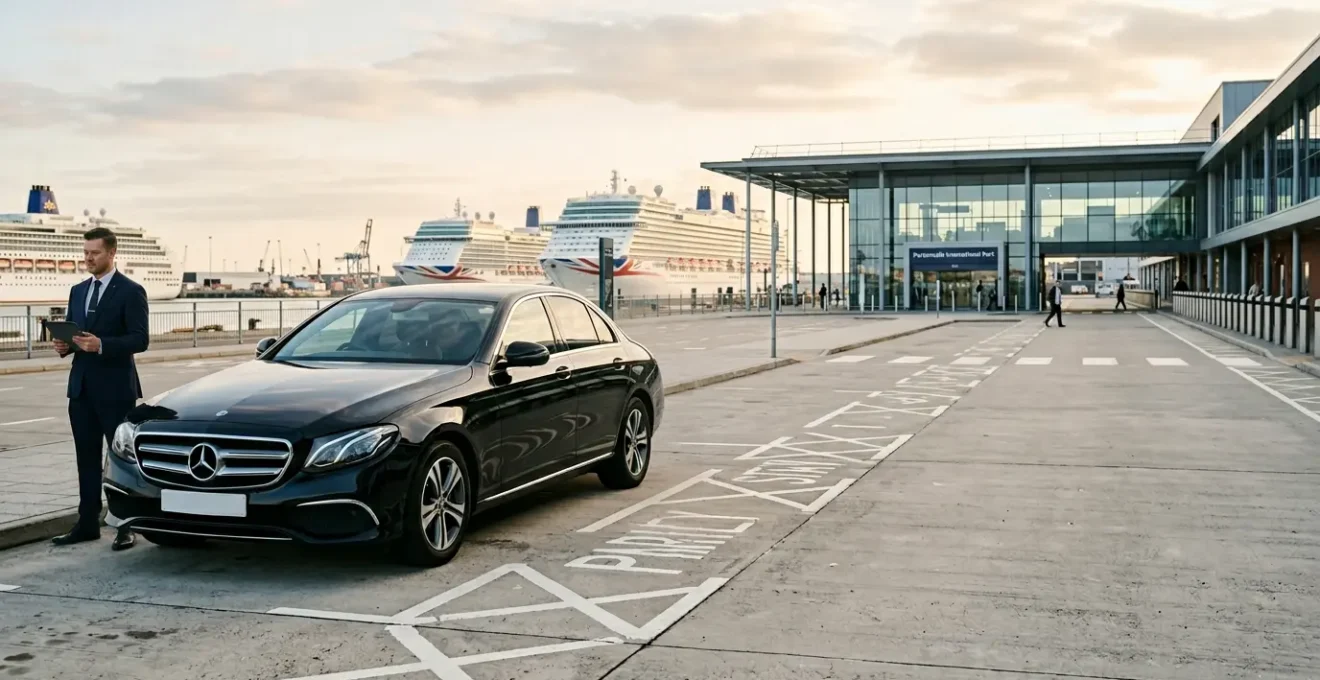
The key to a seamless pickup at Portsmouth Port is not looking for signs, but understanding the port’s operational geography and having a pre-agreed communication protocol with your driver.
- Generic “Pick Up Zone” signs are for the public taxi queue, not your professional chauffeur service.
- Your driver is strategically positioned in a designated holding area and will only approach the terminal front when you make contact.
Recommendation: Use a multi-step communication and verification protocol—the “Confirmation Handshake”—the moment you clear customs to ensure you connect with the right driver and vehicle instantly.
The moment you step off a cruise ship, the sense of holiday relaxation can evaporate. You enter a terminal buzzing with activity, a chaotic mix of fellow passengers, mountains of luggage, and a chorus of announcements. Your primary concern becomes a single, pressing question: where is my driver? The common advice is to “look for the pickup signs” or “find the driver holding your name board.” In a busy port environment like Portsmouth International Port, this advice is not just unhelpful; it’s a recipe for confusion and stress.
The reality of modern port logistics is far more structured than the crowded arrivals hall suggests. There isn’t one single “pickup zone,” but a complex ecosystem of different areas for different types of transport. Relying on generic signage often leads you to the wrong place, typically the back of a long, slow-moving taxi queue. The secret to a smooth exit isn’t about searching randomly; it’s about understanding the specific, pre-defined system that professional chauffeur services operate within.
This guide replaces guesswork with a clear operational blueprint. We will deconstruct the port’s layout from a ground operations perspective, providing you with the exact procedures and geographical reference points used by professional drivers. Forget wandering through the crowds. You will learn the correct communication protocol for low-signal areas, how to verify your vehicle with confidence, and the strategies that allow your chauffeur to bypass the gridlock that traps other passengers. This is your tactical plan for a swift, stress-free departure from the port.
To navigate this process with an expert’s precision, this article breaks down each critical stage of your port exit. Follow this guide to transform a potentially chaotic experience into a seamless transition from ship to shore.
Summary: A Tactical Guide to Your Portsmouth Port Chauffeur Pickup
- Why “Pick Up Zone” Signs at Cruise Terminals Are Often Misleading?
- Phone or Text: The Best Way to Locate Drivers in Poor Signal Port Areas?
- Ship Docking Late: How Does It Affect Your Driver’s Waiting Time?
- The “White Van” Confusion That Happens at Busy Piers
- How to Bypass the Post-Cruise Taxi Queue traffic jam?
- How Far Is the Walk from Customs to the Car Park at Stansted?
- How to Format a Signboard for Maximum Visibility in a Crowded Hall?
- How to Guarantee Your Arrival at Southampton Docks Before the Gangway Closes?
Why “Pick Up Zone” Signs at Cruise Terminals Are Often Misleading?
The primary source of confusion at any major port is the assumption that all “pickup” areas are the same. The prominent signs directing you to a “Pick Up Zone” or “Taxi Rank” are almost exclusively for the public, on-demand taxi service. Following them will lead you directly into a queue, not to your pre-booked chauffeur. Major ports operate a three-tier system based on service type, a crucial piece of operational geography you must understand.
The first tier is the public taxi rank, the most visible and often congested area. The second is a pre-arranged vehicle holding lot, typically located away from the terminal front, where standard minicabs and app-based services wait. The third tier, for professional chauffeur services, is a “Meet & Greet” service conducted inside the terminal itself. Your driver’s physical location is determined by this tier. As a case in point, Portsmouth International Port has a highly organized system to manage passenger flow, with programs in place to guide travelers. During peak times, dedicated ambassadors assist passengers in navigating these different zones. An official report highlighted that in 2023, a team of volunteers welcomed over 26,510 passengers from 35 transit calls, underscoring the port’s structured approach to separating different transport streams.
Therefore, your first action should be to ignore the general taxi signs. Your meeting point is not a physical bay but a person: your driver, waiting in the designated arrivals area just after you exit the secure customs zone. Understanding this distinction is the first step in bypassing the chaos.
Phone or Text: The Best Way to Locate Drivers in Poor Signal Port Areas?
Relying solely on a phone call to locate your driver is a flawed strategy. Cruise terminals are notoriously difficult environments for mobile signals due to their steel and concrete construction and the sheer volume of people trying to connect simultaneously. A failed call can quickly lead to panic. The professional standard is a clear, pre-defined communication protocol that anticipates these connectivity “blackouts.”
The most effective method is a multi-channel approach. The moment you have a sliver of signal, send a pre-formatted SMS. Text messages require far less bandwidth than calls and will often get through when a voice connection is impossible. This initial message should be concise: “Hi [Driver’s Name], this is [Your Name]. Cleared customs at [Time]. At main terminal exit. Wearing [Color] jacket.” This gives the driver actionable intelligence. Immediately follow this by enabling a location-sharing feature like WhatsApp’s “Share Live Location” for a 15-minute window. This provides a visual GPS pin for the driver to home in on.
This protocol is essential because drivers are not permitted to wait indefinitely at the terminal kerbside. Port security regulations at 100% of modern terminals restrict vehicle parking at the immediate pickup points. Your driver will be in a nearby holding or “stacking” area. It is your contact that triggers their movement to the designated meeting point. The dispatcher acts as a central command, relaying your status to the driver, who then proceeds to meet you. This system ensures efficiency and compliance with strict port security rules.
Ship Docking Late: How Does It Affect Your Driver’s Waiting Time?
A common source of anxiety for passengers is the fear that a ship delay will mean their driver has left. With a professional chauffeur service, this is not a concern. Reputable companies do not rely on the passenger for updates; they use real-time ship tracking systems to monitor your vessel’s progress. They know if your ship is arriving early or late and adjust their dispatch schedule accordingly. The driver is sent based on the ship’s actual Estimated Time of Arrival (ETA), not the scheduled one.
Furthermore, it’s important to understand the difference between “docking time” and “disembarkation time.” The complimentary waiting period included in your booking does not begin when the ship ties up to the pier. It starts from the moment passengers are officially permitted to begin disembarking. Professional services build in a generous grace period to account for the time it takes to navigate the ship’s corridors, wait for lifts, and clear immigration and customs. While policies vary, a common industry standard for port pickups is a significant free waiting period after disembarkation begins, often similar to the 60 minutes of free waiting time offered for airport pickups.
This automated tracking and generous waiting policy mean you can proceed through the terminal at a comfortable pace, without the stress of “being on the clock.” The driver is informed and will be ready when you are.
As seen from above, the port’s vehicle management is a highly organized system. Chauffeurs use designated holding areas, or “stacking zones,” where they wait until you make contact. This prevents congestion at the terminal front and ensures your car is just a few minutes away once you are ready.
The “White Van” Confusion That Happens at Busy Piers
At a busy pier, the area outside the terminal can look like a sea of vehicles, with many “white vans” (shared shuttles), minicabs, and private cars. This visual chaos is where the risk of getting into the wrong vehicle is highest. It is critical to have a robust vehicle identification protocol, or a “confirmation handshake,” to ensure you are meeting your designated, professional chauffeur and not an opportunistic or incorrect driver.
Your verification process should begin before you even leave home. Your chauffeur company should provide the driver’s name, mobile number, and the vehicle’s make, model, colour, and registration number 24 hours prior. Upon meeting the driver, do not simply ask “Are you here for [Your Name]?” A fraudulent driver could simply say yes. Instead, initiate the handshake: state your destination first. “Hello, I have a booking for a transfer to London.” Your legitimate driver will respond by confirming your name: “Yes, for Mr. Smith? I’m your driver.” This verbal check, followed by a visual confirmation of the vehicle registration, is a non-negotiable security step.
The type of vehicle itself is a major identifier. Professional chauffeur services use high-end saloons, not standard family cars or vans. The driver’s appearance—typically a dark suit—is another key marker.
This table helps distinguish between the different service types you’ll encounter:
| Service Type | Typical Vehicle | Visual Identifiers | Meeting Point |
|---|---|---|---|
| Premium Chauffeur | Mercedes E/S-Class, BMW 7 Series | Black, pristine condition, suited driver | Inside terminal with name board |
| Standard Minicab | Toyota Prius, Skoda Octavia | Various colors, basic condition | Outside pickup zone |
| Shared Shuttle | Ford Transit, Mercedes Sprinter | White van, company livery | Designated shuttle stop |
Your 5-Point Security Protocol for Vehicle Verification
- Pre-Arrival Intel: Confirm you have received the driver’s name, mobile number, and full vehicle details (make, model, color, registration) 24 hours prior.
- Visual Check: Identify the driver by their professional attire. A chauffeur will be in a suit, distinguishing them from more casually dressed minicab drivers.
- Verbal Handshake (Initiate): State your destination first (“I’m booked for a transfer to Heathrow?”). Do not offer your name.
- Driver Response (Confirm): Wait for the driver to confirm YOUR name in response (“For Mrs. Jones? Yes, please follow me.”).
- Final Verification: Before boarding, visually match the vehicle’s registration plate with the details sent in your booking confirmation.
How to Bypass the Post-Cruise Taxi Queue traffic jam?
The single greatest advantage of a pre-booked chauffeur service is the ability to completely bypass the primary chokepoints that trap other passengers. The most significant of these is the post-cruise taxi queue, a slow-moving line of people and vehicles that can add considerable time and frustration to your journey. The strategy for avoiding this is built into the professional chauffeur’s operational model.
By conducting the “Meet & Greet” service inside the terminal, your chauffeur takes you away from the main flow of passengers heading for the taxi rank. The exit route is different. Drivers utilize short-term car parks, which are much closer to the terminal exit than the sprawling long-term lots or congested kerbside areas. They know the most efficient bays to park in for a quick departure. This strategic positioning allows for a swift exit onto roads that bypass the main terminal entrance gridlock. For example, experienced chauffeurs at Portsmouth know the back routes to avoid the M275 interchange, which frequently becomes a bottleneck for taxis and public transport during peak disembarkation periods.
Case Study: The Chauffeur’s Port Navigation Strategy
Professional chauffeurs at Portsmouth completely avoid the congested kerbside taxi queue by using the inside Meet & Greet service. They meet passengers inside the terminal and lead them to a pre-parked vehicle in the short-term lot. By using strategic bay selection and knowledge of lesser-known exit routes, drivers can execute a quick departure, bypassing the main M275 entrance gridlock that typically traps taxis and public vehicles. This operational knowledge is a key part of the service’s value proposition.
The time saved is significant. Port logistics data shows that using pre-booked services with drivers waiting in designated lots can save travelers up to 60 minutes compared to waiting in public taxi queues or using economy parking shuttles. You are not just paying for a vehicle; you are paying for an expert logistical bypass of the port’s most congested areas.
How Far Is the Walk from Customs to the Car Park at Stansted?
While this question specifies Stansted, the underlying principle of understanding the “internal journey” applies to any large terminal, including Portsmouth. The walk from clearing customs to your chauffeur’s vehicle in the short-stay car park is not instantaneous; it’s a multi-stage process that requires navigation through the terminal building. Being mentally prepared for this walk, especially with luggage, is part of a smooth exit.
Typically, the journey can be broken down into several stages. First, you exit the customs hall into a main arrivals corridor. This area can be crowded, so maintaining a clear path is key. Second, you will need to change levels, usually descending via a lift or escalator to the ground-floor exit. Third, you must cross the main arrivals concourse, following signs for the designated short-stay car park. Finally, you will cross the bus and taxi lanes to reach the car park entrance itself. For a solo traveler with a single carry-on, this entire walk might take 10-15 minutes. However, for a family with multiple large suitcases, a pushchair, and children, it is realistic to add at least 10 minutes to this time. The pace is dictated by your ability to manage your luggage and group through a crowded environment.
Navigating long terminal corridors with family and luggage requires patience. Using luggage trolleys is essential, and it’s wise to keep your group together to avoid getting separated in the flow of people. Your driver will meet you at the arrivals gate, but you still need to complete this final leg of the journey to the vehicle together.
How to Format a Signboard for Maximum Visibility in a Crowded Hall?
The classic image of a chauffeur holding a name board can be misleading. In a crowded arrivals hall with dozens of drivers doing the same, finding your specific name can feel like a game of “Where’s Wally?”. However, as a passenger, you can “hack” this process by knowing what to look for. Professional services adhere to a “Three-Second Glance Principle” for their signboards, designed for maximum visibility and rapid recognition.
The key elements are font, size, and contrast. The most effective signs use a bold, clear, sans-serif font like Arial Black or Helvetica Bold. Your last name should be the most prominent feature, with letters at least 3 inches tall. The highest visibility combination is always black text on a plain white background. Many companies also add a unique, simple identifier—like a coloured corner or a small, clear logo—which your eye can spot faster than trying to read every name. The most modern and effective method is a digital tablet. The back-lit screen and potential for a subtle pulsing animation make it stand out dramatically from a sea of static paper or cardboard signs.
Knowing this, you should scan the crowd not for your full name, but for these visual cues: look for the bright light of a tablet, or a clean, bold, high-contrast sign held at shoulder height, perpendicular to the flow of passengers for easy reading.
This comparison shows how different sign types perform in a real-world environment:
| Sign Type | Visibility Range | Recognition Speed | Professional Rating |
|---|---|---|---|
| Digital Tablet (Backlit) | 20+ meters | 2-3 seconds | Excellent |
| Bold Sans-Serif on White | 15 meters | 3-4 seconds | Very Good |
| Handwritten Marker | 5 meters | 5-7 seconds | Poor |
| Company Logo + Name | 18 meters | 2-3 seconds | Excellent |
Key Takeaways
- Your chauffeur is not in the public taxi queue; they operate on a separate “Meet & Greet” system inside the terminal.
- A pre-defined SMS and location-sharing protocol is more reliable than a phone call in low-signal port environments.
- Professional services track your ship in real-time, so delays do not affect your pickup. Your free waiting time starts at disembarkation, not docking.
How to Guarantee Your Arrival at Southampton Docks Before the Gangway Closes?
While this question concerns arriving at Southampton, the core principle—guaranteeing on-time arrival for a departure—is a critical part of the professional chauffeur’s expertise that applies equally to your journey *to* Portsmouth at the start of your trip. It’s not about leaving “early”; it’s about using a precise Reverse-Planning Buffer Formula. This methodical approach removes all guesswork and ensures you arrive with ample time, stress-free.
The formula starts with the single most important deadline: the “All Aboard” time printed on your cruise documents, not the ship’s sailing time. From this, you work backward. Subtract a minimum of 30 minutes for port navigation, luggage drop-off, and check-in procedures. Then, subtract a significant traffic buffer—a non-negotiable 90 minutes if your route involves notorious motorways like the M25 or M3, and 60 minutes for other major routes. After this, subtract the GPS-calculated travel time for your specific journey on that day and time. Finally, add a 15-minute safety margin for truly unexpected micro-delays. The result is your non-negotiable departure time from home.
Case Study: Real-Time Threat Monitoring System
Professional chauffeur services don’t just “check the traffic.” They use real-time monitoring tools with the “arrive by” feature set hours before your “All Aboard” time. This provides instant alerts for accidents or unusual congestion on critical routes, allowing the driver to make immediate, intelligent route adjustments. This proactive management is essential because, unlike cruise-line-booked excursions, the ship will not wait for late-arriving private transfers.
This disciplined, data-driven approach is the hallmark of a true professional service. It acknowledges that for a cruise departure, there is no margin for error. The gangway will be raised on schedule, and this reverse-planning formula is the only way to guarantee you are on the right side of it when it happens.
By understanding the port’s operational geography and adhering to these expert protocols, you transform your arrival from a moment of uncertainty into a smooth, controlled, and professional experience. To put these strategies into practice and ensure your next journey begins or ends with absolute peace of mind, arrange your professional chauffeur service well in advance.