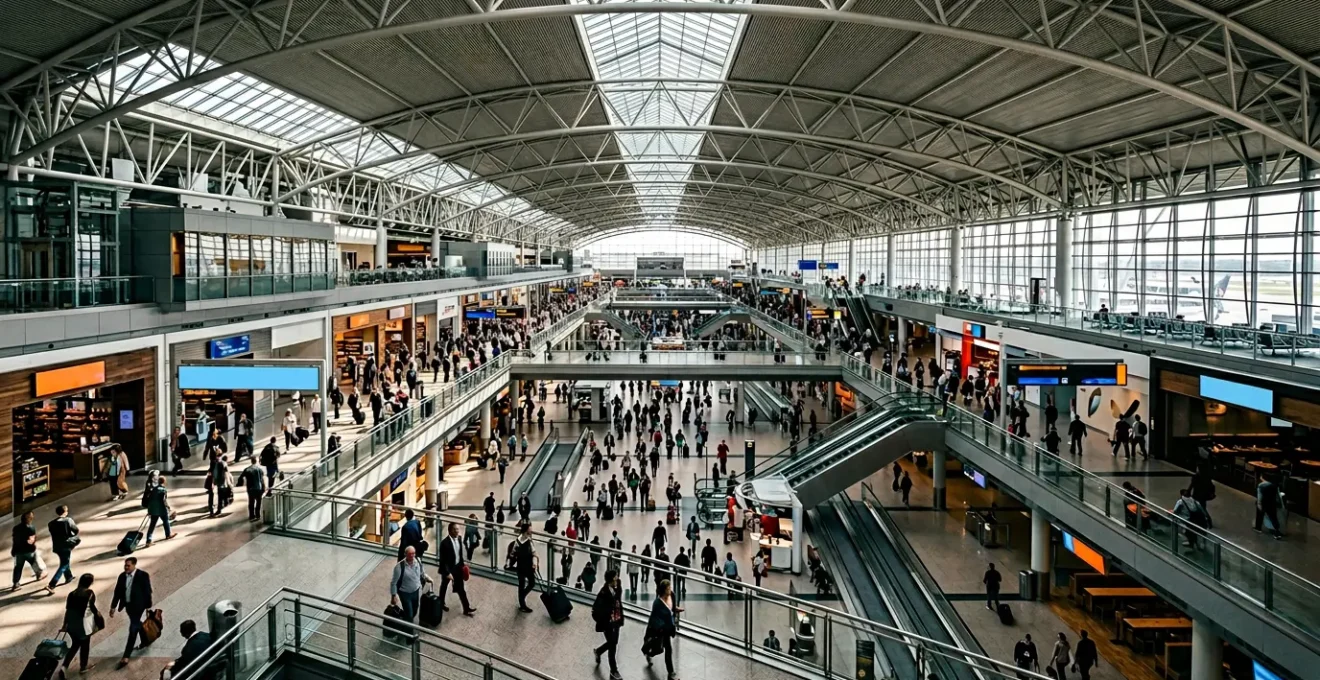
The most confusing Heathrow terminal isn’t a specific number, but a series of predictable ‘wayfinding traps’ that exist across the entire airport system.
- Official ‘Exit’ signs can be ambiguous, directing you to connections or baggage claim instead of the true public exit.
- The most efficient route between points (like gates or transport) is often a counter-intuitive path that bypasses main passenger flows.
Recommendation: Success lies in decoding the airport’s geographical logic and anticipating these common traps, rather than just following signs blindly.
For a first-time American traveler, the moment of arrival at London Heathrow is a mix of excitement and apprehension. The sheer scale of the facility, a sprawling complex that feels more like a city than a transport hub, can be overwhelming. The immediate challenge isn’t jet lag, but navigation. The common advice is to “follow the signs” or “allow plenty of time,” but this guidance often fails to address the core of the issue. Experienced travelers know that airport confusion is rarely about a lack of signs, but about their interpretation and the very architecture designed to manage millions of passengers.
The standard approach to airport navigation is reactive—you look for a sign, you follow it. This method, however, leaves you vulnerable to the subtle but powerful forces of airport design. These are the “retail mazes” that guide you through duty-free, the ambiguous signage at critical forks, and the crowds that obscure your path. The anxiety of getting lost, missing a connection, or keeping a driver waiting is a direct result of falling into these predictable wayfinding traps. For a first-time visitor, this can turn a simple arrival into a stressful 45-minute ordeal.
But what if the key wasn’t simply following directions, but understanding the airport’s geographical logic? This guide takes a different approach. We will not just identify the most confusing terminal; we will deconstruct the very patterns that create confusion in the first place. This is not a map, but a navigator’s mindset. By learning to anticipate these architectural and psychological traps, you can move through Heathrow—or any major UK airport—with purpose and confidence, bypassing the crowds and saving valuable time. This is about transforming from a lost tourist into a strategic navigator.
This article provides a tactical breakdown of the most common navigational challenges. Each section dissects a specific ‘wayfinding trap’ and provides a clear, geographical strategy to overcome it, enabling you to master the complex layouts of the UK’s busiest airports.
Summary: Navigating the Labyrinth of Heathrow and Other UK Airports
- Why Do “Exit” Signs at Heathrow Sometimes Lead You Astray?
- How to Get from Terminal 3 to Terminal 5 in Under 20 Minutes?
- Meeting Point vs Coffee Shop: Where Is the Best Place to Wait?
- The Lift vs Escalator Mistake That Traps You on the Wrong Floor
- How Far Is the Walk from Customs to the Car Park at Stansted?
- How to Locate Your Driver at Gatwick North Terminal in Under 3 Minutes?
- Why the “Meeting Point” at St Pancras Is Not Always the Best Spot?
- How to Navigate Heathrow Arrivals Without Losing 45 Minutes in Crowds?
Why Do “Exit” Signs at Heathrow Sometimes Lead You Astray?
The primary source of navigational error at any major airport stems from the ambiguity of its most fundamental sign: “Exit.” For a traveler whose goal is to leave the airport, this sign seems straightforward. However, in the complex geography of a hub like Heathrow, “Exit” is a multi-purpose term. It can mean exit to baggage reclaim, exit to flight connections, or the final exit to public transport and London. This ambiguity creates critical decision points where a wrong turn can lead you into a different passenger flow entirely, costing significant time.
This isn’t an isolated problem; it’s a systemic challenge in wayfinding design. The reliance on signage is immense, as 67% of US travelers rely on airport signage to guide them, according to a 2024 Tobii survey. When that primary tool is ambiguous, confusion is inevitable. The key is to augment sign-reading with geographical awareness. Before following an “Exit” sign, pause and look for qualifiers: does it say “Flight Connections,” “Baggage Reclaim,” or “Way Out”? The term “Way Out” is the British English equivalent for the final public exit and is the most reliable indicator for reaching taxis, trains, or car parks.
Heathrow itself is aware of these challenges. The airport has actively studied passenger navigation by using eye-tracking technology to see exactly where travelers look and where they become confused. This research helps them optimize signage, but the underlying complexity of the building remains. Therefore, the strategic traveler’s best defense is to treat “Exit” signs with suspicion, always looking for the secondary text that clarifies its true destination. This small act of verification is the first step in avoiding the most common wayfinding trap.
How to Get from Terminal 3 to Terminal 5 in Under 20 Minutes?
The transfer between Heathrow’s terminals, particularly from the older Terminal 3 to the vast Terminal 5, is a classic test of a traveler’s navigational skill. A successful transit in under 20 minutes is not about speed-walking, but about executing a precise sequence of actions without hesitation. The journey involves a combination of walking and rail travel, and any deviation can quickly add 15-20 minutes to the process. The path is clearly marked, but only if you know which signs to follow from the moment you deplane.
Your primary guide is the distinct purple signage for “Flight Connections.” Follow these signs religiously, ignoring all others for “Baggage Reclaim” or “Arrivals.” This path will keep you “airside” (within the security-controlled area) and direct you towards the inter-terminal transit system. The key is making no unnecessary stops and moving with purpose towards the Heathrow Central station, which serves Terminals 2 and 3.
Your Action Plan: Terminal 3 to Terminal 5 Transit
- Immediately after deplaning, locate and follow the purple ‘Flight Connections’ signs. Do not follow signs for Arrivals or Baggage Reclaim.
- Walk to Heathrow Central station. This is a 7-10 minute walk from most Terminal 3 gates.
- At the station, obtain a free inter-terminal transfer ticket from one of the dedicated machines. Alternatively, you can tap in and out with a contactless card or Oyster card for a zero-fare journey.
- Board the next available Heathrow Express or Elizabeth Line train heading to Terminal 5. Both services are free for this journey.
- The travel time on the train is approximately 5 minutes.
- Upon arrival at Terminal 5 station, follow signs to the departures level. The walk to your gate can take another 5-8 minutes.
To choose the best transit method for your specific needs, it’s helpful to understand the differences between the available options. The following comparison, based on a detailed guide to Heathrow connections, breaks down the key factors.
| Transfer Method | Journey Time | Frequency | Cost | Best For |
|---|---|---|---|---|
| Heathrow Express | 5 minutes | Every 15 mins | Free with ticket | Speed priority |
| Elizabeth Line | 5 minutes | Every 10 mins | Free with ticket | Most frequent |
| Piccadilly Line | 10 minutes | Every 5 mins | Free with Oyster | No ticket needed |
| Flight Connection Bus | 15-20 minutes | Every 6-10 mins | Free (airside only) | Connecting flights |
Meeting Point vs Coffee Shop: Where Is the Best Place to Wait?
The designated “Meeting Point” in an arrivals hall seems like the most logical place to wait for a passenger. However, these areas are often epicenters of congestion, noise, and anxiety. They become a chaotic sea of faces, making it difficult to spot the person you’re looking for. For a US traveler accustomed to more spacious layouts, the dense crowds at a Heathrow meeting point can be particularly jarring. A strategic navigator understands that the best waiting spot is rarely the official one; it is a location that balances visibility with comfort and control.
The goal is to find a vantage point with a clear line of sight to the customs exit but situated away from the main crush of people. A nearby coffee shop with window seats, such as a Costa Coffee or Pret A Manger, is often the ideal solution. It provides a fixed, comfortable base from which you can observe the entire arrivals flow without being swept up in it. This transforms a stressful wait into a relaxed period of observation.
As the image above illustrates, the experience of waiting can differ dramatically based on your chosen position. Instead of standing in the scrum, positioning yourself strategically allows you to survey the area calmly. To make an informed choice, consider this hierarchy of waiting spots:
- For Maximum Visibility (Short Wait): Stand near a numbered pillar just outside the main arrivals exit. These are clear, unmistakable landmarks, but offer no seating.
- For Comfort with Good Sightlines: Secure a seat at a Costa Coffee or Pret A Manger that directly overlooks the arrivals door. This is the optimal strategy.
- For Families or Anxious Waiters: The area near the M&S Simply Food exit is often less crowded and provides a clear, well-lit landmark that is easy to describe.
- For Business Meetings: If meeting a colleague, designated lounge areas or business centers within the terminal offer a professional and quiet environment.
The Lift vs Escalator Mistake That Traps You on the Wrong Floor
One of the most subtle yet frustrating wayfinding traps in a multi-level terminal is the choice between a lift (elevator) and an escalator. The mistake is not in choosing one over the other, but in failing to anticipate where each will deposit you. Escalators are designed for mass passenger flow and often deliver you into the middle of a crowded concourse, far from the decision point you need. Lifts, while slower, often open onto quieter, more strategic locations with clearer signage. A wrong choice can leave you disoriented, on the wrong floor, and fighting against the flow of traffic to find your bearings.
This issue is particularly prevalent at transition zones—the points where you move between floors. Passengers arriving at the top of an escalator are often met with a confusing array of visual information (shops, crowds, distant signs) but no immediate directional cue. This momentary disorientation is where critical time is lost.
Case Study: The Escalator Confusion at Bristol Airport
A wayfinding study at Bristol Airport identified a critical design flaw that perfectly illustrates this problem. The study revealed that passengers reaching the top of main escalators faced immediate confusion because directional signage was not visible from that specific decision point. Despite the terminal having clear signage elsewhere, this failure at the crucial transition zone between floors caused passengers to lose their orientation and backtrack, significantly increasing their journey time and stress levels. The study concluded that the physical placement of escalators created a navigational dead zone that signage alone could not fix.
The solution is to think vertically. When faced with a choice, consider your next objective. If you need to make a clear navigational decision (e.g., find a specific gate line or transport link), a lift is often the more strategic choice, as it places you in a more controlled environment. If you are simply moving with the main passenger flow towards a general area like baggage reclaim, an escalator is efficient. As one expert puts it, the architecture itself should guide you.
A well-designed terminal should reveal the routes before wayfinding elements are even added
– Sarah Owen, Senior Planner at Applied Information Group, quoted in Airports International
How Far Is the Walk from Customs to the Car Park at Stansted?
While this guide focuses on Heathrow, the question about the walk at London Stansted Airport highlights a universal feature of modern airport design: the “retail gauntlet.” After clearing customs, passengers are almost universally funneled through a long, winding path bordered by duty-free shops, restaurants, and other retail outlets. The walk from customs to the car park or public transport at Stansted—and similarly at Heathrow or Gatwick—can feel unexpectedly long, often taking 10-15 minutes at a steady pace.
This design is not accidental. It is a deliberate strategy for managing massive passenger flows and maximizing commercial revenue. The path is intentionally indirect, forcing exposure to retail. For the traveler focused on exiting, this can feel like a disorienting maze where the actual “Way Out” signs are distant and periodically obscured by storefronts and promotional displays. The sheer scale of these operations is staggering; in 2024, Heathrow handled a record-breaking 83.86 million passengers, and these retail corridors are a primary tool for managing such volumes.
As the visual suggests, the journey through this retail space is a journey in itself. The strategy for navigating it is to maintain a “destination-lock.” Ignore the distractions of the shops and keep your eyes fixed on the overhead directional signs. Look for the symbols for trains, buses, or car parks and move towards them with singular focus. The path may wind, but as long as you are following the correct overhead signage, you are on the right track. Resisting the impulse to browse is key to an efficient exit.
How to Locate Your Driver at Gatwick North Terminal in Under 3 Minutes?
Locating a pre-booked driver at a sprawling terminal like Gatwick North (or any Heathrow terminal) is a task where 60 seconds of pre-planning can save 10 minutes of frantic searching. The official pick-up and drop-off zones are often congested, and drivers face high parking fees, meaning they cannot wait for long. The key to a sub-3-minute connection is not speed, but proactive communication and bypassing official meeting points.
Relying on the generic “arrivals hall” as a meeting place is a recipe for failure. Instead, you must establish a precise, unmistakable landmark *before* you even land. This requires clear communication with your driver or transport service. The strategy shifts the burden of finding from a visual search in a crowd to a simple execution of a pre-agreed plan. This is especially crucial for a US traveler who may not be familiar with the terminal’s layout.
Follow this tactical checklist for a seamless pick-up:
- Before Landing: Share your flight number with your driver so they can track your arrival in real-time.
- Upon Landing: Send a text or WhatsApp message confirming you have landed and are heading to immigration.
- Establish a Specific Landmark: Do not agree to meet at the “Meeting Point.” Instead, pre-arrange a less crowded, highly specific spot. Examples: “at the Special Assistance desk to the left of Costa Coffee” or “under the large digital screen opposite the currency exchange.”
- Use Live Location: Once you are through customs, ask your driver to share their live Google Maps or Waze location pin. This allows you to walk directly to their vehicle.
- Provide a Visual Marker: Send a message describing what you are wearing (e.g., “red jacket, blue roller bag”) for quick visual identification.
- Synchronize Your Exit: Coordinate with your driver so that you exit the terminal building at the same time they are pulling into the short-stay pick-up lane.
Why the “Meeting Point” at St Pancras Is Not Always the Best Spot?
While St Pancras International is a train station, not an airport, its main meeting point provides a perfect case study in why official rendezvous spots are often inefficient. The designated meeting area is “The Kissing Statue,” a massive bronze sculpture on the upper concourse. The problem is that it serves a dual purpose: it is both a meeting point and a major tourist attraction. This creates a state of perpetual congestion, as waiting passengers mix with crowds of tourists taking photographs.
Furthermore, the station’s geography segregates different arrivals. Passengers arriving on Eurostar trains from Europe exit through a controlled channel far from the main concourse and the statue. Meanwhile, passengers on domestic UK trains arrive on platforms that open directly onto the main concourse. A traveler waiting at the statue for a Eurostar arrival might miss them completely, assuming they will emerge into the main hall when they actually exit from a different area downstairs.
This principle is directly transferable to Heathrow’s terminals. Official meeting points are often designed for generic passenger flow, not for specific arrival channels. Better alternatives at St Pancras, like under the main station clock or near the entrance to a prominent store like Fortnum & Mason, offer high visibility with significantly less crowd density. The lesson is clear: an effective meeting spot is defined by its clear sightlines and lower crowd density, not its official designation. For any US traveler navigating a UK transport hub, questioning the utility of the official “Meeting Point” is a crucial strategic instinct.
Key Takeaways
- Navigational confusion stems from predictable ‘wayfinding traps’ within the airport’s system, not from a single ‘bad’ terminal.
- Proactive navigation—anticipating layouts and decision points—is far more effective than reactively following signs.
- The key skill is identifying and bypassing common obstacles like ambiguous signage, crowded meeting points, and retail-focused corridors.
How to Navigate Heathrow Arrivals Without Losing 45 Minutes in Crowds?
The secret to a fast passage through Heathrow arrivals is not luck; it’s a strategy of controlled aggression. While Heathrow boasts impressive efficiency metrics, with reports that 92% of passengers passed through security in less than 5 minutes in 2024, this statistic applies to departures. The real bottleneck for arriving passengers is immigration, and every second lost between the plane door and the immigration hall can translate to minutes of queueing. Being just 60 seconds ahead of the main passenger disembarkation wave can save you 30 minutes in line.
This requires executing a “de-planing sprint.” This is not about running, but about moving with purpose and making a series of smart, quick decisions. It’s a mindset that treats the journey from the aircraft to the immigration E-gates as a tactical challenge to be won. The goal is to arrive at the immigration hall before the bulk of passengers from your flight and, critically, before passengers from other recently landed wide-body aircraft.
Your Action Plan: The De-Planing Sprint
- Exit the Aircraft Swiftly: Be packed and ready to move the moment the seatbelt sign turns off. An aisle seat in a forward cabin is a significant geographical advantage.
- Walk with Purpose: Use the sides of the corridors to overtake slower-moving passengers. This is not rude; it is efficient.
- Skip Initial Bathroom Stops: The toilets nearest the gate are a bottleneck. Wait until you are through immigration.
- Assess Immigration Queues Instantly: As you approach the immigration hall, quickly assess the queues for the electronic E-gates versus the manned desks. The E-gates are almost always faster for eligible nationalities (including US citizens).
- Predict Surges: Use an app like FlightRadar24 before you land to see if other large aircraft (e.g., an A380) are scheduled to arrive at the same time. This will increase your urgency.
By adopting this proactive approach, you are no longer a passive passenger being herded through a system. You are an active navigator, making conscious decisions to optimize your path based on the geographical and human landscape of the airport. You are decoding the system and beating it.
Armed with this geographical logic, you are now equipped to navigate not just Heathrow, but any major airport, with confidence. The next step is to put this mindset into practice on your upcoming journey, turning potential stress into a feeling of control and mastery.
Frequently Asked Questions About Navigating UK Transport Hubs
Why is The Kissing Statue always crowded?
As both the official meeting point at St Pancras and a major tourist attraction, it draws both waiting passengers and photo-taking tourists, creating perpetual congestion.
What’s the difference between Eurostar and domestic arrivals areas?
Eurostar passengers exit through a controlled funnel far from the main concourse, while domestic trains arrive at the main station platforms.
Where are the best alternative meeting spots?
Under the main station clock offers good visibility with less crowding, while the Fortnum & Mason entrance provides a clear landmark with nearby seating.