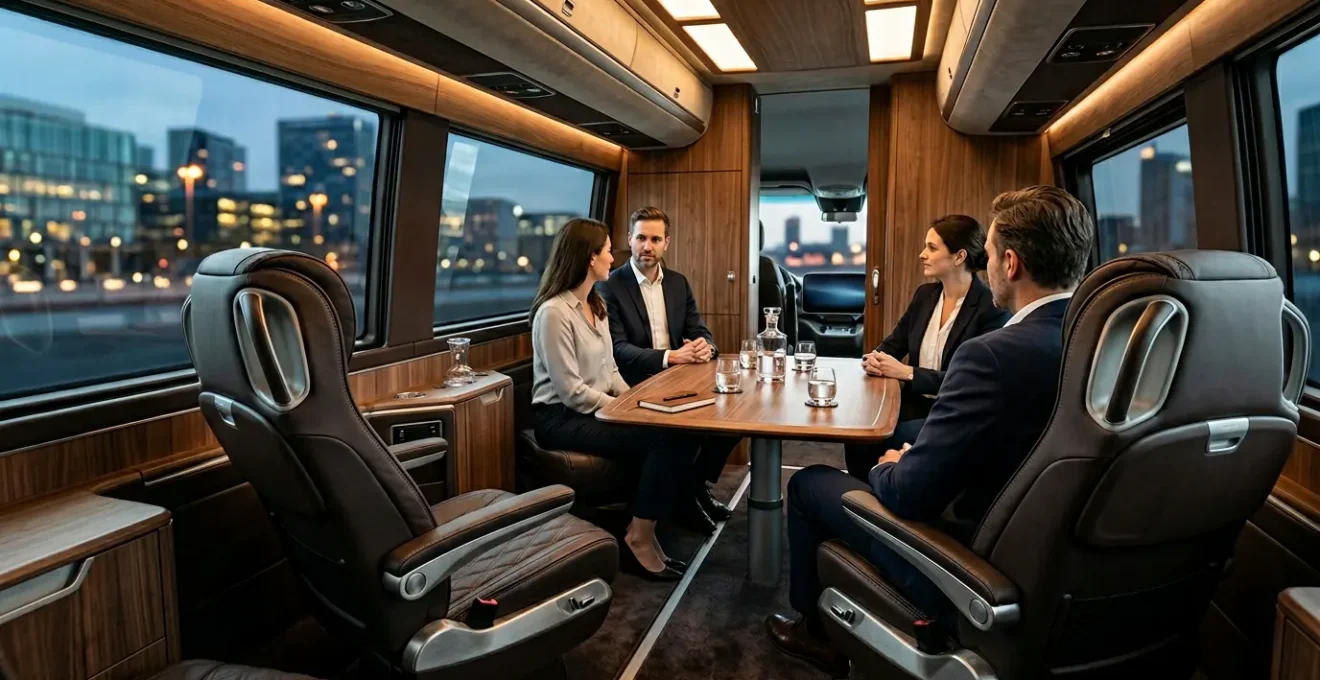
A luxury minicoach is not a smaller bus; it’s a strategic business tool that transforms travel into productive, confidential work sessions.
- Standard bus travel creates a “productivity dead-zone,” whereas an executive minicoach functions as a secure, mobile boardroom.
- Features like air suspension and partitioned cabins directly combat travel fatigue and protect sensitive discussions, preserving executive energy and focus.
Recommendation: Evaluate transport not on cost per seat, but on return on investment in executive time, productivity, and wellbeing.
When arranging transport for a board of directors, the default choice often oscillates between a fleet of luxury cars or a large, standard bus. The former is prestigious but fragments the team, while the latter is practical for numbers but disastrous for productivity. Corporate bookers frequently overlook the strategic middle ground: the luxury executive minicoach. The common perception is that it’s just a ‘nicer minibus’, with leather seats and a bit more legroom. This fundamentally misunderstands its purpose.
The crucial question isn’t about comfort as a perk, but comfort as a prerequisite for performance. While a standard bus moves people, it simultaneously creates a productivity dead-zone where focused work is impossible and confidential conversations are unthinkable. The real value of an executive minicoach lies in its ability to create a seamless transition from the office to the destination, turning what would be lost transit time into a valuable extension of the workday. This is the shift from tactical transport to strategic asset.
This article will deconstruct the specific elements that elevate a minicoach from a simple transport solution to a mobile boardroom. We will analyze how technical specifications like suspension systems directly impact cognitive function, explore the critical importance of cabin configuration for confidentiality, and provide practical frameworks for managing logistics, from central London hotel access to coordinating large delegate movements for major events.
To navigate these critical considerations, this guide breaks down the key differences and strategic advantages, allowing you to make an informed decision that prioritizes executive efficiency and security. Explore the sections below to understand the full picture.
Summary: Why a Luxury Minicoach Is Better Than a Standard Bus for Executive Teams?
- Tables and Fridges: What Distinguishes an “Executive” Minicoach?
- Air Suspension vs Leaf Springs: Why It Matters for Working En Route?
- Can a 16-Seater Minicoach Access Your Central London Hotel?
- Driver Partition or Open Cabin: Which Is Best for Confidential Talks?
- The Luggage Trailer Question: Do You Need One for 16 People?
- Luxury MPV vs Minibus: At What Point Do You Lose the “Executive” Feel?
- How to Add Corporate Branding to Delegate Shuttles?
- How to Manage Transport for 50 Delegates at ExCeL London?
Tables and Fridges: What Distinguishes an “Executive” Minicoach?
The distinction between a standard bus and an executive minicoach begins where basic transport ends. It’s not about the seats being leather; it’s about the vehicle’s entire design philosophy shifting from mass transit to a mobile boardroom. A standard bus offers a seat. A true executive minicoach provides a workspace. The presence of stable, conference-style tables is the first non-negotiable feature. These aren’t flimsy, seat-back fold-downs; they are robust surfaces designed to securely hold laptops, documents, and coffee, allowing for uninterrupted work.
This environment is engineered to mitigate the inherent stresses of travel. In fact, research reveals that 87% of business travellers lose at least one hour of productivity due to travel-related stress. An executive minicoach directly counters this by providing amenities that create a calm, controlled environment. A built-in fridge with chilled water and a coffee machine are not luxuries; they are tools that keep a team refreshed and focused, eliminating the need for time-wasting stops and maintaining momentum. This controlled climate extends to power, with USB and mains outlets at every seat, ensuring no device runs out of battery before a crucial meeting.
The following table clearly illustrates the chasm between a vehicle designed for commuting and one designed for executive performance.
| Feature | Executive Minicoach | Standard Bus |
|---|---|---|
| Seating | Luxury leather reclining seats with individual controls | Basic fabric bench seating |
| Tables | 4+ stable conference tables for laptops | No tables or unstable fold-downs |
| Power | USB & 110V outlets at every seat | Limited or no power options |
| Climate | Multi-zone climate control | Basic heating/cooling |
| Connectivity | 4G WiFi standard | No connectivity |
| Refreshments | Built-in fridge & coffee machine | None |
Ultimately, these features combine to transform dead time into productive, billable, or strategic hours. It’s the difference between arriving drained and arriving prepared.
Air Suspension vs Leaf Springs: Why It Matters for Working En Route?
While features inside the cabin are visible, the single most important component for en-route productivity is one you can’t see: the suspension. Standard buses and converted vans typically use a leaf spring suspension system. This is a durable, cost-effective technology designed for hauling heavy loads, but it provides a notoriously harsh and bumpy ride. For passengers, this translates into constant, jarring vibrations that make reading a screen difficult, typing error-prone, and concentrating for any length of time exhausting.
A purpose-built executive minicoach, by contrast, employs a sophisticated air suspension system. This technology uses computer-controlled airbags to absorb imperfections in the road, creating a remarkably smooth and stable ride, akin to a high-end luxury saloon. The impact on executive performance is profound. It eliminates what can be termed ‘kinetic fatigue’—the subtle but draining mental and physical toll caused by constant motion and vibration. With air suspension, the cabin becomes a stable platform where executives can comfortably work on laptops, conduct steady video calls, or simply relax without being jostled.
This commitment to ride quality is why a growing number of companies are looking beyond basic transport. A recent corporate travel behaviour report shows that 82% of companies now allow chauffeur services for business travel, recognizing that the quality of the journey directly impacts the effectiveness of the traveller. Choosing a vehicle with air suspension is a direct investment in the energy and focus of your most valuable assets: your leadership team. It ensures they arrive at their destination not just on time, but also in peak condition to make critical decisions.
Ignoring the suspension system is akin to booking a meeting room with a jackhammer operating next door; it makes the space technically available, but functionally useless.
Can a 16-Seater Minicoach Access Your Central London Hotel?
The compact footprint of a luxury 16-seater minicoach, typically based on a Mercedes-Benz Sprinter chassis, is one of its greatest assets in a congested urban environment like Central London. Unlike a full-sized, 50-seater coach which is restricted to major arteries and designated drop-off zones, the minicoach is nimble enough to navigate the narrow streets of Mayfair, the City, or Kensington. However, assuming unrestricted access is a common and costly mistake.
The primary challenge is not the street, but the final 10 metres: the hotel entrance. Many of London’s premier luxury hotels are housed in historic buildings with tight turning circles, low-hanging porticos, and strict access protocols. A standard Sprinter-based minicoach has a height of approximately 2.8 metres and a width of 2.3 metres (excluding mirrors). While this fits most scenarios, it’s essential to verify these dimensions against the specific hotel’s clearance. The concierge is your most valuable ally here; a call 48 hours in advance can prevent a logistical nightmare, confirming the best entry point and any weight restrictions for underground access.
To avoid any day-of disasters, a pre-trip verification process is essential. The driver should conduct a virtual reconnaissance using tools like Google Street View to identify potential obstacles. It’s also wise to identify alternative service entrances as a backup. A professional chauffeur company will perform these checks as standard practice, ensuring a seamless transition from the road to the lobby without the undignified need to stop short and unload luggage on a busy pavement.
As the image demonstrates, the minicoach’s maneuverability allows it to approach high-end locations that are simply inaccessible to larger vehicles, offering a truly door-to-door service. This level of precision is not a luxury, but a fundamental requirement for executive travel where time is paramount and first impressions are critical.
In essence, the minicoach combines the capacity for a group with the accessibility of a much smaller vehicle, but only if due diligence is applied.
Driver Partition or Open Cabin: Which Is Best for Confidential Talks?
For a board of directors, the journey between meetings is not downtime; it’s an opportunity for candid strategy sessions, sensitive personnel discussions, or M&A negotiations. In a standard bus or an open-cabin minibus, such conversations are impossible. Even with a professional driver, the lack of a physical barrier makes privacy an illusion. This is where the choice of cabin configuration becomes a matter of corporate governance, not just comfort.
An executive minicoach with a full driver partition is the only viable solution for truly confidential work. This feature creates a self-contained, sound-proofed rear cabin—an ‘acoustic bubble’ completely separated from the driver. This physical and auditory separation allows the executive team to converse freely and openly, with the same level of security as they would have in their own boardroom. The ability to discuss sensitive information in transit can provide a significant competitive advantage, allowing for real-time decision-making and strategy refinement right up to the moment of arrival.
The importance of this feature is increasingly recognized in the corporate world. An analysis of executive transport preferences found that companies prioritizing security specifically request vehicles with full acoustic partitions. These are not seen as an add-on, but as a core requirement for board-level meetings. The open-cabin alternative, while perhaps fostering a more social atmosphere for a team-building outing, is wholly inappropriate for high-stakes business. It forces a choice between silence and security risk, effectively neutralizing the vehicle’s potential as a productive workspace.
Choosing an open-cabin vehicle to save a marginal cost is a false economy that gambles with your company’s most valuable asset: its confidential information.
The Luggage Trailer Question: Do You Need One for 16 People?
A common oversight when booking a 16-seater minicoach is luggage capacity. The vehicle is designed to maximize passenger space and comfort, which often comes at the expense of storage. A standard Mercedes Sprinter conversion, the workhorse of the executive fleet, can typically accommodate around 16 medium-sized suitcases (standard check-in size). This one-bag-per-person ratio sounds reasonable, but it rarely holds up in the real world of executive travel.
The need for a separate luggage van or trailer hinges on three key factors: the duration of the trip, the origin of the travellers, and any special equipment. For a domestic, overnight trip, the built-in capacity is usually sufficient. However, for a multi-day international conference, the calculation changes dramatically. International travellers bring larger cases, and often a separate carry-on or laptop bag that also needs stowing. As a rule of thumb, if your group consists of more than 10 passengers on an international trip lasting more than two days, you should strongly consider a trailer.
Special equipment is the other major variable. A single set of golf clubs can displace two to three standard suitcases. Presentation displays, product samples, or extensive corporate event materials will quickly overwhelm the available space. A simple checklist can help make the decision:
- Passenger Count: Is it over 12 for an international trip?
- Trip Duration: Is it longer than 3 days?
- Luggage Type: Do you anticipate large suitcases and multiple bags per person?
- Special Items: Are there golf clubs, event displays, or other bulky items?
If you answer ‘yes’ to two or more of these questions, arranging a luggage trailer or a separate luggage van is not just a good idea—it’s essential for ensuring a smooth, uncluttered, and professional journey.
Failing to plan for luggage is the quickest way to turn a luxury executive transport experience into a cramped and disorganized shuttle run.
Luxury MPV vs Minibus: At What Point Do You Lose the “Executive” Feel?
The line between an oversized luxury car and a small bus is not just about the number of seats; it’s about the passenger experience. The “executive feel” is defined by personal space, exclusivity, and a sense of being catered to. This is perfectly captured in a luxury MPV (Multi-Purpose Vehicle) like a Mercedes V-Class, which typically seats up to 7 passengers in individual ‘captain’s chairs’. In this environment, every passenger has their own domain, with personal controls and ample elbow room.
The critical transition point, where the intimate, exclusive feel of an MPV gives way to the group dynamic of a minibus, occurs at 7 to 8 passengers. This is the threshold where, to accommodate the extra person, the vehicle’s architecture must change. Individual captain’s chairs are replaced by conference-style or forward-facing seating arrangements in a larger vehicle chassis, like a Sprinter. While still luxurious, the dynamic shifts from a private car experience to a small group environment. The sense of personal space is slightly reduced, and interaction becomes more communal.
According to a detailed comparison of Mercedes V-Class and Sprinter Executive models, this shift is fundamental. The V-Class is the pinnacle of small-group luxury, while the Sprinter minicoach is designed as a mobile boardroom for a larger team. Neither is inherently “better,” but they serve different purposes. For a small board of up to seven, a V-Class maintains the prestige and personal space of individual chauffeured cars while keeping the group together. Once the group size hits eight or more, attempting to squeeze into multiple MPVs becomes logistically inefficient and breaks the “one team” ethos. At this point, embracing the move to a true executive minicoach is the correct strategic choice, preserving the group’s cohesion in a purpose-built environment.
The goal is to match the vehicle to the group’s size and purpose, ensuring the chosen transport enhances, rather than diminishes, the executive experience.
How to Add Corporate Branding to Delegate Shuttles?
As Jenny Southan, CEO and Founder of Globetrender, aptly notes, ” Every journey needs to be optimised to justify the return on investment.” For corporate events and delegate shuttles, this optimisation includes leveraging the vehicle as a powerful branding tool. A fleet of sleek, anonymous minicoaches is a missed opportunity. Transforming them into a visible, mobile extension of your corporate identity reinforces brand presence from the moment a delegate is collected.
The method of branding should be tailored to the event’s scale, budget, and lead time. For a high-stakes board meeting or a single VIP transfer, subtlety is key. Low-tack, high-quality magnetic decals featuring the company logo can be applied and removed easily, offering a touch of customisation without being ostentatious. This is a cost-effective option with a quick turnaround.
For larger events like corporate roadshows or multi-day conferences, more immersive options are available. Branded headrest covers create a uniform, professional look inside the cabin, while a branded amenities package—containing items like bottled water, mints, and notebooks with the company logo—provides a tangible, welcoming touch. For a major product launch or marketing event where maximum impact is required, a full vehicle wrap offers an unmissable branding statement, though this requires significant lead time and budget. The most modern executive vehicles also offer digital display screens, which can be used to show welcome messages, company videos, or event schedules, providing a dynamic and easily updated branding solution.
Choosing the right approach depends on your specific goals, but a tiered strategy often works best.
| Branding Approach | Best For | Implementation Time | Cost Level |
|---|---|---|---|
| Magnetic Decals | VIP/Board Meetings | 24 hours | Low ($200-500) |
| Branded Headrest Covers | Corporate Roadshows | 48 hours | Medium ($500-1,500) |
| Digital Display Screens | Product Launches | Same day | Included in premium vehicles |
| Full Vehicle Wrap | Major Marketing Events | 5-7 days | High ($3,000-8,000) |
| Branded Amenities Package | All Corporate Events | 24 hours | Low ($50-200 per vehicle) |
Ultimately, branded transport signals a high level of organisation and attention to detail, elevating the entire delegate experience.
Key Takeaways
- An executive minicoach is a ‘mobile boardroom’, designed for productivity, not just transport.
- Air suspension is a non-negotiable feature for en-route work, as it prevents ‘kinetic fatigue’ and creates a stable workspace.
- Logistical details like London hotel access and luggage capacity must be verified pre-trip to ensure a seamless executive experience.
How to Manage Transport for 50 Delegates at ExCeL London?
Managing transport for a large group to a major venue like ExCeL London presents a complex logistical challenge that demands a strategic, not reactive, approach. The goal is not simply to move 50 people from A to B, but to do so with efficiency, flexibility, and clear communication. A single 50-seater coach, while seemingly efficient, is a high-risk strategy. It creates a single point of failure; if the coach is delayed in traffic, all 50 delegates are late. Furthermore, it offers no flexibility for delegates staying in different locations or having varying schedules.
The superior solution is a hub-and-spoke model using a small fleet of 3-4 executive minicoaches. This model offers robustness and flexibility. The minicoaches can service different hotel clusters, running on a fixed, predictable schedule (e.g., departures every 30 minutes during peak times). This decentralizes risk and empowers delegates with choice, allowing them to travel at a time that suits their morning schedule. A critical component of this strategy is stationing an on-site coordinator at a key ExCeL entrance, like the Prince Regent DLR station access point. This coordinator acts as the central command, managing arrivals, departures, and making real-time adjustments based on traffic or schedule changes.
Clear communication is paramount. A simple WhatsApp broadcast group is an effective tool for sending out real-time updates on departure times, vehicle locations, and any potential delays. Finally, a robust plan must include contingencies. This means reserving approximately 20% overflow capacity to accommodate last-minute changes or flight delays, and pre-planning alternative routes (e.g., via the A13) in the event of public transport strikes or closures on the DLR, which is the primary rail link to ExCeL.
Audit Checklist: Coordinating Large Group Transport
- Point of Contact Audit: List all communication channels (on-site coordinator, driver contacts, delegate broadcast group) and key hotel/venue personnel to ensure seamless information flow.
- Resource Inventory: Collect and verify existing assets, including the exact number of vehicles, their passenger and luggage capacity, and confirmed driver schedules.
- Route & Schedule Coherence: Confront proposed routes (e.g., via A13) and fixed timetables against potential disruptions (e.g., DLR strikes, peak traffic) and the delegates’ own event itineraries.
- Contingency Plan Assessment: Review the overflow capacity and alternative plans. Is the reserved 20% buffer sufficient for likely scenarios? Is the contingency plan simple enough to execute under pressure?
- Integration Plan: Define clear triggers for deploying backup vehicles or switching to alternative routes, and establish the protocol for communicating these changes instantly to all delegates and drivers.
To put these principles into practice, the next logical step is to partner with a transport specialist who can execute this level of detailed coordination on your behalf.