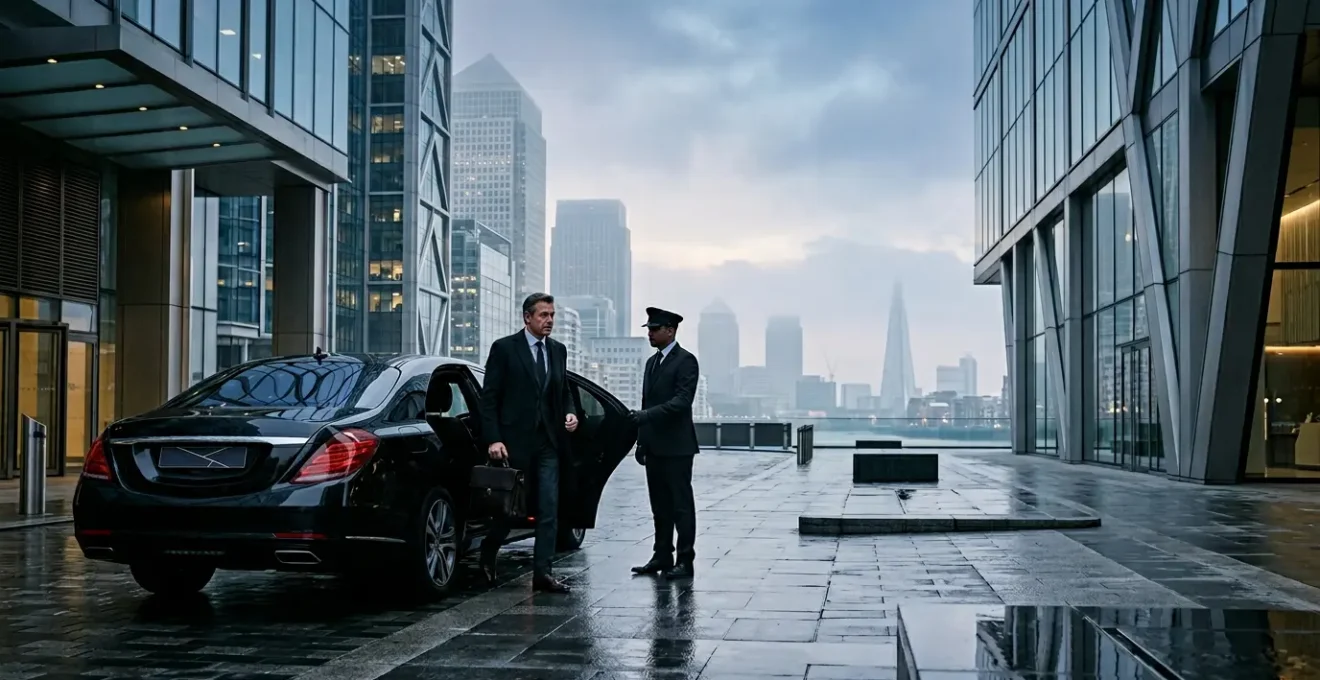
A professional chauffeur is a strategic asset that de-risks high-stakes meetings, while a black cab represents an unquantified but significant liability.
- The true cost of a 10-minute delay is not the fare, but the potential loss of reputational capital and deal momentum.
- True executive vehicles offer an acoustically secure environment for confidential work, a feature entirely absent in standard transport.
Recommendation: Vet your transport partner on their operational robustness—backup fleets, advanced driver vetting, and transparent pricing—not just their vehicle model.
As an executive assistant, you orchestrate the intricate ballet of a board member’s day. Every detail is scrutinised, every minute scheduled. Now, picture this: it’s 8:50 AM on a Tuesday, and a board member is due at a critical M&A negotiation in Mayfair. They are, however, stationary in a black cab on the Embankment, the driver is distracted by the radio, and a confidential preparatory call is impossible over the city’s din. This isn’t just an inconvenience; it’s a logistical failure with quantifiable financial and reputational consequences.
The conventional debate pits the iconic London black cab against the professional chauffeur service, often framed as a simple choice between convenience and style. This framing, however, is fundamentally flawed for high-stakes business. The decision is not about superficial aesthetics; it is a calculated risk assessment. The pertinent question is not “Which looks better?” but “What is the return on investment of guaranteed punctuality, absolute privacy, and a controlled environment, and what is the potential six-figure cost of its absence?”
This analysis moves beyond the platitudes of “comfort” and “professionalism.” We will dissect the true variables that a discerning executive assistant must weigh. We will quantify the reputational calculus of tardiness, evaluate the vehicle as a secure mobile office, and provide a framework for procuring this service without succumbing to hidden costs. Ultimately, we will demonstrate that for high-stakes London meetings, a professional chauffeur is not a transport expense; it is a non-negotiable component of a successful business strategy.
This guide breaks down the critical factors that determine the success of executive transport in London. By exploring each element, you will gain a comprehensive framework for making strategic decisions that protect your executives and your firm’s reputation.
Summary : The Strategic Value of Executive Transport for London’s Elite
- Why Being Late by 10 Minutes Can Cost Your Firm £5,000 in Reputation?
- Executive Saloon or Black Cab: Which Offers Better Privacy for Sensitive Calls?
- How to Book a Premium Chauffeur in London Without Hidden Surcharges?
- The “Cheap Luxury” Trap That Ruins 30% of Corporate Roadshows
- When to Book Your Ride: The 24-Hour Rule for Guaranteed Availability
- Why Is a Simple DBS Check Not Enough for Executive Transport?
- Why Does a Black Mercedes S-Class Signal “Authority” in Finance?
- How to Execute an IPO Roadshow with Zero Transport Failures?
Why Being Late by 10 Minutes Can Cost Your Firm £5,000 in Reputation?
Punctuality in the corporate world is not a courtesy; it is a signal of competence and respect. A ten-minute delay to a high-stakes meeting is not just ten lost minutes. It is a subtle erosion of trust, a demonstration of poor planning, and a transfer of control to the party left waiting. The financial impact of such events is staggering; while a 2024 report reveals billions are lost annually to unproductive meetings, the reputational cost of a single, crucial late arrival can be exponentially higher. It can shift negotiation dynamics, imply disrespect, and create an impression of disorganisation that can jeopardise a multi-million-pound deal before a single word is spoken.
The choice of transport is the primary variable in mitigating this risk. A black cab, subject to street-hail availability and the driver’s on-the-spot route knowledge, introduces a high degree of unpredictability. In contrast, a professional chauffeur service operates on a principle of pre-emptive logistics. Routes are planned in advance, traffic patterns are monitored in real-time, and contingency plans are in place. This transforms the journey from a gamble into a controlled, predictable event. The executive arrives not just on time, but in a state of readiness, having had their cognitive load reduced instead of increased by travel-related stress.
The table below outlines the fundamental differences in impact, moving beyond the simple fare cost to a more strategic analysis of value and risk. It demonstrates that the investment in a chauffeur service is a direct investment in the executive’s performance and the meeting’s potential success.
| Factor | Black Cab Service | Professional Chauffeur Service |
|---|---|---|
| Average delay | 37% of meetings start late | Pre-planning with 24-hour advance booking |
| Annual cost of delays | 5 days lost for senior executives | Zero-delay guarantee with backup vehicles |
| Preparation time | Driver focused on next fare | Route pre-studied, contingency plans ready |
| Meeting readiness | Last-minute stress affects performance | Cognitive load reduction for executives |
Ultimately, the £50 fare for a cab becomes irrelevant when weighed against the potential loss of a £50,000 opportunity cost due to a poor first impression. This is the core of the ROI calculation.
Executive Saloon or Black Cab: Which Offers Better Privacy for Sensitive Calls?
For a senior executive, the time spent in transit is not downtime; it is a critical window for preparation, confidential calls, and strategic thinking. The environment of the vehicle is therefore not a luxury, but a functional necessity. A black cab, with its open partition and lack of acoustic insulation, is fundamentally a public space. Attempting to discuss sensitive M&A details, review legal documents, or conduct a discreet conversation is not only unprofessional but a serious security risk. Eavesdropping, whether intentional or accidental, is a tangible threat.
An executive saloon, such as a Mercedes S-Class, is engineered from the ground up to be a private, isolated sanctuary. It functions as a secure mobile office. This is not a marketing claim but a result of specific design features. For example, the 2024 Mercedes S-Class Executive Line incorporates acoustic dampening materials throughout the cabin, integrated ear-level speakers in the headrests for private audio, and privacy glass. These features work in concert to create a confidential bubble, allowing the passenger to work with the same level of security as they would in their own office.
As the image above illustrates, the focus is on creating an environment free from external distractions and internal compromises. This allows the executive to remain productive and secure, transforming travel time into a strategic asset. The ability to personalise over 800 individual settings, including connectivity and privacy preferences, means the vehicle adapts to the specific needs of the passenger and the confidential nature of their work. This level of control and security is structurally impossible to achieve in a vehicle designed for mass public transport.
For any meeting where sensitive information will be discussed en route, the question of privacy becomes the single most important deciding factor, rendering the black cab a non-viable option.
How to Book a Premium Chauffeur in London Without Hidden Surcharges?
Procuring executive transport in London can be a minefield of opaque pricing and unexpected fees. The initial quote often excludes mandatory charges like the Congestion Charge, ULEZ fees, airport drop-off charges, or waiting time. This “cheap luxury” approach can lead to invoice shock and complicates expense reporting. For an executive assistant, achieving price transparency is paramount for budget control and building a trusted relationship with a service provider. The key is to demand an all-inclusive, fixed-price quote from the outset.
A reputable chauffeur firm that values corporate partnerships will always provide this. They operate on a model of transparency because their goal is a long-term service agreement, not a one-off transaction. To ensure you are partnering with such a firm, it is crucial to book directly with fleet operators rather than aggregator platforms. Aggregators often add a layer of commission and have less accountability for service quality or pricing discrepancies. A direct relationship with the operator allows for the establishment of a corporate account with pre-agreed pricing structures and a dedicated account manager who understands your firm’s specific needs. Furthermore, while tipping is a common query, this is often handled within corporate account agreements, simplifying the process for the executive.
Your Checklist for Transparent Chauffeur Booking
- Request an all-inclusive fixed quote that explicitly covers Congestion Charge, ULEZ fees, and airport drop-off charges.
- Verify the company holds a valid TfL Private Hire Operator license and request proof of their specific hire-and-reward insurance.
- Book directly with established fleet operators rather than aggregator platforms to ensure price transparency and direct accountability.
- Establish a corporate account for customised service, dedicated account management, and pre-agreed, repeatable pricing structures.
- Confirm that 24/7 customer service and real-time flight monitoring are included in the service without additional surcharges.
This methodical approach shifts the power to you, ensuring that the price agreed upon is the price you pay, and allows you to focus on the quality of service rather than worrying about hidden costs.
The “Cheap Luxury” Trap That Ruins 30% of Corporate Roadshows
A corporate roadshow is one of the most logistically intense and high-stakes undertakings a company can face. With a schedule of back-to-back meetings across multiple locations, a single transport failure can have a cascading effect, jeopardising multi-million-pound investments. The most common and costly mistake is falling into the “cheap luxury” trap: selecting a transport provider based on the appearance of their vehicles rather than the robustness of their operational backend. These services may offer a premium-looking car but lack the critical infrastructure to handle the dynamic and unforgiving nature of a roadshow.
A true professional roadshow partner operates as a logistics firm, not a taxi service. The vehicle is merely the endpoint of a complex support system. For example, a premier service like the one detailed in the professional roadshow management case study by Driven Worldwide includes dedicated backup vehicles on standby, lead drivers with specific roadshow experience, and a 24/7 operations team monitoring the entire mission. This is the crucial difference: the “cheap luxury” provider has a driver; the professional partner provides a fully managed, redundant logistical solution. They act as a logistical failure point mitigator.
Their operational platforms often use sophisticated technology to manage the itinerary, flagging potential risks like traffic or flight delays and proactively suggesting adjustments. This level of management ensures that the executive team is focused solely on their investor presentations, not on transport logistics. The vehicle and driver are allocated assets, part of a meticulously planned strategy designed for zero-failure execution. Choosing a provider without this proven operational depth because of a slightly lower headline price is a classic example of false economy, introducing unacceptable risk into a critical corporate event.
The investment in a partner with a proven roadshow management system is an insurance policy against logistical collapse, ensuring the roadshow’s success and protecting the significant resources invested in it.
When to Book Your Ride: The 24-Hour Rule for Guaranteed Availability
The “24-hour rule” is a common guideline in the chauffeur industry, but it’s a baseline, not a universal solution. While booking 24 hours in advance may secure a standard vehicle for a simple airport transfer, it is wholly inadequate for high-stakes executive requirements. The booking timeline must be directly proportional to the complexity and importance of the event. Relying on last-minute availability, even 24 hours out, relinquishes control over critical variables such as vehicle class, specific driver allocation, and the level of pre-mission briefing.
A strategic approach to booking involves treating the chauffeur and vehicle as an allocated asset that requires proper lead time for deployment. For a crucial business meeting in the City, a 48-72 hour window is advisable. This allows the provider to assign a senior chauffeur familiar with the area and prepare the specific vehicle requested. For more complex events, the timeline expands significantly. As an EA, your planning timeline should reflect the logistical demands of the event to ensure flawless execution. A professional chauffeur uses this lead time for meticulous preparation, studying routes and preparing contingency plans, ensuring a seamless experience.
To guarantee the highest level of service and asset availability, consider the following booking timeline as a guide:
- Standard Airport Transfer: Book 24 hours in advance for a basic service guarantee.
- Business Meeting in the City: Book 48-72 hours ahead to secure a specific vehicle class and driver preference.
- Multi-Day Roadshow or Corporate Event: Book 2-4 weeks in advance to secure dedicated asset allocation and a lead driver.
- Major London Events (e.g., Wimbledon): Book 4-6 weeks ahead to avoid peak demand lockouts and inflated pricing.
- High-Profile IPO Roadshow: Book 6-8 weeks ahead with a detailed itinerary to allow for comprehensive pre-mission briefings and logistical planning.
This foresight is what separates standard service from the guaranteed, zero-failure execution demanded by high-stakes corporate life in London.
Why Is a Simple DBS Check Not Enough for Executive Transport?
A standard Disclosure and Barring Service (DBS) check is a legal necessity for any professional driver in the UK. However, for executive transport, it represents the absolute bare minimum, not a hallmark of quality or security. Relying on a DBS check alone is a critical oversight. The role of an executive chauffeur extends far beyond simply driving; they are a temporary custodian of your company’s most valuable assets: its people and its information. They must be vetted for discretion, security awareness, and advanced driving skills, attributes that a DBS check does not and cannot measure.
Elite chauffeur firms understand this distinction and implement a far more rigorous vetting process. As the award-winning firm Belgraves of London demonstrates, their process is akin to five-star hotel standards. This includes advanced defensive driving qualifications like RoSPA Gold or IAM RoadSmart, which ensure the passenger’s physical safety is in the hands of a highly skilled professional. Furthermore, vetting extends to first aid training, counter-surveillance awareness to protect against corporate espionage, and even a thorough social media footprint analysis to ensure the highest levels of discretion and professionalism.
This level of scrutiny ensures the chauffeur is not just a driver, but a security-conscious professional who can operate seamlessly with close protection officers (CPOs) if required. As the security protocol from a top-tier provider states:
Our chauffeurs are trained to be security aware and can work with CPOs and other professionals. Driving standards are closely monitored
– Chabé Financial Roadshow Transport, Chabé Security Protocol Documentation
This highlights the shift from a passive driver to an active part of the executive’s security detail. The chauffeur is trained to be an asset in maintaining the integrity of the “corporate bubble,” not a potential weak link in it.
The answer to that question will reveal the provider’s true commitment to executive safety and security, which is a far more accurate indicator of their suitability for high-stakes transport.
Why Does a Black Mercedes S-Class Signal “Understated Authority” in Finance?
In the world of London finance, every choice is a signal. The suit, the watch, and, most certainly, the car. The vehicle an executive arrives in is a non-verbal communication of their status, their firm’s health, and their approach to business. While a black cab signals pragmatism and an “on-the-ground” mentality, it carries no weight of authority. At the other extreme, arriving in a flamboyant Bentley or Rolls-Royce for a corporate meeting can be perceived as ostentatious and focused on personal wealth rather than corporate strength, potentially alienating prospective partners.
The black Mercedes S-Class occupies a unique and powerful position in this semiotic landscape. It is the unspoken uniform of the global financial elite, projecting understated power and established success. It is not flashy, but its quality is unmistakable. Its brand equity is built on decades of engineering excellence, safety, and reliability—qualities that mirror the values of the financial institutions it serves. The choice of an S-Class signals a discerning, serious, and successful individual who values substance over spectacle. This is reinforced by financial data; as Kelley Blue Book data shows, the S-Class’s managed depreciation helps it maintain an air of exclusivity that signals established wealth, not fleeting new money.
The specific perception of different executive vehicles is a nuanced language that a skilled EA must understand to project the correct image for their principal. The choice of vehicle should align with the context of the meeting and the industry culture.
The following table provides a general guide to how different executive vehicles are perceived within the London financial and corporate sectors.
| Vehicle Choice | Industry Perception | Suitable For |
|---|---|---|
| Black Mercedes S-Class | Understated power, established success | Investment banks, law firms, traditional finance |
| Range Rover Autobiography | Landed luxury, creative leadership | Property developers, creative directors |
| Bentley/Rolls-Royce | Ostentatious, personal wealth focus | Ultra-high-net-worth individuals, not corporate |
| Mercedes EQS/Audi e-tron | Forward-thinking, sustainable | Tech firms, ESG-focused organizations |
Choosing the right vehicle is not about personal preference; it’s about deploying the correct non-verbal tool for the strategic objective at hand.
Key takeaways
- The choice between a black cab and a chauffeur is a risk management decision, not a style preference. The potential cost of logistical failure far outweighs any fare difference.
- A true executive vehicle serves as a secure, private mobile office, enabling productivity and protecting confidential information—a function a public taxi cannot fulfil.
- Vetting a chauffeur service must go beyond vehicle appearance to scrutinise their operational backend, including transparent pricing, advanced driver vetting, and logistical redundancy (e.g., backup vehicles).
How to Execute an IPO Roadshow with Zero Transport Failures?
Executing an IPO roadshow is the ultimate logistical challenge. The stakes are astronomical, the schedule is unforgiving, and there is absolutely no margin for error. In this environment, transport is not a service; it is a critical mission component. Achieving “zero transport failures” requires a strategic framework that integrates the principles of risk mitigation, operational robustness, and strategic communication discussed throughout this analysis. It is the synthesis of choosing the right partner, the right vehicle, and the right planning protocol.
The foundation of a flawless roadshow is selecting a transport partner who functions as a dedicated logistics manager. This partner must demonstrate a proven track record in roadshow execution, supported by a 24/7 operations centre, a fleet of backup vehicles, and chauffeurs specifically trained for the demands of multi-city, high-pressure itineraries. The planning phase must begin weeks, not days, in advance, with the transport partner receiving the full, detailed itinerary to conduct route reconnaissance, identify potential chokepoints, and develop primary and secondary travel plans for every leg of the journey.
The vehicle selection must align with the message of the IPO—typically, a fleet of identical, discreet executive saloons like the Mercedes S-Class to project an image of consistency, seriousness, and success. Every chauffeur must be fully briefed on the itinerary, the individuals involved, and the protocols for communication and discretion. The entire operation must function as a single, cohesive unit dedicated to one goal: ensuring the executive team moves between meetings seamlessly, allowing them to conserve their energy and focus exclusively on securing investment. This is the blueprint for turning a potential logistical nightmare into a strategic advantage.
To put these principles into action, the next logical step is to engage a vetted transport partner to conduct a logistical review of your upcoming high-stakes travel, ensuring every potential failure point has been identified and mitigated well in advance.