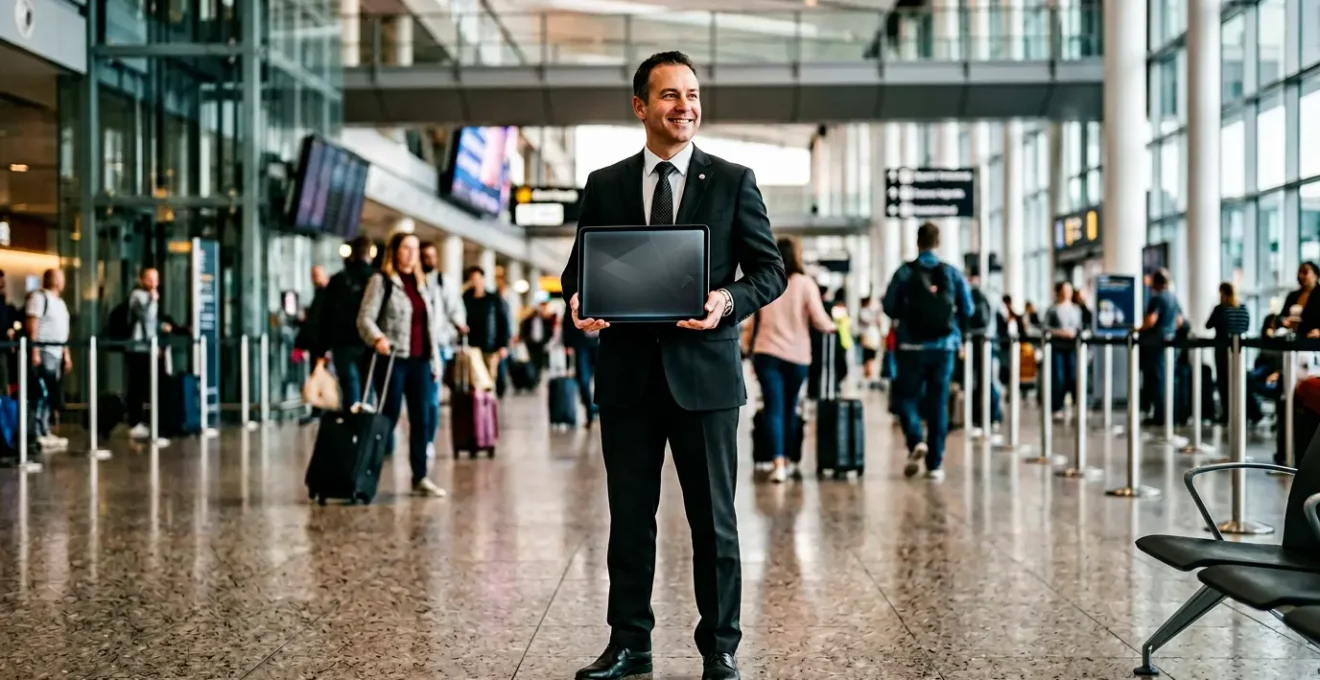
Contrary to common belief, a signboard service isn’t about logistics; it’s a strategic act of non-verbal communication that defines the first impression for an international VIP.
- Success lies in anticipating cultural needs and eliminating communication friction before it occurs.
- Details like the signboard’s format, the meeting location, and in-car amenities signal respect and authority more powerfully than words.
Recommendation: Shift your focus from simply “picking up” a guest to orchestrating a frictionless transition that demonstrates cultural intelligence and meticulous care from the very first second.
For any UK company hosting a delegation from Asia, the first point of contact is not the boardroom handshake; it is the moment a tired traveller scans the arrivals hall. The conventional wisdom is to ensure a chauffeur is there on time, holding a sign with the guest’s name. This approach, while functional, completely misses the profound opportunity to make a powerful first impression. It treats the welcome as a logistical task rather than what it truly is: the opening statement in a high-stakes business relationship, delivered without a single word of English.
Most services focus on the basics: a legible sign, a polite driver, and help with luggage. But these are merely the table stakes. They do not account for the cultural nuances, the psychological state of a person after a long-haul flight, or the subtle signals of status and respect that are paramount in many business cultures, particularly in Asia. A simple handwritten sign can inadvertently signal a lack of prestige, while an ill-timed handshake can create immediate discomfort.
But what if the true purpose of a signboard service was not just to be seen, but to communicate respect, authority, and meticulous anticipation? This is the core of true corporate hospitality. It’s about shifting from a reactive “meet and greet” to a proactive, culturally intelligent welcome. It’s about orchestrating a seamless, frictionless transition from the aircraft to the vehicle, where every detail has been considered to put a non-English speaking client at ease and affirm their VIP status.
This guide will deconstruct the elements of a world-class welcome. We will explore how to move beyond basic logistics to master the art of non-verbal communication, ensuring your international guests feel valued, respected, and impeccably cared for from the moment they land.
In this article, we will delve into the critical details that transform a standard airport pickup into a strategic hospitality experience. The following sections outline the key considerations, from cultural greeting protocols to the amenities that define a true first-class service.
Summary: The Strategic Elements of a Flawless VIP Welcome
- Why a Handshake Is Not Always Appropriate in a VIP Welcome?
- How to Format a Signboard for Maximum Visibility in a Crowded Hall?
- In-Terminal Meet or Curbside Call: Which Is Better for VIPs?
- The “Wrong Passenger” Mistake That Happens When Names Are Common
- What to Say in the First 30 Seconds to Put a Tired Traveler at Ease?
- Why Does a Black Mercedes S-Class Signal “Authority” in Finance?
- What Snacks and Stationeries Must Be in a Roadshow Car?
- What Amenities Define a True First Class Service Today?
Why a Handshake Is Not Always Appropriate in a VIP Welcome?
The first moment of interaction sets the tone for the entire visit. In Western business culture, a firm handshake is the default gesture of greeting, signifying confidence and openness. However, for a non-English speaking VIP, particularly from Asia, this physical gesture can be forward or even inappropriate. True cultural intelligence (CQ) involves understanding and adapting to the guest’s communication style. For many Asian cultures, a slight bow or a respectful nod is the preferred greeting, maintaining a comfortable personal distance. For guests from the Middle East, placing a hand over the heart is a sign of sincere and respectful welcome that avoids physical contact.
A professional hospitality service is trained in these nuances. Their protocol prioritises making the guest feel comfortable, not imposing a foreign custom upon them. The primary greeting method should be visual and respectful: the clear presentation of the name signboard. This allows the client to identify their chauffeur and approach at their own pace. Professional services demonstrate their adaptability in other ways too; for instance, premium meet-and-greet services are equipped to offer personalised assistance for individuals with mobility or visual impairments, proving that care can be demonstrated effectively without relying on conventional physical contact.
The safest and most universally accepted form of greeting is a warm, professional smile combined with clear eye contact. This non-verbal cue transcends language barriers, immediately communicating warmth and a welcoming attitude. By defaulting to observation and respectful distance, you allow the guest to initiate the level of interaction they are comfortable with, which is the highest form of respect. The goal is to create a sense of ease, not to force an awkward or culturally dissonant interaction.
Ultimately, deferring to the guest’s lead and prioritising non-physical gestures of respect is a powerful signal that your company is considerate, globally aware, and has invested in their comfort.
How to Format a Signboard for Maximum Visibility in a Crowded Hall?
In the visual chaos of an international arrivals hall, a signboard is a beacon. Its effectiveness, however, depends entirely on its design and presentation. A hastily written paper sign is not only difficult to spot but also sends a message of amateurism. For a VIP welcome, the signboard itself is a piece of communication, and its format must be optimised for clarity and professionalism. The key is high contrast and simplicity. A dark background with bold, white, sans-serif lettering is the industry standard for a reason: it’s readable from a distance. The guest’s name should be the most prominent element, with any company logos secondary and smaller.
Today, digital signboards on tablets have become the gold standard for premium services. They offer superior visibility and project a modern, high-end image that aligns with a VIP’s expectations. These tools allow for instant customisation of text size and colour, and many include a blinking text feature that dramatically increases visibility in a crowded environment. This technological edge is not merely for show; it is a practical tool that serves the primary goal of a frictionless welcome.
This comparison highlights how digital solutions directly address the challenges of a busy terminal. According to an analysis of signboard technologies, the shift to digital is a clear trend among top-tier professionals.
| Feature | Traditional Paper Sign | Digital Signboard | Visibility Impact |
|---|---|---|---|
| Recognition Distance | 10-15 feet | 25-30 feet | Blinking text feature helps VIP clients spot drivers instantly in crowded terminals |
| Professional Image | Basic/Handwritten | High-end appearance | iPad looks significantly more high-end than handwritten cardboard sign |
| Customization Speed | Minutes to recreate | Seconds to adjust | Easily change welcome sign text, color, size, create blinking text sign |
| User Base | Occasional use | 25,000+ professionals | Over 25,000 professionals and travelers have ditched paper |
Beyond the technology, the chauffeur’s positioning is critical. They should hold the sign at chest height, facing the flow of passenger traffic from the customs exit, ensuring the sign is neither too high nor too low to be seen easily over the crowd.
In-Terminal Meet or Curbside Call: Which Is Better for VIPs?
The choice between meeting a guest inside the terminal versus coordinating a curbside pickup is a defining factor in the quality of a welcome service. For a non-English speaking VIP navigating an unfamiliar airport like Heathrow or Gatwick, a curbside call is a recipe for stress and confusion. It places the burden on the guest to find an exit, make a phone call, and locate a vehicle in a chaotic environment. A premium service eliminates this friction entirely. An in-terminal meet and greet is unequivocally the superior option for any VIP, as it provides a seamless and reassuring experience from the moment they enter the arrivals hall.
With an in-terminal service, the chauffeur takes on all the logistical stress. They monitor the flight status in real-time, adjusting for any delays, and are already in position at the designated meeting point—typically the baggage claim area—before the guest even arrives. This proactive approach ensures there is zero waiting time or uncertainty for the traveller. The chauffeur is a fixed, reliable point in an otherwise overwhelming environment. This is the essence of a frictionless transition: removing every potential obstacle to create a smooth, uninterrupted journey from the gate to the car.
Case Study: The Seamlessness of In-Terminal VIP Reception
An analysis of premium services, such as those detailed by Seattle’s VIP town car providers, consistently shows the value of in-terminal service. Instead of the guest waiting curbside or searching for their ride, they are personally received inside the terminal. The chauffeur’s role extends beyond just driving; they monitor the flight, position themselves strategically before arrival, and provide immediate assistance. This protocol completely eliminates navigational stress, which is particularly valuable for international clients who may not be familiar with the airport’s layout or language.
Furthermore, the in-terminal meet allows for immediate personal assistance. As soon as the guest is identified, the chauffeur can help with luggage, creating a hassle-free experience. Modern services enhance this by sending a text message with the driver’s photo and contact details in advance, adding another layer of reassurance and easy identification. This level of curated service is simply impossible to replicate with a curbside call.
In short, the in-terminal meeting point is not just a location; it is a statement of care, demonstrating that the host has prioritised the guest’s comfort and peace of mind above all else.
The “Wrong Passenger” Mistake That Happens When Names Are Common
In a busy arrivals hall, common names like “Mr. Zhang” or “Mr. Kim” can easily lead to a chauffeur picking up the wrong passenger. This mistake is more than a logistical hiccup; it can cause significant delays and embarrassment for both the guest and the host company. Preventing this requires a system that goes beyond simply displaying a name. A professional service implements a form of two-factor authentication to ensure a 100% positive identification, a sort of “digital handshake” that works without language.
The first and simplest layer of verification is adding a second piece of unique information to the signboard. This could be the flight number, the company name the guest is representing, or a booking reference code. This immediately distinguishes your “Mr. Zhang” from another arriving on a different flight. This small detail is a hallmark of a meticulous and professional service, showing a level of foresight that builds immediate trust. It is a standard practice for chauffeurs to meet passengers at the arrival area with a signboard, but the quality of that signboard’s information is what makes the difference.
For an even more secure and technologically advanced approach, some services are implementing QR code verification. The guest receives a unique QR code with their booking confirmation, and the chauffeur’s app can scan it for an instant, error-proof match. This method is completely language-independent and provides a discreet, modern, and highly secure way to confirm identities. It’s the ultimate expression of a frictionless, tech-enabled welcome. Beyond technology, clear protocols are essential. Drivers must be trained to contact their dispatch office immediately if they cannot locate their passenger within a set timeframe, rather than leaving the area or making assumptions.
Your Action Plan: The Two-Factor VIP Identification Protocol
- Review Signboard Content: Mandate that all signboards must display the passenger’s name plus a unique secondary identifier (e.g., flight number, company logo, or booking reference).
- Implement Secondary Verification: Train drivers to discreetly confirm the secondary identifier with the guest. This can be a simple pointing gesture towards the flight number on the sign.
- Establish a Communication Protocol: Create a clear procedure for drivers if a passenger cannot be located after 15 minutes past the expected arrival at the meeting point. The protocol must be to call the dispatch office, never to leave the post.
- Leverage Technology: For high-volume or high-security arrangements, explore implementing a QR code verification system as a “digital handshake” to eliminate ambiguity.
- Pre-Send Driver Details: Always send the guest an email or text message with the driver’s name and photo before their flight, so they also have a means of visual verification.
By implementing these layers of verification, you transform the pickup from a game of chance into a precise, secure, and professional procedure that reflects well on your organisation’s attention to detail.
What to Say in the First 30 Seconds to Put a Tired Traveler at Ease?
For a non-English speaking guest, the first 30 seconds of interaction are not about what you say, but what you do. After a long flight, a traveller is often tired, disoriented, and not receptive to complex conversation. The primary goal is to communicate care and competence through action, a concept best described as anticipatory hospitality. This means anticipating needs and addressing them proactively, creating an immediate sense of being looked after. The chauffeur’s non-verbal communication is paramount.
Upon identification, the first action, after a warm smile and respectful nod, should be to take control of the luggage. This should be done without asking. The chauffeur should confidently and gently reach for the luggage trolley or bags, a universal gesture that says, “Allow me, your journey is now in my hands.” This single, proactive move lifts a physical and mental burden from the guest and establishes the chauffeur as a capable assistant. Any verbal communication should be minimal, simple, and accompanied by clear gestures. For example, a simple “Welcome” followed by an open-handed gesture towards the exit is far more effective than a string of questions.
The second critical action within the first minute is offering refreshment. Presenting a bottle of chilled water is a universal sign of hospitality. It’s a small gesture that shows consideration for the guest’s physical comfort after a dehydrating flight. To elevate this, a welcome card can be presented alongside the water. This card, printed in the guest’s native language, can contain essential information like the Wi-Fi password for the vehicle, the chauffeur’s name, and an estimated travel time to the hotel. It’s a sophisticated touch that provides clarity and comfort without requiring any verbal exchange, perfectly demonstrating anticipatory care.
By focusing on these deliberate, non-verbal actions, you create a powerful and positive first impression that a tired traveller will appreciate far more than any forced conversation, ensuring they feel relaxed and valued from the outset.
Why Does a Black Mercedes S-Class Signal “Authority” in Finance?
The choice of vehicle for a VIP transfer is a critical element of non-verbal communication, extending far beyond simple transportation. In the world of finance and high-level corporate affairs, a black Mercedes S-Class is not just a car; it is a globally recognised symbol of non-verbal authority, success, and discretion. For a non-English speaking VIP, who may be judging your organisation on visual cues, the vehicle is a powerful statement about the importance you place on their visit and your own company’s standing.
The S-Class and similar vehicles like the BMW 7 Series or Audi A8 are associated with heads of state, CEOs, and diplomats. This association instantly confers a sense of prestige and security. The choice of black is deliberate: it signals seriousness, elegance, and a professional, understated power. The vehicle’s reputation for cutting-edge technology, supreme comfort, and a silent, smooth ride directly translates into a message for the guest: we provide only the best, and we value your comfort and privacy. Features like a privacy partition further reinforce this message of a secure, confidential environment where business can be conducted or relaxation can be enjoyed.
Case Study: Vehicle Choice as a Statement of Service Quality
Premium airport transfer services understand that the vehicle is an integral part of the service promise. As outlined in an analysis of executive chauffeur offerings, the selection of luxurious cars like a Mercedes or BMW is a conscious decision to communicate quality. This is paired with a well-trained chauffeur who provides a premium service, from a warm meet and greet to reliable luggage handling. The combination ensures the guest can relax and recover from jet lag in a serene and prestigious environment, with the vehicle itself setting the high standard for the experience to come.
This extends to private aviation as well. Chauffeurs serving private terminals (FBOs) are expected to be well-versed in their specific protocols, facilitating a seamless transition between a private jet and a luxury vehicle. The consistency of a high-end experience, from air to ground, reinforces the message of impeccable, detail-oriented service. The vehicle is the first tangible asset the guest interacts with, and its quality reflects directly on the host company.
Therefore, investing in a high-end vehicle is not an extravagance; it is a strategic investment in brand perception, ensuring the first impression is one of undeniable authority and respect.
What Snacks and Stationeries Must Be in a Roadshow Car?
For a multi-stop financial roadshow or an extended VIP visit, the vehicle becomes a mobile office and a sanctuary. The amenities provided within are a crucial opportunity to demonstrate a deep level of anticipatory hospitality and cultural awareness. Generic offerings like mints and standard bottled water are insufficient. A first-class service tailors its provisions to the specific needs and cultural preferences of the non-English speaking client, showing a level of research and care that leaves a lasting impression.
The foundation of in-car amenities is connectivity and comfort. A high-speed mobile Wi-Fi hotspot is non-negotiable, allowing the guest to remain productive and connected without worrying about international roaming charges. Multi-port charging stations compatible with a range of international devices are equally essential. Beyond technology, refreshments should be thoughtfully selected. For a delegation from Japan, providing high-quality green tea in addition to water would be a deeply appreciated gesture. For guests from the Middle East, offering premium dates would show cultural understanding. This level of customisation, based on a simple pre-arrival check of the guest’s origin, transforms a standard service into a highly personalised one.
A truly premium service, such as those detailed by service providers like DRVN, empowers the guest with discreet control. Bilingual request cards can be placed in the seat-back pocket, allowing the client to easily communicate preferences for temperature, music, or an unscheduled stop without a language barrier. This simple tool returns a sense of agency to the guest. Preparation is everything. Top-tier greeter services review every client file in advance, noting language preferences and any special requirements to ensure every detail is curated for a personalised and efficient service. This meticulous preparation is what separates an adequate service from an exceptional one.
These thoughtful touches communicate a powerful message: we have not just prepared a car for you, we have prepared this car specifically for *you*.
Key Takeaways
- A VIP welcome for non-English speakers is an act of strategic non-verbal communication, not just logistics.
- Every detail, from the signboard’s font to the type of vehicle, signals respect, authority, and the value you place on the guest.
- The ultimate goal is a frictionless transition, achieved through anticipatory hospitality and cultural intelligence that removes stress and confusion.
What Amenities Define a True First Class Service Today?
In today’s competitive landscape, a true first-class welcome service is defined by one principle: the complete and utter elimination of friction. For a non-English speaking VIP, this means an experience so seamless and intuitive that the language barrier becomes irrelevant. This is achieved through a masterful integration of personalised human service and smart technology. The modern luxury experience is not just about comfort; it’s about providing effortless control and proactive assistance at every single touchpoint, from the jet bridge to the hotel lobby.
The service begins before the guest even deplanes. A professional greeter meets them right at the gate, ready to escort them through the airport. This is where the real value becomes apparent. These services leverage fast-track passes and special VIP lanes to bypass long queues at immigration and security, a benefit of immense value to a tired traveller. The greeter provides clear, simple navigation assistance, turning a potentially confusing journey through a large terminal into a calm and efficient procession. The demand for this level of service is surging, with some providers seeing a more than 160 percent increase in demand for airport greeters compared to pre-pandemic times.
Technology is the key enabler of this modern first-class experience. Imagine a QR-code-enabled digital concierge on the guest’s phone, providing all necessary information in their native language. Real-time flight tracking allows for automatic rescheduling if a flight is delayed, a process that happens in the background without the guest needing to do anything. Inside the vehicle, entertainment systems are pre-configured to the guest’s language, and one-touch communication buttons can signal common requests to the driver. This seamless digital integration ensures that information and assistance are always just a glance or a touch away, creating a bubble of effortless control and comfort around the VIP.
To ensure your next international delegation receives this level of anticipatory hospitality, the next logical step is to audit and upgrade your current welcome protocol, integrating these first-class standards to deliver an unforgettable first impression.