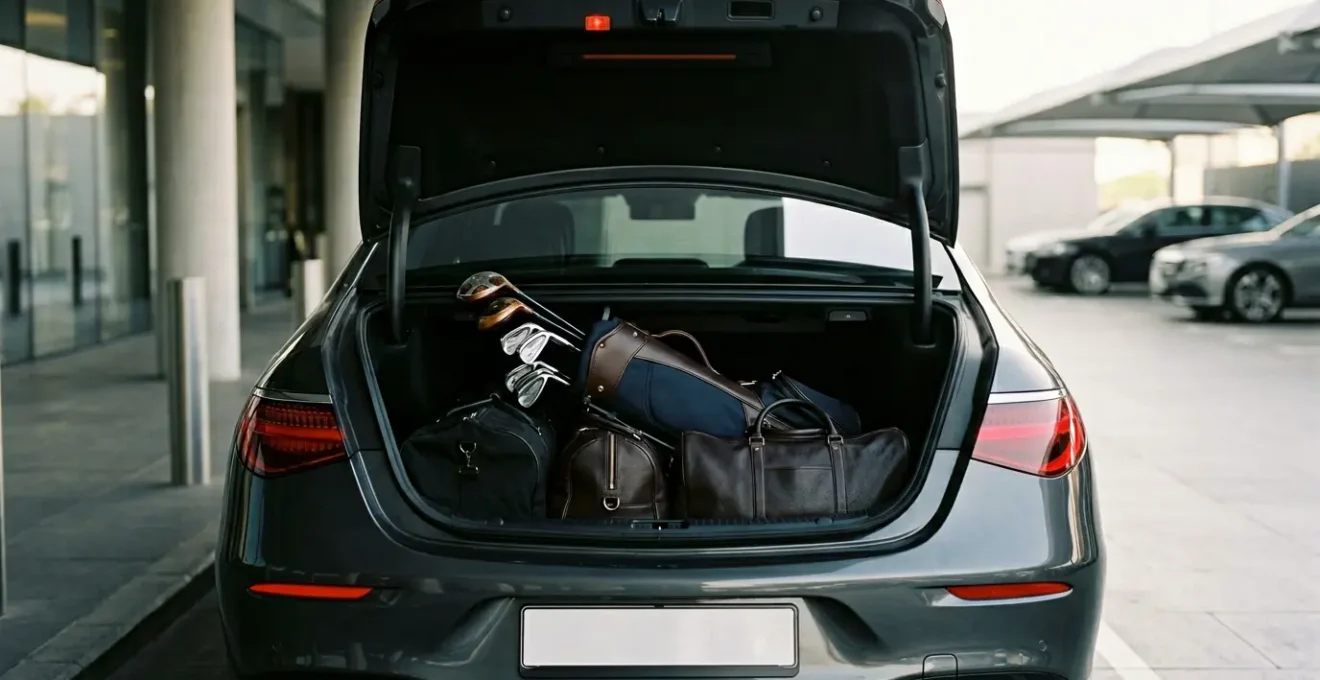
The advertised boot capacity of an executive saloon is a dangerously misleading metric; real-world usability is dictated by hidden geometry, intrusions, and loading ergonomics.
- Hybrid batteries and wheel arches can create unusable “dead space” that litres don’t account for.
- A car’s load lip height and aperture shape are more critical for heavy or bulky items than its raw volume.
Recommendation: Stop relying on brochure numbers. Instead, assess a vehicle’s boot for its longest diagonal measurement and internal obstructions before booking for critical journeys.
The moment of truth for any corporate host often arrives not in the boardroom, but on the kerbside. You’ve arranged a premium executive saloon for your clients, the journey is planned, but a single, crucial question hangs in the air: will the golf bags and hard-shell suitcases actually fit? It’s a moment fraught with potential for professional embarrassment, turning a seamless experience into a logistical scramble. Many assume that a car’s boot capacity, stated in litres, is the definitive guide. This is the first and most common mistake.
The standard advice—to “check the boot capacity”—is a platitude that ignores the practical reality of transport logistics. A boot is not a perfect cube. It’s an irregular space, compromised by wheel arches, audio equipment, and, increasingly, hybrid battery systems. The true measure of a boot’s utility is not its total volume, but its usable shape and the ergonomics of loading it. Can you stand a suitcase upright? Is the load lip low enough to lift a heavy bag over without straining? Is the diagonal length sufficient for a golf bag or a musical instrument?
This guide moves beyond the misleading simplicity of litre-based measurements. We will explore the “hidden geometry” of executive car boots, revealing why a vehicle with a smaller advertised capacity might, in practice, be far more practical. We will dissect the common packing mistakes that lead to driver refusal and provide a framework for assessing real-world luggage capacity. The goal is to replace anxiety with a specialist’s understanding, ensuring your focus remains on your clients, not on a last-minute game of luggage Tetris.
To navigate this complex topic, we will break down the key factors that determine practical luggage capacity, from the impact of modern technology to the physics of safe loading. This structured approach will provide the clarity needed to make informed decisions for your executive transport needs.
Contents: The Executive Guide to Luggage Logistics
- Why Do Hybrid Batteries Reduce Boot Space by 30%?
- How to Tetris 4 Suitcases into a BMW 7 Series Boot?
- Estate Car or SUV: Which Is Easier for Loading Heavy Boxes?
- The “Luggage Count” Mistake That Leads to Driver Refusal at Pickup
- What Happens if Loose Luggage Shifts During Emergency Braking?
- Saloon or Estate: Which Vehicle for 3 Large Hard-Shell Suitcases?
- Why Won’t a Standard S-Class Take a Cello Case?
- Traveling Solo With 3+ Suitcases: Who Handles the Heavy Lifting?
Why Do Hybrid Batteries Reduce Boot Space by 30%?
The shift towards hybrid and plug-in hybrid (PHEV) technology in the executive class offers significant benefits in emissions and running costs, but it comes with a hidden, physical compromise. The large lithium-ion battery pack and associated electronics must be housed somewhere, and the most common location is beneath the boot floor. This is not a minor adjustment; it fundamentally alters the “hidden geometry” of the luggage compartment, often in ways that brochure specifications fail to adequately convey.
This intrusion has two primary effects. First, it raises the boot floor, dramatically reducing the available vertical height. A suitcase that could once stand upright may now have to lie flat, consuming a much larger floor footprint. Second, the battery housing often creates an uneven, stepped floor, eliminating the flat, practical surface of a conventional vehicle. This makes sliding heavy items into place difficult and creates awkward, unusable pockets of space around the central bulge.
The impact is quantifiable and significant. For example, in a vehicle like the SEAT Leon e-Hybrid, a popular choice in its class, the hybrid system’s placement is not a trivial matter. The need to accommodate the batteries means that the e-Hybrid must give over 110 litres of boot space compared to its petrol counterpart, reducing the total figure to a disappointing 270 litres. This is the difference between easily accommodating two large suitcases and struggling to fit one with a carry-on bag, a critical distinction for executive travel.
How to Tetris 4 Suitcases into a BMW 7 Series Boot?
On paper, the challenge seems trivial. A flagship executive saloon like the BMW 7 Series boasts one of the most generous luggage compartments in its class. With an official capacity that can approach an impressive 19.1 cubic feet of room, one might assume that fitting four standard suitcases would be a simple task. However, this is where the difference between abstract volume and practical usability becomes starkly apparent. Successfully loading a boot to its maximum potential is a strategic exercise in “Luggage Tetris.”
The key is to work with the boot’s shape, not against it. A professional chauffeur doesn’t simply throw bags in; they follow a tested methodology. The process begins by identifying the heaviest, most rigid suitcases. These form the base of the structure. They should be placed on their sides, wheels facing inward, against the rear seat bulkhead. This maximizes stability and creates a solid foundation.
Next, any smaller or softer bags, such as duffels or carry-ons, are used to fill the gaps. These malleable items are perfect for tucking into the irregular spaces around the wheel arches or on top of the larger cases. This technique of using soft luggage to fill dead space is what separates a professional pack from an amateur one. Finally, the last suitcase is often the trickiest. If space is tight, try placing it vertically if height allows, or at a slight angle. The goal is to ensure nothing is loosely packed and everything is interlocked. A well-packed boot is a quiet and safe boot.
Estate Car or SUV: Which Is Easier for Loading Heavy Boxes?
When the task involves not just volume but also weight, the debate between an executive estate and an SUV becomes a question of ergonomics and physics. While an SUV often advertises a larger total boot capacity, the ease of loading heavy, cumbersome items like boxes or flight cases is not guaranteed. The design of the vehicle plays a crucial role in the physical effort required, and for this, the traditional estate car often holds a significant, if less obvious, advantage.
The primary factor is the load lip height. An estate car is built on a standard car platform, meaning its boot floor is relatively low to the ground. This minimizes the vertical distance you need to lift a heavy object. Conversely, an SUV’s raised ride height and fashionable rugged styling often result in a much higher boot floor and a pronounced lip, or bumper, that you must clear. This can turn the simple act of loading into a physically demanding and potentially hazardous task. The following comparison highlights the key ergonomic differences.
| Factor | Estate Car | SUV |
|---|---|---|
| Load Lip Height | Low (60-70cm) | High (75-90cm) |
| Aperture Shape | Wide, rectangular | Often tapered |
| Center of Gravity Impact | Minimal change | Significant rise |
| Boot Floor Material | Robust, metal scuff plates | Often delicate carpet |
The shape of the boot opening, or aperture, is also critical. Estates typically offer a wide, square opening, making it easy to slide bulky, box-shaped items straight in. SUVs, with their sloping rooflines, can have tapered apertures that are narrower at the top, complicating the loading of tall items. As the editorial team at Carwow notes when discussing large SUVs, “All that space isn’t easy to access, though, thanks to a high-set boot lip and rear bumper, so heavy items can be tricky to lift in and out.” This single observation perfectly summarises the ergonomic challenge.
The “Luggage Count” Mistake That Leads to Driver Refusal at Pickup
One of the most stressful situations in executive travel is the “refusal threshold” – the point where a professional chauffeur must, for safety and legal reasons, refuse to carry the client’s luggage as presented. This rarely happens because of a lack of goodwill. It happens because of a fundamental misunderstanding between how a client counts luggage and how a professional assesses it. A client thinks in terms of item count (“I only have two bags”), while a chauffeur thinks in terms of volume, weight, and safe distribution.
The “luggage count” mistake is assuming that “2 bags” is a fixed unit. To a chauffeur, two small carry-ons are completely different from two oversized hard-shell cases, which are different again from two sets of golf clubs. Professional services operate on a volume-based assessment. This is why clear communication before pickup is vital. Failing to specify the type and size of luggage can lead to the arrival of a vehicle that is perfectly adequate on paper but practically insufficient for the task.
A professional driver is not just a driver; they are responsible for the safety of the vehicle and its occupants. An overloaded or improperly loaded vehicle can be dangerously unstable. This is why they are trained to politely but firmly refuse a load that cannot be safely secured within the designated luggage compartment. Understanding what your chauffeur is looking for can prevent this embarrassing scenario.
Your Driver’s Pre-Pickup Checklist: What They Assess
- Item Dimensions: Do the bags conform to the pre-agreed dimensions for the booked vehicle?
- Volume vs. Count: Is the total volume of luggage within the vehicle’s safe operating capacity, regardless of the number of individual items?
- Specialist Equipment: Is there a golf tour bag? A professional will mentally allocate space equivalent to 2.5 large suitcases for it.
- Safety Compliance: Can all items be stowed securely in the boot, with no items in the passenger cabin?
- Contingency Plan: If the load is unsafe, what is the script? A professional will not just refuse, but immediately offer a solution, such as arranging for a larger vehicle or a luggage van.
What Happens if Loose Luggage Shifts During Emergency Braking?
The chauffeur’s insistence on securing all luggage in the boot is not a matter of tidiness or protecting the leather seats; it is a critical safety protocol rooted in the laws of physics. An unsecured item inside a moving vehicle, even a seemingly innocuous laptop bag, becomes a dangerous projectile during a sudden deceleration, such as an emergency stop or a collision. The forces involved are far greater than most people imagine.
The principle is simple: an object inside the car continues to travel at the car’s original speed until it is stopped by something. In a crash, that “something” can be the dashboard, the back of a seat, or an occupant. Research into vehicle safety dynamics provides a sobering perspective on the immense forces generated. A key finding from a study on emergency braking physics highlights this danger starkly: in a 50 km/h (31 mph) collision, a 20kg (44 lbs) suitcase can exert a force equivalent to 1,000kg (1 tonne). This is more than enough to cause catastrophic damage and severe or fatal injuries.
This principle is well-understood in other transport sectors. The aviation industry, for example, is acutely aware of the risks. Studies have documented thousands of injuries caused by items falling from overhead compartments, demonstrating the danger of even relatively small objects at a short distance. The physics are the same inside a car, but the potential for harm is arguably greater due to the smaller, enclosed space. A professional driver’s refusal to allow a hard-shell suitcase or any heavy item in the passenger cabin is a direct application of this vital safety knowledge. It is a non-negotiable rule designed to protect everyone in the vehicle.
Saloon or Estate: Which Vehicle for 3 Large Hard-Shell Suitcases?
For a travelling group of three, each with a large hard-shell suitcase, the choice of vehicle becomes paramount. This specific scenario is often the breaking point for a standard executive saloon, pushing its practical capacity to the absolute limit. While it may be technically possible under ideal conditions, relying on a saloon is a gamble. The executive estate, however, is specifically designed for this type of challenge, offering not just more space, but more flexible and usable space.
An executive saloon’s boot is typically long and deep but lacks height. This forces a loading strategy where two large cases must lie flat, one on top of the other, with the third squeezed in beside them if width allows. More often than not, it doesn’t fit, leading to unprofessional compromises like trying to place a suitcase in the front passenger footwell – a solution that is both unsafe and unacceptable in a premium context.
The estate car solves this problem with its boxier shape and increased vertical height. The larger, more accessible aperture allows for a different loading strategy altogether: vertical stacking. The ability to stand large suitcases on their sides, like books on a shelf, is far more space-efficient and is often the only way to accommodate three large, rigid cases. This table clearly shows the practical advantage.
| Vehicle Type | Boot Volume | 3 Large Cases Feasible | Loading Strategy |
|---|---|---|---|
| Executive Saloon | 480-540L | Rarely | 2 flat + soft bag |
| Executive Estate | 560-650L | Yes | Vertical stacking possible |
Why Won’t a Standard S-Class Take a Cello Case?
The cello case is the ultimate litmus test for a vehicle’s practical luggage capacity. It perfectly illustrates why abstract volume measurements in litres are almost meaningless. A Mercedes-Benz S-Class, the benchmark for executive luxury, has a cavernous boot by any standard. Yet, for a standard hard-shell cello case, it is utterly impractical. The problem is not one of volume, but of a single, critical dimension: diagonal length.
A standard full-size cello case measures approximately 130cm in length. The boot of an S-Class, despite its overall size, may only offer a maximum diagonal length of around 120cm. That 10cm difference is insurmountable. The case simply will not fit, no matter how you angle it. Common sense might suggest using the “ski hatch” – the small opening behind the rear armrest designed to pass through long, thin items. However, this is also a non-starter. The aperture is designed for the slender profile of skis and is far too narrow to accommodate the wide body of a cello.
This situation forces a compromise that musicians know all too well, but which is highly undesirable in a chauffeur-driven context: the instrument must travel in the cabin. The only viable solution in a saloon is to place the cello case on the front passenger seat, fully reclined and securely buckled in with the seatbelt. While this secures the instrument, it sacrifices a passenger seat and undermines the sense of space and luxury that defines an executive vehicle. For musicians or clients travelling with large, rigid items, the saloon is often the wrong tool for the job. The solution lies in vehicles with more flexible interior spaces, such as large estates (like a Volvo V90) or MPVs (like a Mercedes V-Class), where seats can be folded or removed to accommodate such items safely and securely on the floor.
Key takeaways
- The advertised boot capacity in litres is a poor indicator of real-world usability; shape, intrusions, and diagonal length are more critical.
- Hybrid vehicle batteries significantly reduce usable boot space by raising the floor and creating uneven surfaces.
- Professional chauffeurs assess luggage by volume and safety, not item count, and will refuse loads that cannot be secured in the boot.
Traveling Solo With 3+ Suitcases: Who Handles the Heavy Lifting?
For the solo executive traveler, a journey with three or more large suitcases presents a significant logistical and physical challenge. The question of “who handles the heavy lifting?” is a valid concern. In the world of premium chauffeur services, the answer is unequivocal: the chauffeur does. This is not just a courtesy but a core component of the “white glove” service that defines the upper echelon of executive transport.
A premium chauffeur service includes complete, end-to-end luggage management. The process begins the moment you are met at the arrivals hall. The chauffeur will take charge of your trolley, handle all items with care, and load them into the vehicle using techniques that protect both the luggage and the car. Upon arrival at your destination, the process is reversed, with the chauffeur ensuring every piece is brought to the hotel concierge or your doorstep. This service is built on the understanding that the client’s journey should be effortless from start to finish.
This level of service is underpinned by strict safety protocols. As professional services like Prime Limo state, policy and often law dictates that no hard luggage can be in the passenger compartment of any commercial vehicle. This is because such items become dangerous projectiles in an accident. The chauffeur’s responsibility for loading the vehicle is therefore directly tied to their responsibility for passenger safety. They are trained in proper lifting techniques to handle expensive luggage brands without risk of damage and are insured for the task. The client’s role is simply to identify their bags; the professional handles the rest.
This comprehensive handling is the final piece of the luxury transport puzzle, transforming a potentially stressful logistical task into a seamless part of the premium travel experience. It provides peace of mind, allowing the traveler to focus on the purpose of their trip.
By understanding the realities of boot geometry and professional protocols, you can confidently book your executive transport, assured that every detail, especially luggage, is professionally managed. The next logical step is to communicate your specific luggage needs clearly to your chosen chauffeur service to ensure the perfect vehicle is allocated for your journey.
Frequently Asked Questions About Executive Car Luggage Capacity
What’s the maximum diagonal length in an S-Class boot?
The maximum usable diagonal length in a standard S-Class boot is approximately 120cm. This is critically shorter than the 130cm required for a standard hard-shell cello case, making it an unsuitable vehicle for this specific item.
Can the ski-hatch accommodate a cello?
No, the ski-hatch or pass-through is designed only for very thin items like skis. The aperture is far too narrow and small to allow the main body of a cello or similarly shaped bulky item to pass through from the boot into the cabin.
What’s the musician’s solution for transporting a cello in a saloon?
When an estate or MPV is not available, the standard professional practice is to sacrifice the front passenger seat. The cello is buckled into the seat with the seatbelt, with the seat often fully reclined for better support and a lower center of gravity.