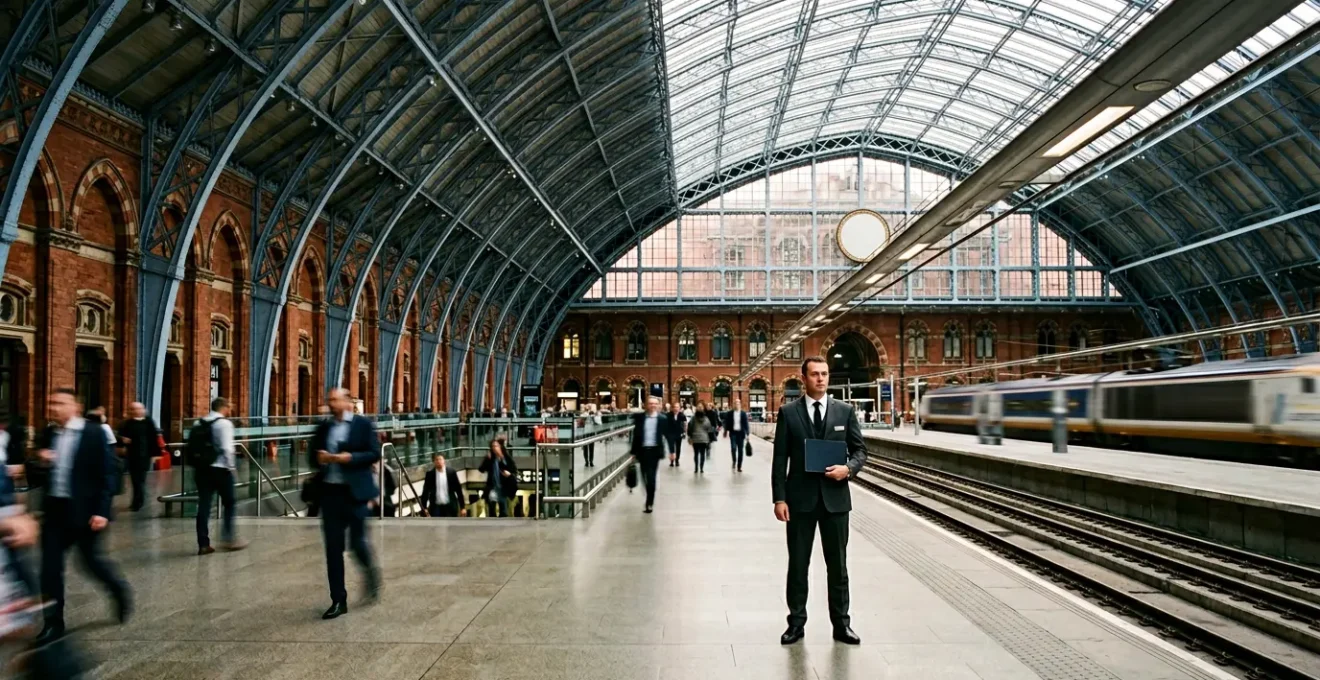
The secret to a swift exit from St Pancras is not following the crowd, but using the same system as professional drivers.
- The official “Meeting Point” is often a congested chokepoint; seasoned travellers use quieter, specific landmarks.
- A professional chauffeur service doesn’t just wait; it uses live train data to adapt to your actual arrival time, absorbing most delays.
Recommendation: Pre-book a chauffeur service that provides real-time tracking and agree on a specific, less-crowded pickup point like the Betjeman statue or the Renaissance Hotel entrance.
Stepping off the Eurostar at St Pancras International, your mind is already on your next meeting in London. The journey from Paris was smooth, efficient, and civilised. Your arrival should be the same. The common advice is simple: follow the “Exit” signs and head to the designated meeting point. For a business traveller who values time and predictability, this is often the first step towards delay and frustration.
The station, a marvel of Victorian engineering, is also a complex, multi-level hub teeming with commuters, tourists, and shoppers. The official passenger flow can be a confusing muddle of merging queues and ambiguous signage. This guide is not about the standard tourist route. It’s about the parallel system—the one used by professional chauffeurs and savvy travellers to navigate the station’s hidden friction points. We’ll deconstruct the journey from the moment you disembark to the moment you are comfortably seated in your car, providing a clear path through the potential chaos.
This article will provide a clear, location-specific walkthrough to ensure your connection from international rail to London road is seamless. We will explore the station’s layout, explain the real-world timings for customs, and reveal the strategies that professional drivers use to guarantee they are in the right place at the right time, every time.
Summary: A Concierge’s Guide to Seamless St Pancras Pickups
- Why the “Meeting Point” at St Pancras Is Not Always the Best Spot?
- Eurostar Arrival to Car Seat: How Long Does Customs Really Take?
- The Platform Change Nightmare at Euston and How Your Driver Adapts
- Escalator or Lift: The Fastest Route to the Car Park with Suitcases?
- What Happens to Your Booking When the Train Stops Before the Station?
- Why Do “Exit” Signs at Heathrow Sometimes Lead You Astray?
- What Passport Rules Apply to Chauffeur Passengers Entering France?
- What Is the Minimum Connection Time Between Heathrow and Kings Cross?
Why the “Meeting Point” at St Pancras Is Not Always the Best Spot?
The official “Meeting Point” at St Pancras, located on the main concourse, sounds like the logical place to find your driver. However, for an efficient exit, it’s often the worst. This area is a natural chokepoint for general passenger traffic, not just those meeting drivers. The experience is often one of confusion, as described by travellers. One recent visitor noted, “The management of passenger flow… was a muddle… There are clear signs but they are confusingly placed and the queues… seem to be confusingly close together.” This confusion affects both passengers and staff, making a quick connection difficult.
The root cause is a combination of station design and passenger volume. The arrival area has to cope with a significant number of people in short bursts, and post-Brexit processing changes have further constrained capacity. With a 30% lower peak capacity than pre-2019, any concentration of people creates a bottleneck. A professional chauffeur understands this and will almost always suggest an alternative, more strategic location.
These alternative points are chosen for their visibility, lower footfall, and ease of access. Common suggestions include:
- The statue of Sir John Betjeman on the upper level, a highly visible landmark in a quieter area.
- The main entrance of the St. Pancras Renaissance Hotel, which offers a covered waiting area away from the main throng.
- Near the East Midlands Railway ticket barriers, accessible without entering the busiest zones.
- By the long Searcys champagne bar, a memorable and spacious reference point.
Agreeing to one of these specific landmarks with your driver beforehand transforms a potentially stressful search into a predictable and calm rendezvous.
Eurostar Arrival to Car Seat: How Long Does Customs Really Take?
A key variable in your exit time is clearing the UK border. Thanks to juxtaposed controls, you complete this formality before boarding in Paris, Lille, or Brussels. Upon arrival at St Pancras, you simply disembark and walk into the station. However, this is only for immigration. You will still pass through customs, which is typically a simple walk-through via the green “nothing to declare” channel. The entire process from train door to station concourse for most passengers is less than 5-10 minutes.
The real queueing happens on departure. But on arrival, the main factor influencing your time is your passport. For faster processing, EU, EEA, and Swiss citizens, as well as those from several other countries with biometric passports, can use the e-gates. Non-EU nationals may need to be processed manually by a Border Force officer, which can add a few minutes to the journey. Families with children who have different surnames may also be asked for additional documentation, so having this ready is crucial.
The efficiency of this process is a matter of constant review, with current capacity at St Pancras sitting at around 1,800 passengers per hour, with plans to expand this significantly. Visualising this process helps in understanding the flow.
While the customs and immigration part of your arrival is swift, the time it takes to navigate the station itself is what you must account for. From the platform on the upper level to the car park on the lower ground level can take a further 5-10 minutes depending on your route and luggage. A realistic total time from train seat to car seat, assuming no delays, is between 15 and 20 minutes.
The Platform Change Nightmare at Euston and How Your Driver Adapts
Disruptions are a fact of life on the UK rail network. A last-minute platform change at nearby Euston or a signal failure just outside the station can have a ripple effect, delaying your Eurostar’s arrival. This is precisely where a professional chauffeur service demonstrates its value, moving from a simple transport provider to a logistics partner. A pre-booked minicab might wait, but a premium service actively adapts.
The core of this adaptation is technology and protocol. As a leading chauffeur service for the station explains, this is a standard part of their operation. Crownwood Charters highlights this proactive approach:
We monitor live arrival information for all Eurostar and Thameslink services. This allows us to adjust your pickup time automatically to match your train’s actual arrival, ensuring your chauffeur is there when you are.
– Crownwood Charters, St Pancras International Chauffeur Services
This isn’t just about avoiding waiting charges; it’s about ensuring the “seamless” part of the promise holds true, even when the timetable doesn’t. Your driver receives automatic updates, often knowing about a delay before you do. The system typically includes:
- Real-time train tracking using rail network data to automatically adjust pickup times.
- A standard complimentary waiting time (often 15 minutes for station pickups) to absorb minor delays.
- A text message with a link to track your driver’s location in real-time, sent just before pickup.
- Direct communication protocols for significant delays, ensuring you’re kept informed.
This predictive adaptation means that whether your train is 10 minutes early or 30 minutes late, the system adjusts. You don’t need to worry about frantically calling your driver; they are already adapting their schedule to yours.
Escalator or Lift: The Fastest Route to the Car Park with Suitcases?
You’ve disembarked and cleared customs. Now for the final leg of your journey within the station: getting from the upper-level Eurostar platforms down to the lower ground level where your chauffeur awaits in the car park. As you exit the platform area into the main station arcade, you’re faced with a choice: escalator or lift? The optimal choice depends entirely on your luggage and the time of day.
With a single rolling suitcase, the escalators are almost always faster. They are plentiful and designed to move a high volume of people. However, if you are travelling with multiple heavy bags or a pram, the lift is the only practical option. Be aware that the lifts can be a “friction point,” often with a queue forming during peak arrival times. If you need the lift, factor in an extra 5 minutes.
The route itself is straightforward once you know the destination. You need to head towards the domestic part of the station. As the Man in Seat 61 explains, after descending from the platforms, “Walk on into the next shopping area… and you’ll find the left luggage office at the back.” The car park is well-signposted from this area, but the key is to specifically follow signs for “Car Park,” not “Taxis,” which will lead you to the taxi rank on the other side of the station.
The designated car park is secure and efficiently run, with 315 parking spaces and 24/7 staff, making it a reliable meeting point. Your chauffeur will have a designated bay and will typically meet you at the pedestrian entrance to the car park, helping with your luggage for the final few metres.
What Happens to Your Booking When the Train Stops Before the Station?
The ultimate test of a chauffeur service is not how it performs when things go right, but how it responds when things go wrong. A major disruption, like a train being held at signals indefinitely or even a rail strike, is a moment of high stress for any traveller. A professional service is designed to be a point of stability in this chaos.
First, it’s important to understand the policies. Most reputable firms build contingency plans into their service. Trackable delays—those caused by signal failures, technical issues, or network congestion—are typically covered without any extra charge to you. The service’s live tracking system simply adjusts your pickup to the new, later arrival time. A grace period of 15-45 minutes is also standard, covering small delays on the passenger’s side.
But what about catastrophic failures, like a strike? This is where a pre-booked commitment shines. One customer asked Blackberry Cars this exact question:
‘What if there is a rail strike, can you arrange for a driver to take from St Pancras to my home?’ Yes, once you have made your booking with us, regardless of any rail strikes, we will arrange for a driver to pick you up from St Pancras as booked.
This is the guarantee you are paying for: a confirmed booking is a commitment to service, not just an aspiration. The service has a duty of care to get you from point A to point B. This commitment is underpinned by clear policies on how different types of delays are handled, ensuring transparency and removing uncertainty for you, the passenger. Knowing these rules provides immense peace of mind during your journey.
Why Do “Exit” Signs at Heathrow Sometimes Lead You Astray?
The notorious “follow the signs” problem at large transport hubs like Heathrow is a well-known traveller frustration. Generic signs are designed for the masses and often lead to the most congested routes. St Pancras, unfortunately, shares this characteristic. As one traveller lamented on TripAdvisor, “More signs please! …the signage is sadly lacking.” This is a classic “friction point” where the official system fails the time-conscious traveller.
The solution, as used by professionals, is to ignore generic signage and navigate by using distinct, immovable landmarks. This creates a “parallel system” of navigation that is faster and more reliable. Instead of looking for a small “Exit” or “Meeting Point” sign in a sea of visual noise, you are looking for a giant statue or a specific storefront. This reduces cognitive load and makes the route far more predictable. Your chauffeur will provide a specific landmark, and your only task is to head towards it.
This visual navigation strategy is the single most effective way to ensure a swift and error-free exit from the station. Here is a checklist of the most reliable landmarks to use.
Your St Pancras Visual Navigation Plan
- Target the Iconic Clock: As you exit the Eurostar platforms, your primary bearing should be the large station clock at the far end of the main shed.
- Use the Champagne Bar for Orientation: The long Searcys champagne bar is the most prominent feature of the concourse and serves as an excellent primary orientation point.
- Look for the Betjeman Statue: Instead of following generic signs, navigate towards the bronze statue of Sir John Betjeman; it’s a popular, quieter meeting spot.
- Reference the Information Desk: The large, circular information desk in the main arcade is a useful central reference point if you become disoriented.
- Follow “Car Park” Signs Specifically: When ready to exit, ignore “Taxi” or general “Way Out” signs. Your goal is the car park, so follow only those specific signs.
What Passport Rules Apply to Chauffeur Passengers Entering France?
While this guide focuses on arriving in London, understanding the process in reverse—departing for France—perfectly illustrates the system of juxtaposed controls that makes your London arrival so efficient. The passport rules that apply when you enter France are actually enforced on UK soil, before you even board the train.
When you depart from St Pancras, you will pass through two sets of passport control in sequence: first, you are checked out of the UK by the UK Border Force. Immediately afterwards, you pass through French passport control (Police aux Frontières) and are officially stamped into the Schengen Area. All of this happens within a secure zone in the St Pancras departures hall.
This is the “juxtaposed control” system. Its great advantage is that when your train arrives at Gare du Nord in Paris, there are no further immigration checks. You simply get off the train and walk into the city, just as you do on arrival in London. It effectively moves the international border to your point of departure.
For you as a passenger, this means all document checks, visa requirements, and passport stamping for entry into the EU are completed in London. The rules are the same as they would be if you were flying into Paris: you need a valid passport, and depending on your nationality, you may need a Schengen visa. Post-Brexit, UK citizens must have their passports stamped on entry and exit from the Schengen zone, a manual process which adds time to the departure sequence from London.
Key Takeaways
- Avoid the official “Meeting Point” at St Pancras; it’s a congested chokepoint. Agree on a specific, quieter landmark with your driver instead.
- A professional chauffeur service uses technology to track your train in real-time, automatically adjusting your pickup for a seamless connection, even with delays.
- Navigate by major landmarks like the station clock, the champagne bar, or the Betjeman statue, not by following generic “Exit” signs which can be confusing.
What Is the Minimum Connection Time Between Heathrow and Kings Cross?
While your journey starts with the Eurostar, the question of connection times across London—for instance, between Heathrow and the King’s Cross St Pancras area—highlights the strategic choice every business traveller faces: public transport versus a private chauffeur. The “minimum time” is not just a number in a timetable; it’s a calculation of risk, comfort, and predictability.
Public transport offers a direct route via the Piccadilly Line (around 60-75 minutes) or a faster but more expensive option via the Heathrow Express and a short tube ride. These options are efficient but vulnerable to delays, strikes, and overcrowding, especially with luggage. For a business traveller, the lack of predictability is the main drawback.
A chauffeur service offers a higher degree of time-certainty. The journey time by road can vary with traffic, but a professional driver knows the alternative routes and can often provide a more reliable door-to-door experience. The following table gives an approximate comparison for key routes from St Pancras, illustrating the trade-off between time, cost, and convenience.
| Route | Chauffeur Time | Public Transport Time | Chauffeur Cost (approx) | Public Transport Cost |
|---|---|---|---|---|
| St Pancras to Heathrow | 45-60 mins | 60-75 mins (Piccadilly Line) | £80-120 | £5.70 |
| St Pancras to Gatwick | 60-75 mins | 45-60 mins (Thameslink direct) | £90-130 | £12-20 |
| St Pancras to City Airport | 30-40 mins | 40-50 mins (DLR) | £60-80 | £5.70 |
For a business traveller arriving at St Pancras, the 15-minute walk from nearby Euston or a 30-minute tube ride from Paddington are theoretical connection times. In practice, with luggage and the need to be punctual for a meeting, the value of a pre-booked car that eliminates these variables often makes it the most efficient choice overall.
To ensure your arrival in London is as smooth and efficient as your Eurostar journey, the next logical step is to book a professional chauffeur service that understands the unique intricacies of St Pancras and provides the real-time, adaptive service this guide has outlined.
Frequently Asked Questions about Arriving at St Pancras
What documents do EU citizens need when arriving at St Pancras?
EU citizens can use e-gates with biometric passports for faster processing. You will have already cleared UK immigration before boarding the Eurostar, so on arrival, it is typically a straightforward walk-through.
What about non-EU passport holders?
Non-EU nationals typically require manual passport stamping, which is done at your point of departure (e.g., Paris Gare du Nord). This can add 5-10 minutes to your check-in process before the journey but means your arrival at St Pancras is swift.
Are there special requirements for families with children?
Yes. Adults traveling with minors who have different surnames may be asked to provide additional documentation proving their relationship or that they have permission to travel. It is advisable to have copies of birth certificates or a letter of consent ready.